
AI infrastructure is shifting from individual accelerators toward complete rack-scale systems. Performance now depends on how GPUs, CPUs, memory, networking, software, power, and cooling operate together, not simply on the specifications of one processor.
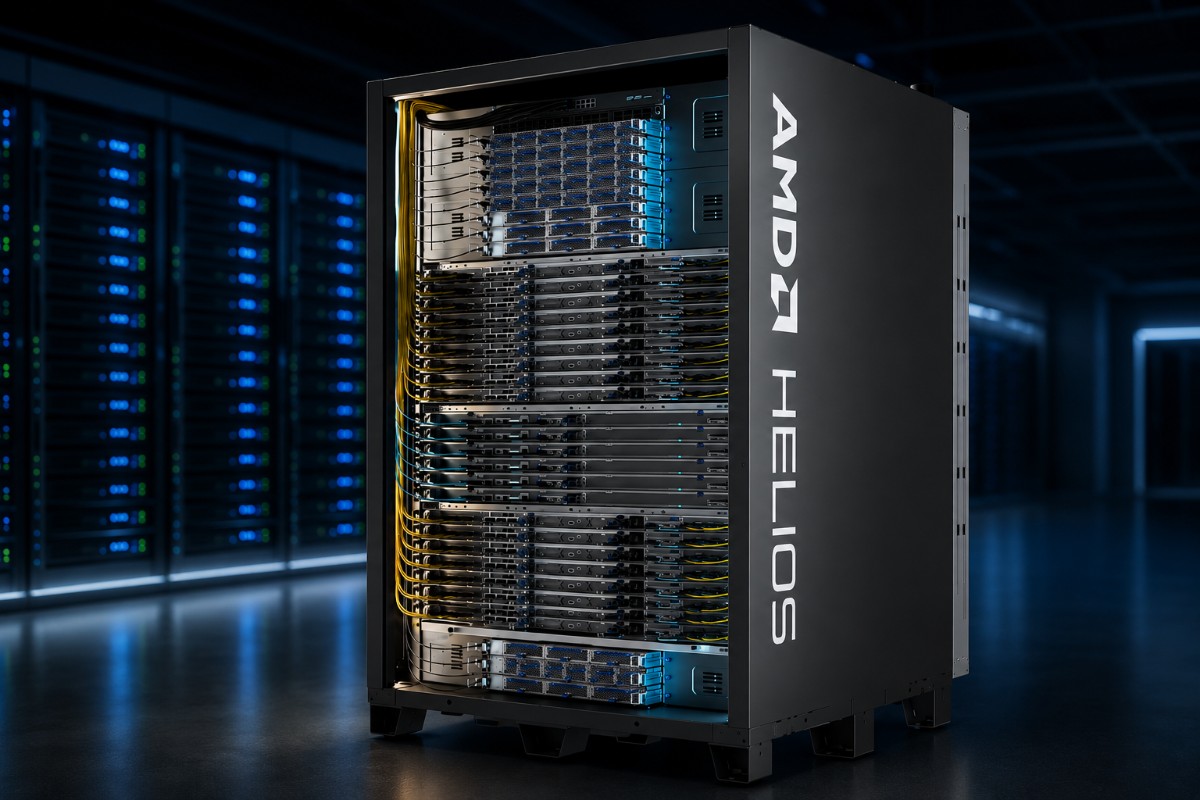
AMD Helios represents AMD’s answer to that change. It combines AMD Instinct MI455X accelerators, 6th Gen AMD EPYC “Venice” CPUs, Pensando networking, open rack standards, and ROCm software into a rack-scale AI architecture for large training and inference deployments.
The important distinction is that Helios is an AMD rack-scale reference design, not a single AMD server or retail rack SKU. OEM and ODM partners can build systems around the blueprint, which makes platform integration and validated configuration important for buyers.
What Is AMD Helios?
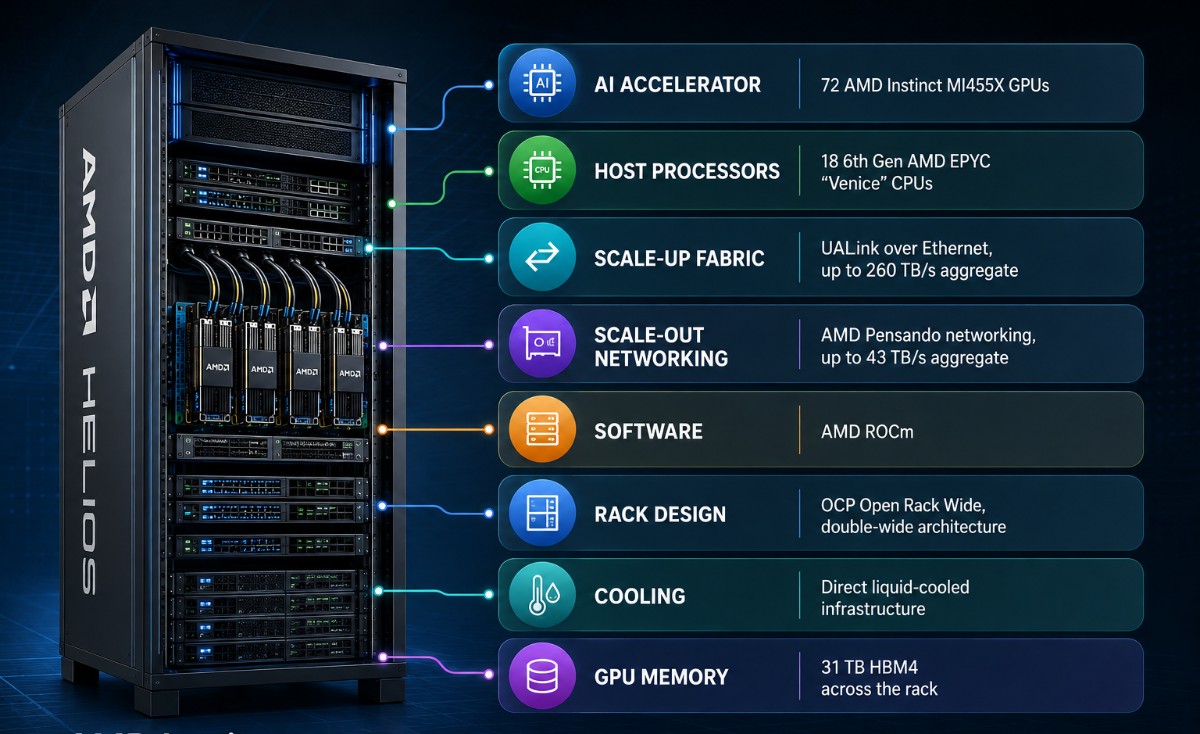
AMD Helios is a next-generation rack-scale AI reference architecture designed to make an entire rack operate as a coordinated AI computing system. AMD’s current design combines 72 MI455X GPUs with 18 EPYC Venice CPUs and AMD Pensando networking.
That approach differs from buying independent GPU servers and connecting them afterward. Helios defines compute trays, scale-up networking, scale-out connectivity, power distribution, liquid cooling, serviceability, management, and software as parts of one AMD AI factory platform.
| AMD Helios layer | Current architecture |
| AI accelerators | 72 AMD Instinct MI455X GPUs |
| Host processors | 18 6th Gen AMD EPYC “Venice” CPUs |
| GPU memory | 31 TB HBM4 across the rack |
| Scale-up fabric | UALink over Ethernet, up to 260 TB/s aggregate |
| Scale-out networking | AMD Pensando networking, up to 43 TB/s aggregate |
| Software | AMD ROCm |
| Rack design | OCP Open Rack Wide, double-wide architecture |
| Cooling | Direct liquid-cooled infrastructure |
AMD describes Helios as an open design using OCP Open Rack Wide, UALink, and Ultra Ethernet standards. The architecture targets frontier-model training, fine-tuning, large-scale inference, and other hyperscale AI workloads.
This system-level approach matters because an accelerator cannot work at full potential when networking, memory movement, storage, or cooling becomes the limiting factor. Similar challenges already shape modern AI data center networking as clusters expand beyond individual servers.
How MI455X Powers AMD Helios AI Compute
The AMD Instinct MI455X supplies the main AI compute inside AMD Helios. AMD launched it on July 23, 2026, as part of the MI400 Series and designed it for the Helios rack-scale AI architecture.
MI455X at a Glance
- Architecture: AMD CDNA 5
- Memory: Up to 432 GB HBM4 per GPU
- Memory bandwidth: Up to 23.3 TB/s per accelerator
- Primary role: AI training, inference, fine-tuning, and distributed workloads
- Rack configuration: 72 MI455X GPUs in a full Helios rack
Why CDNA 5 and HBM4 Matter
MI455X uses AMD’s CDNA 5 architecture, which targets high-performance AI and data-center computing. Its large HBM4 capacity helps keep model data close to the accelerator.
This is important for workloads that repeatedly access:
- Model parameters
- Activations
- KV cache
- Intermediate training data
- Inference context
Higher memory bandwidth can reduce data movement between the GPU and external memory or storage. That helps distributed AI workloads keep the accelerators busy instead of waiting for data.
MI455X Capacity Inside AMD Helios
A complete AMD Helios rack combines 72 MI455X GPUs. Together, those accelerators provide approximately 31 TB of HBM4 capacity across the rack.
This rack-level design supports:
- Large language model training
- Distributed inference
- Model fine-tuning
- High-throughput AI services
- Memory-intensive agentic AI workloads
The MI455X should not be evaluated only as an individual GPU. Its performance inside Helios also depends on the rack’s CPU configuration, UALink scale-up fabric, Pensando networking, ROCm software, storage, power delivery, and liquid cooling.
Buyers evaluating the accelerator separately can review the MI455X architecture details before assessing how multiple GPUs operate together at rack scale.
What workloads does MI455X target?
AMD positions MI455X and Helios for several demanding AI workloads:
- Frontier-model and foundation-model training
- Large-scale and distributed AI inference
- Model fine-tuning and post-training
- Memory-intensive and agentic AI workloads
The GPU does not operate as 72 isolated accelerators inside Helios. The rack uses a scale-up fabric so distributed AI software can coordinate the GPUs as a much larger compute domain.
The Role of EPYC Venice CPUs in AMD Helios
AI racks still require powerful CPUs because GPUs do not manage the entire application workflow. The host processor handles orchestration, data preparation, operating-system services, application logic, storage activity, networking tasks, and other work surrounding accelerated computation.
Helios uses 6th Gen AMD EPYC 9006 Series processors, formerly code-named Venice, based on AMD’s Zen 6 architecture. AMD’s 9006 portfolio reaches up to 256 cores and 512 threads per socket, with up to 16 DDR5 memory channels and PCIe Gen 6 connectivity.
That host-compute capacity becomes particularly relevant for agentic AI. An agent may retrieve information, execute code, call APIs, access databases, manage context, invoke a model, evaluate the result, and repeat the process.
In simple terms, MI455X handles heavily accelerated AI computation while EPYC Venice manages much of the workflow around that compute. The architecture therefore depends on GPU-CPU integration rather than treating the CPU as a secondary component.
| Component | Primary role inside Helios |
| MI455X GPU | Training, inference, matrix/vector AI computation |
| EPYC Venice CPU | Host compute, orchestration, preprocessing and system services |
| AMD Infinity Fabric | High-performance CPU-GPU communication within the architecture |
| UALink over Ethernet | Rack-scale GPU-to-GPU scale-up communication |
| Pensando Vulcano AI NIC | Scale-out connectivity between systems and racks |
| Pensando Salina DPU | Front-end networking, storage and security offload |
| ROCm | Software environment for running and scaling AI workloads |
AMD specifically describes Infinity Fabric as a high-performance communication technology between CPU and GPU, while UALink over Ethernet connects the larger 72-GPU scale-up domain. Those functions should not be treated as interchangeable.
Why Rack-Scale AI Is the Future of Large AI Data Centers
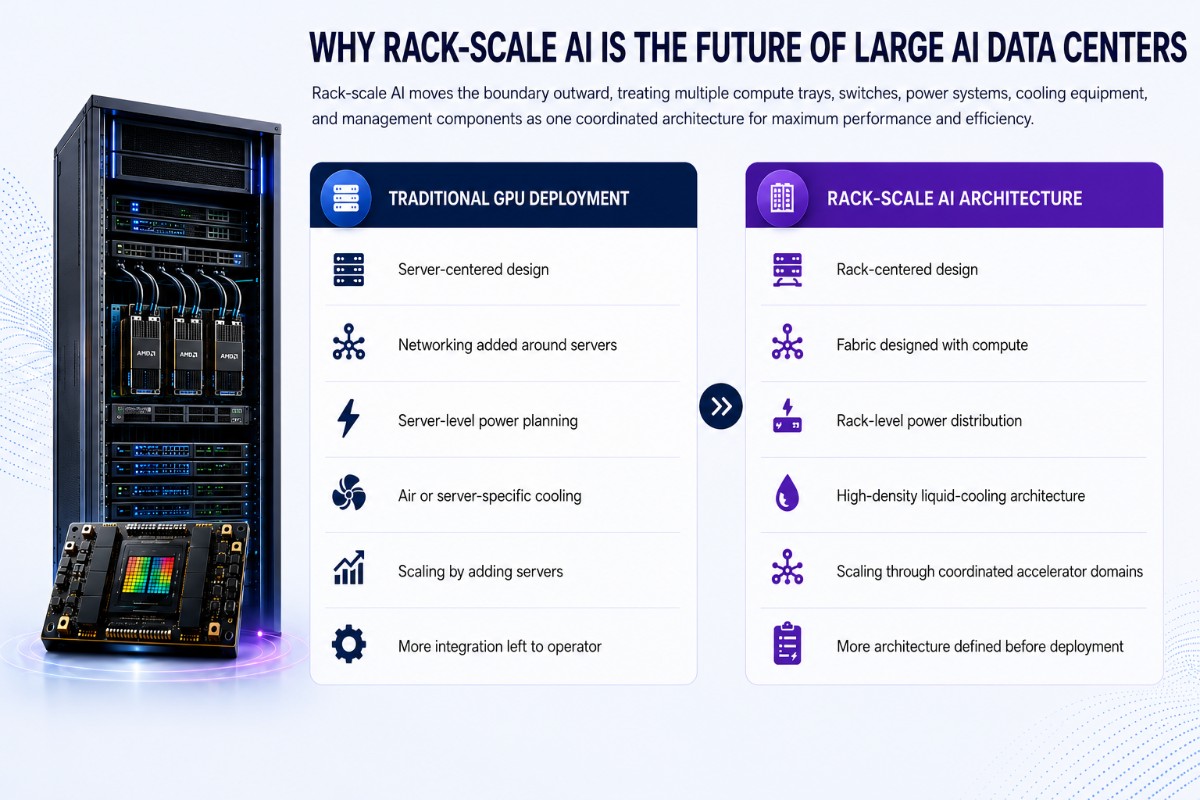
A traditional GPU server defines the main system boundary at the chassis. Rack-scale AI moves that boundary outward, treating multiple compute trays, switches, power systems, cooling equipment, and management components as one coordinated architecture.
Large distributed training illustrates why. Adding accelerators does not automatically increase useful performance if synchronization slows, memory capacity becomes constrained, or network congestion prevents GPUs from exchanging data quickly enough.
| Traditional GPU deployment | Rack-scale AI architecture |
| Server-centered design | Rack-centered design |
| Networking added around servers | Fabric designed with compute |
| Server-level power planning | Rack-level power distribution |
| Air or server-specific cooling | High-density liquid-cooling architecture |
| Scaling by adding servers | Scaling through coordinated accelerator domains |
| More integration left to operator | More architecture defined before deployment |
AMD’s Helios design reflects this shift through integrated scale-up switching, scale-out networking, centralized power distribution, a liquid-cooling manifold, rack telemetry, and modular serviceability. AMD also uses Meta’s Open Rack Wide specification to support the physical requirements of dense AI infrastructure.
Cooling therefore becomes part of the computing architecture rather than a facility issue handled later. High-density AI deployments need coordinated cold plates, coolant distribution, heat rejection, redundancy, and facility planning, which makes an effective AI cooling strategy part of system design.
AMD Helios Architecture: CPU, GPU and Networking Together
The easiest way to understand the AMD Helios AI rack is to follow the movement of work and data through it.
Application and orchestration → EPYC Venice CPU → MI455X accelerators → UALink scale-up fabric → Pensando scale-out network → additional racks and data-center infrastructure
Each Helios compute tray groups four MI455X GPUs with EPYC host compute. Across the rack, AMD uses UALink over Ethernet to connect the accelerator domain, with up to 260 TB/s of aggregate scale-up bandwidth in its current published design.
AMD Pensando Vulcano 800 AI NICs provide 800 Gb/s-class scale-out connectivity at the node level. They connect the rack to the broader Ethernet AI cluster, while Salina DPUs can offload selected networking, storage, and security services.
This distinction between scale-up and scale-out matters. Scale-up networking allows accelerators inside a tightly coupled domain to cooperate, while scale-out networking connects those domains across racks to create much larger AI supercomputer infrastructure.
ROCm completes the architecture at the software layer. AMD states that its current stack supports frameworks and runtimes including PyTorch, TensorFlow, JAX, ONNX Runtime, vLLM, and Triton while scaling from individual GPUs to multi-rack environments.
What Does an AMD Helios Deployment Need Beyond the Rack?
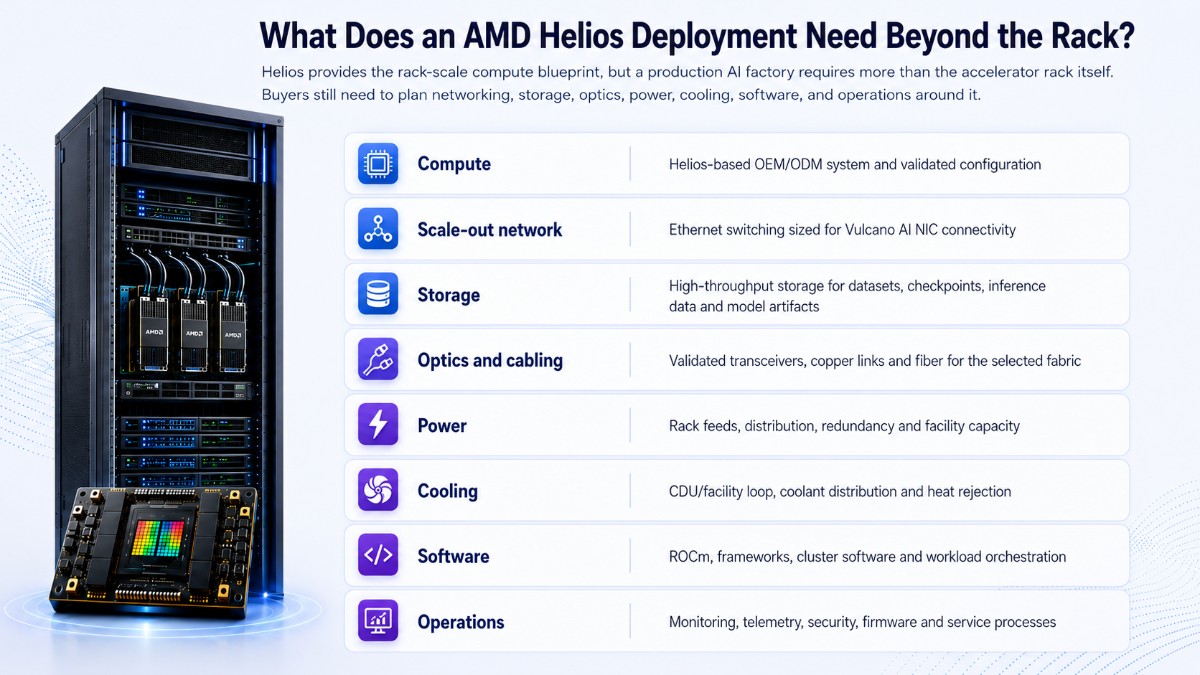
Helios provides the rack-scale compute blueprint, but a production AI factory requires more than the accelerator rack itself. Buyers still need to design the network, storage, optics, facility power, cooling loop, management environment, and physical data-center integration around it.
| Deployment layer | What buyers need to plan |
| Compute | Helios-based OEM/ODM system and validated configuration |
| Scale-out network | Ethernet switching sized for Vulcano AI NIC connectivity |
| Storage | High-throughput storage for datasets, checkpoints, inference data and model artifacts |
| Optics and cabling | Validated transceivers, copper links and fiber for the selected fabric |
| Power | Rack feeds, distribution, redundancy and facility capacity |
| Cooling | CDU/facility loop, coolant distribution and heat rejection |
| Software | ROCm, frameworks, cluster software and workload orchestration |
| Operations | Monitoring, telemetry, security, firmware and service processes |
The exact switch, storage array, optics, cabling, and facility configuration will depend on the OEM implementation and deployment scale. Similar connectors or speeds should never be treated as proof of compatibility; buyers should validate the complete configuration with the relevant OEM documentation.
Storage deserves particular attention. Training systems need to ingest datasets and write checkpoints quickly, while large inference environments may need fast model loading, retrieval pipelines, context storage, and persistent data services.
Networking creates the same dependency. A powerful rack can still lose effective accelerator utilization when the fabric cannot sustain distributed traffic, so GPU deployment planning principles around network topology, storage throughput, rack density, and facility capacity remain relevant across vendors.
AMD Helios vs NVIDIA Rack-Scale AI Systems
AMD Helios and NVIDIA Vera Rubin NVL72 represent two different full-stack approaches to rack-scale AI. Both integrate 72 accelerators with host CPUs, high-speed scale-up fabrics, scale-out networking, software, and liquid-cooled rack infrastructure.
Their largest differences come from ecosystem architecture. AMD emphasizes EPYC x86 host compute, MI455X accelerators, UALink and Ethernet-based networking, open rack standards, and ROCm; NVIDIA tightly integrates Rubin, Vera, NVLink 6, ConnectX-9, BlueField-4, Spectrum-X or Quantum-X800, and its CUDA software ecosystem.
| Category | AMD Helios | NVIDIA Vera Rubin NVL72 |
| Accelerator count | 72 MI455X GPUs | 72 Rubin GPUs |
| Host CPUs | 18 EPYC Venice CPUs | 36 Vera CPUs |
| GPU memory | About 31 TB HBM4 | 20.7 TB HBM4 |
| Scale-up | UALink over Ethernet | NVLink 6 |
| Published scale-up bandwidth | Up to 260 TB/s aggregate | 260 TB/s switch bandwidth |
| Scale-out | Pensando Ethernet | Spectrum-X Ethernet or Quantum-X800 InfiniBand |
| Main software ecosystem | ROCm | CUDA |
| Rack philosophy | Open Rack Wide / open standards | Vertically integrated NVIDIA platform |
AMD figures come from its current Helios materials, while NVIDIA labels several Vera Rubin specifications as preliminary and subject to change. These numbers also use different vendor methodologies, so the table should guide architectural comparison rather than act as a neutral benchmark.
For buyers researching AMD Helios vs NVIDIA Rubin, software support may matter as much as raw hardware.
Existing CUDA investments, ROCm readiness, workload portability, networking strategy, power limits, availability, and deployment schedules can change which platform makes more operational sense.
The earlier AMD Helios vs NVIDIA GB200 NVL72 comparison can still matter for organizations deciding whether to deploy available Blackwell-generation infrastructure or move toward newer rack designs. For the closest next-generation architectural comparison, however, the Vera Rubin rack platform provides the more relevant reference point.
Neither architecture wins every workload automatically. Buyers should compare validated application performance, software maturity, power, cooling, network design, availability, deployment timing, and total infrastructure requirements rather than relying on vendor headline benchmarks.
Why Helios Matters for Hyperscalers, Cloud Providers and Enterprise AI
Helios gives AMD a platform-level position in AI infrastructure rather than competing only at the accelerator level. Microsoft plans Helios deployment for Azure AI services, while AMD has also announced Helios-related deployments or collaborations with OpenAI, Meta, Anthropic, Cerebras, and other infrastructure providers.
- AMD Helios fits organizations that need:
- Large AI training clusters
- High-throughput inference
- Frontier-model development
- Sovereign AI infrastructure
- Large cloud AI services
- Its 72-GPU rack-scale design makes the most sense when the workload can use that density.
- Operators must also support:
- High rack power requirements
- Direct liquid cooling
- High-speed networking
- Large-scale storage
- Cluster management and monitoring
Not every enterprise needs an AMD Helios AI rack. Smaller private-AI projects, departmental inference, visualization, experimentation, and moderate fine-tuning may achieve better economics with smaller GPU servers or cloud capacity.
Rack-scale AI is an architecture choice, not simply an upgrade tier. The right system depends on:
- Workload size and utilization
- Software ecosystem and framework support
- Data location and storage requirements
- Budget and deployment timeline
- Facility power and cooling readiness
- Expected growth over the next several years
The Future of AMD AI Infrastructure
Helios shows how AMD’s AI strategy now connects accelerators, EPYC CPUs, networking, rack design, and ROCm rather than treating them as separate product lines. That integration gives AMD a foundation for scaling from a single rack toward much larger distributed AI clusters.
AMD is also building Helios around industry standards rather than a fully proprietary rack architecture. OCP Open Rack Wide, UALink, and Ethernet-based scale-out networking could give OEMs and large operators more flexibility in how they build next-generation AI data centers.
Future AI competition will therefore involve more than MI455X versus Rubin or one GPU specification versus another. Buyers will increasingly compare complete platforms: compute, memory, software, network behavior, storage throughput, cooling, power density, serviceability, and deployment economics.
Planning an AMD Helios Rack-Scale Deployment?
Catalyst Data Solutions works across OEM, channel, and distribution ecosystems to help organizations evaluate AI, HPC, and data-center infrastructure. For Helios-based projects, that can include checking current system availability and matching computers with compatible networking, storage, optics, cabling, power, and supporting infrastructure.
Organizations planning a new rack-scale environment can request a configuration quote from Catalyst Data Solution based on workload, accelerator count, deployment scale, network architecture, storage requirements, cooling, and facility constraints.
FAQs
When will AMD Helios be available?
AMD says the Helios reference design is already being shared with partners, with volume deployments expected during the second half of 2026. AMD has also said it will begin shipping Helios-based systems to customers including Microsoft during that period, but Helios is not one universally available AMD retail SKU.
What processors are inside AMD Helios?
The current reference design combines 72 AMD Instinct MI455X GPUs with 18 6th Gen AMD EPYC “Venice” CPUs. It also uses AMD Pensando networking and ROCm software as part of the integrated rack architecture.
How many MI455X GPUs can an AMD Helios rack support?
A full AMD Helios reference design supports 72 MI455X GPUs. AMD groups the accelerators in repeatable four-GPU compute trays and connects the rack-scale accelerator domain using UALink over Ethernet.
Is AMD Helios designed for AI training or inference?
It supports both. AMD positions Helios for frontier-model training, fine-tuning, large-scale inference, and emerging agentic AI workloads, while specific deployments may optimize the architecture toward one workload type.
What is the difference between AMD Helios and AMD Instinct?
AMD Instinct refers to AMD’s accelerator family, while Helios is a complete rack-scale architecture. MI455X provides the GPU compute inside Helios, but the full system also requires EPYC host processors, networking, software, power, cooling, and rack infrastructure.
Does AMD Helios support large language models?
Yes. AMD designed Helios for large foundation models and distributed AI workloads, with 31 TB of HBM4 across a full rack and high-bandwidth scale-up communication between the 72 GPUs. Actual model performance still depends on software, model architecture, precision, and deployment configuration.
Can AMD Helios compete with NVIDIA AI racks?
Helios gives buyers a direct alternative to NVIDIA rack-scale infrastructure, but the best choice depends on more than peak specifications. Buyers should compare workload performance, ROCm versus CUDA requirements, networking, memory capacity, power, cooling, availability, and existing infrastructure.
What software runs on AMD Helios?
AMD Helios uses the ROCm software ecosystem. AMD lists support for major frameworks and runtimes including PyTorch, TensorFlow, JAX, ONNX Runtime, vLLM, and Triton, with software designed to scale from individual GPUs into multi-rack environments.
Research Record
Research Date: August 20, 2026
Official Datasheet / Specification Status: https://www.amd.com/content/dam/amd/en/documents/products/accelerators/instinct/amd-instinct-mi455x_brochure.pdf
Research Key Points:
- AMD officially launched MI455X and its broader Helios rack-scale solution program on July 23, 2026. The current Helios architecture uses 72 MI455X GPUs, 18 EPYC Venice CPUs, Pensando networking, and ROCm.
- AMD’s current MI455X product page lists 432 GB HBM4 and up to 23.3 TB/s memory bandwidth per GPU. Some earlier Helios materials used lower projected bandwidth figures, so current product documentation should take precedence when specifications change.
- Helios is a reference architecture rather than a single product for direct sale. AMD says OEM/ODM partners will implement Helios-based systems, with volume deployment expected in the second half of 2026.