
Data center buyers face a harder switch decision than they did a few years ago. Hardware costs remain high. Lead times can change fast. AI, virtualization, storage, and cloud workloads keep pushing more east-west traffic across the network.
That pressure creates a common question: Arista 7050SX3 vs 7050CX3 , which switch fits the job?
The short answer is simple. The 7050SX3 is usually the better fit for 25G server access with 100G uplinks. The 7050CX3 is usually the better fit for dense 100G spine, collapsed spine, or high-performance fabric roles.
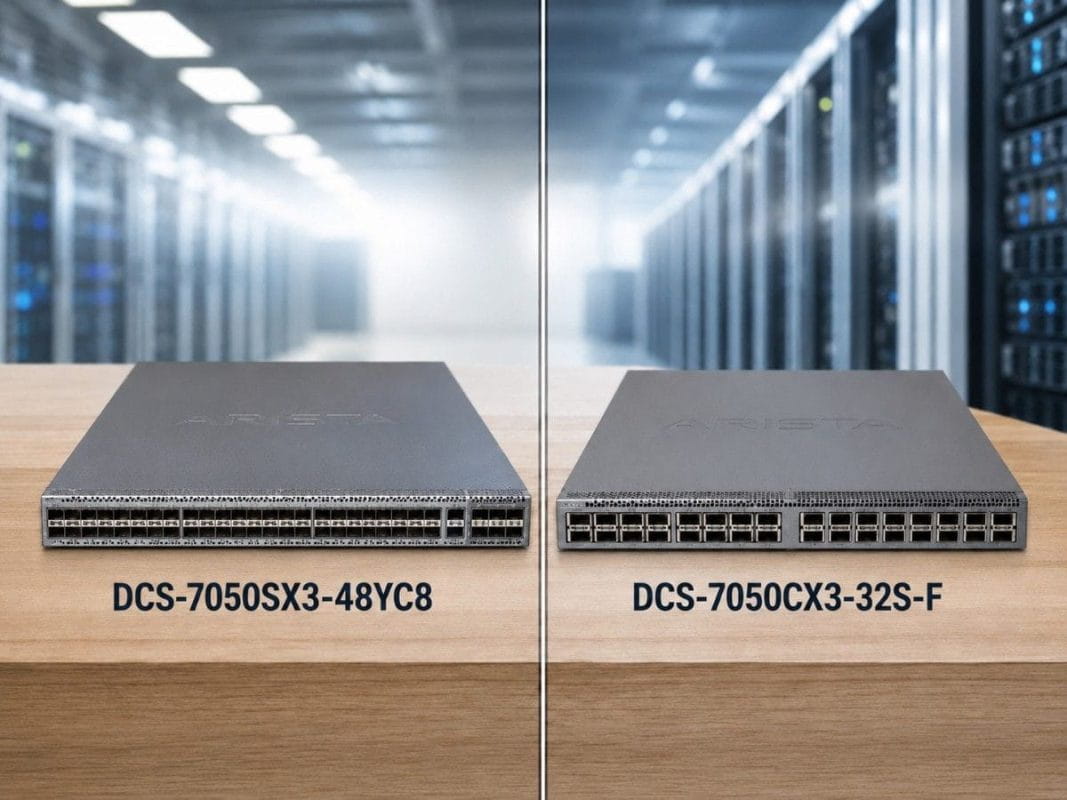
For many data centers, this is not an either-or decision. The right design may use the DCS-7050SX3-48YC8 at the leaf layer and the DCS-7050CX3-32S-F at the spine layer.
That gives buyers a practical 25G/100G leaf-spine fabric without overbuilding every rack.
What Is the Main Difference Between Arista 7050SX3 vs 7050CX3?
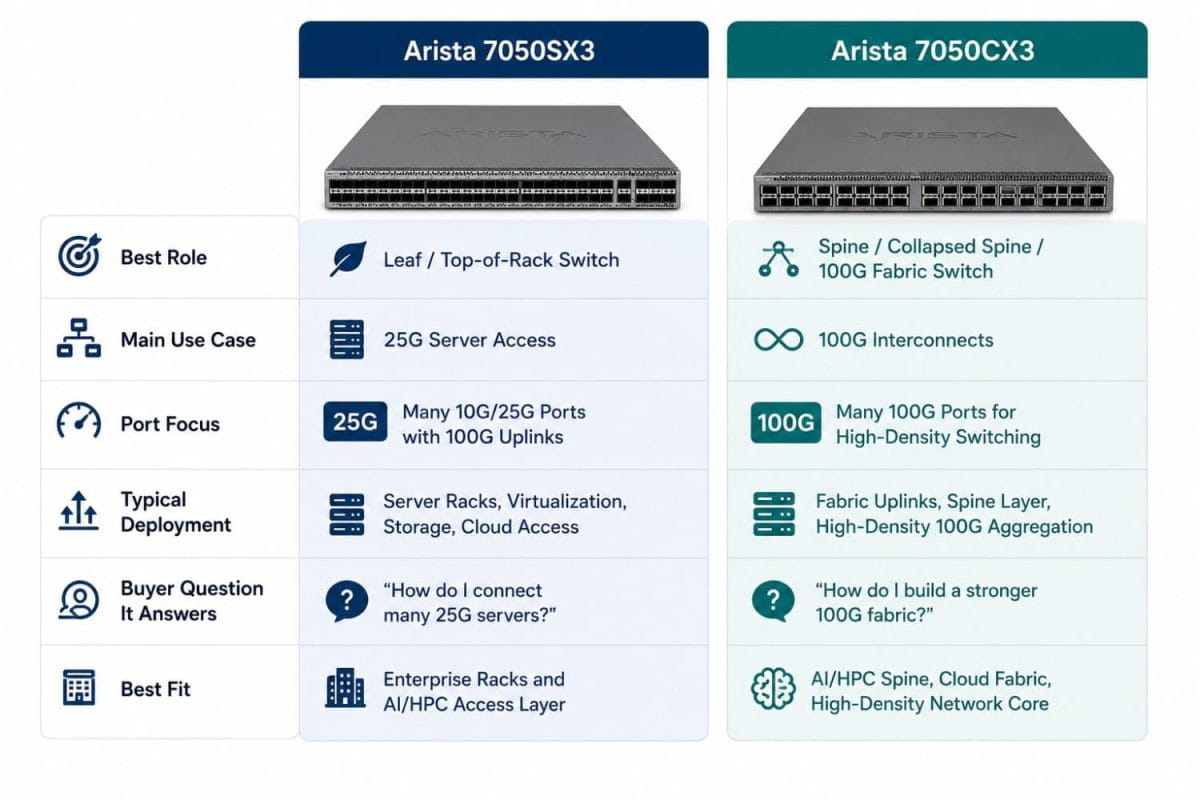
The Arista 7050SX3 is a 25G leaf switch with 100G uplinks. The Arista 7050CX3 is a 100G switch designed for higher-density fabric, spine, collapsed spine, or interconnect use.
The DCS-7050SX3-48YC8-F works well when many servers need 10G/25G access and the fabric needs 100G uplinks. The 7050CX3-32S-F makes more sense when the network needs many 100G ports in a compact switch.
| Decision Point | Arista 7050SX3 | Arista 7050CX3 |
| Best role | Leaf / top-of-rack switch | Spine / collapsed spine / 100G fabric switch |
| Main use case | 25G server access | 100G interconnects |
| Common deployment | Server racks, virtualization, storage, cloud access | Fabric uplinks, spine layer, high-density 100G aggregation |
| Buyer question it answers | “How do I connect many 25G servers?” | “How do I build a stronger 100G fabric?” |
| Best fit | Enterprise racks and AI/HPC access layer | AI/HPC spine, cloud fabric, high-density network core |
The practical difference comes down to port planning. The 7050SX3 helps connect servers. The 7050CX3 helps connect switches, racks, and high-speed fabric paths.
This matters because many buyers do not need 100G to every server. They need 25G at the rack and 100G across the fabric.
Why Are Buyers Comparing These Arista Switches Now?
Many IT teams have to refresh aging 10G networks while controlling cost. They need more bandwidth, but they also need faster sourcing, reliable compatibility, and a better plan for optics and cables.
A 25G/100G design solves a common upgrade problem. It gives servers more bandwidth than older 10G access networks while keeping the uplink layer ready for heavier traffic.
For procurement teams, the decision also includes availability. New hardware may not always match the timeline or budget. Refurbished Arista switches can help buyers complete a refresh faster, especially when they also need optics, DAC cables, fiber, and tested parts.
That is why a switch comparison should not stop at port speed. A better buying process should include:
- Workload type
- Port count
- Rack layout
- Fiber distance
- Airflow direction
- Optics compatibility
- New vs refurbished availability
- Budget and lead time
This is also where cost strategy matters. Many teams looking at Arista also review broader ways to reduce network costs without weakening performance.
When Should You Choose Arista 7050SX3 for 25G Leaf Switching?
Choose the Arista 7050SX3 when your main need is 25G server access with 100G uplinks.
This model fits top-of-rack and leaf switch roles. It works well when servers, storage nodes, or compute hosts need 25G connections, while the switch uplinks into a 100G spine or aggregation layer.
In a typical rack, the 7050SX3 can support many server-facing links. The 100G uplinks then move traffic north-south or east-west through the fabric.
This makes the 7050SX3 useful for:
- Virtualized server environments
- Cloud-style data centers
- Storage-heavy racks
- GPU or AI access racks
- Enterprise 25G refresh projects
- Leaf-spine designs with 100G uplinks
The key benefit is balance. You do not overpay for 100G on every access port, but you still gain stronger uplink capacity.
For server links, buyers can use the SFP-25G-SR when they need short-reach multimode fiber. For shorter rack-level connections, 25G DAC cables may offer a simple and cost-effective option.
When Should You Choose Arista 7050CX3 for 100G Spine Switching?
Choose the Arista 7050CX3 when your main need is dense 100G switching.
The 7050CX3-32S-F fits spine, collapsed spine, interconnect, and high-performance fabric roles. It works best when the network needs many 100G ports instead of many 25G server-facing ports.
This switch makes sense when you need to connect:
- Multiple leaf switches
- High-performance storage systems
- AI/HPC racks
- Data center aggregation layers
- 100G-heavy workloads
- High-throughput east-west traffic paths
In a leaf-spine design, the 7050CX3 often sits above the leaf layer. It helps move traffic between racks at higher speed.
The 7050CX3 can also fit a collapsed spine design in smaller data centers. In that case, one switch layer may handle both aggregation and spine-like traffic movement.
For uplinks, buyers often compare QSFP-100G-SR4 for shorter multimode fiber runs and QSFP-100G-LR4 for longer single-mode fiber links.
How Do 25G Leaf and 100G Spine Use Cases Compare?
A 25G leaf switch and a 100G spine switch solve different problems.
The leaf switch sits close to servers. It handles access. The spine switch sits above the leaf layer. It handles fabric movement between racks or network segments.
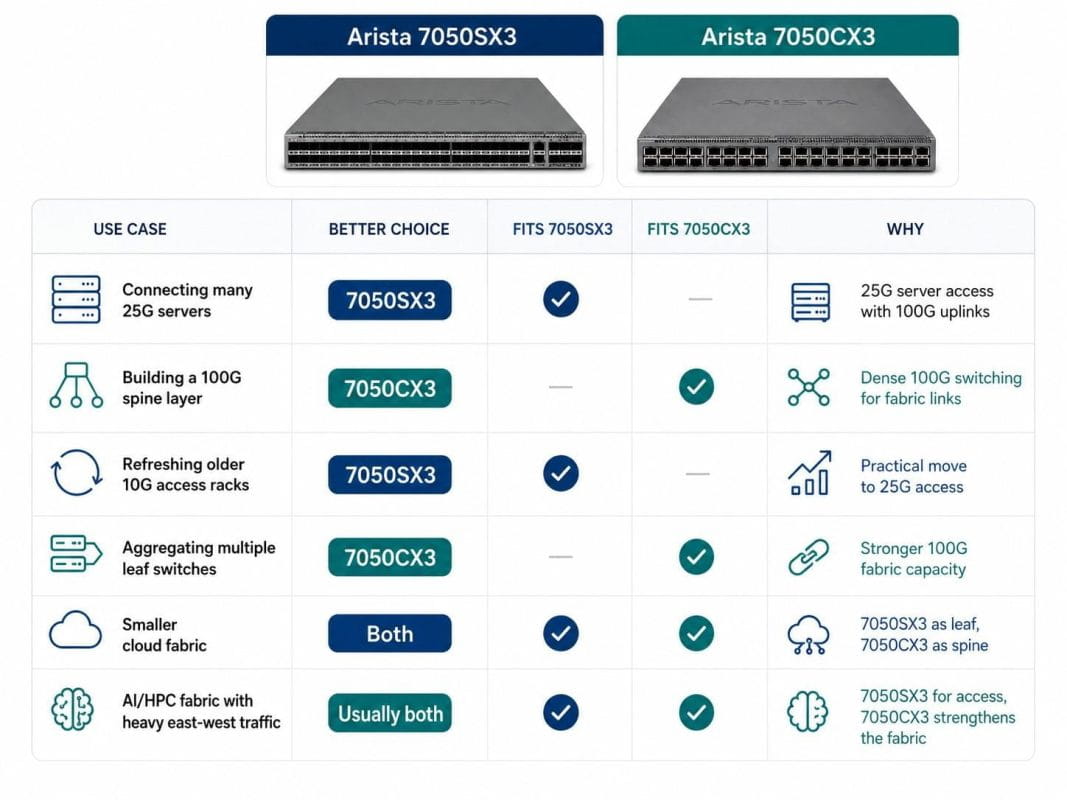
| Use Case | Better Choice | Why It Fits |
| Connecting many 25G servers | 7050SX3 | It provides 25G server access with 100G uplinks |
| Building a 100G spine layer | 7050CX3 | It offers dense 100G switching for fabric links |
| Refreshing older 10G access racks | 7050SX3 | It supports a practical move to 25G access |
| Aggregating multiple leaf switches | 7050CX3 | It provides stronger 100G fabric capacity |
| Smaller cloud fabric | Both | 7050SX3 can act as leaf, while 7050CX3 can act as spine |
| AI/HPC fabric with heavy east-west traffic | Usually both | 7050SX3 supports access, while 7050CX3 strengthens the fabric |
This is why the phrase Arista 7050SX3 vs 7050CX3 can be misleading. In many networks, these models work better together than apart.
The 7050SX3 answers the server access question. The 7050CX3 answers the fabric scale question.
Server Access vs Fabric Uplink: What Should Buyers Check First?
Start with the device that needs the port.
If the port connects to a server, storage node, or compute host, you are usually planning server access. If the port connects to another switch, spine layer, aggregation layer, or cross-rack fabric path, you are usually planning fabric uplink.
Server access planning should focus on:
- Number of hosts per rack
- Required server speed
- 10G vs 25G migration needs
- Copper vs fiber distance
- NIC compatibility
- Rack-level cable length
Fabric uplink planning should focus on:
- East-west traffic volume
- Oversubscription targets
- Number of leaf switches
- Distance between racks
- MMF vs SMF fiber
- 100G optics or DAC/AOC options
A buyer who only counts ports may miss the real issue. The better question is: where does the traffic need to go, and how fast does it need to move?
This is also where teams should check sourcing strategy. If budget pressure drives the project, broader IT optimization strategies can help teams plan around lifecycle, spares, and refresh timing.
Which Switch Is Better for AI and HPC Clusters?
For AI and HPC clusters, the better choice often depends on the layer.
The 7050SX3 can fit the access layer where GPU servers, compute nodes, or storage systems need 25G connectivity. It gives each rack a strong access switch with 100G uplink options.
The 7050CX3 fits better in the 100G spine or interconnect layer. AI and HPC workloads often create heavy east-west traffic. Training jobs, storage access, and distributed workloads can move large amounts of data between nodes.
That traffic pattern needs a fabric with enough bandwidth and low delay. A 100G spine switch can help support that need.
For many AI/HPC builds, the stronger answer is both:
- Use 7050SX3 for 25G server access.
- Use 7050CX3 for 100G spine or fabric links.
- Use SFP-25G-SR or 25G DAC for server links.
- Use QSFP-100G-SR4, QSFP-100G-LR4, 100G DAC, or 100G AOC for uplinks.
- Use MMF or SMF fiber based on distance.
This design supports practical growth. It also helps buyers avoid overbuilding every access port with 100G when the server layer only needs 25G.
Which Switch Is Better for Enterprise Data Centers?
For enterprise data centers, the 7050SX3 often makes more sense as the starting point.
Many enterprise buyers need to modernize access racks. They may have virtualization clusters, storage arrays, backup systems, and application servers that need more than 10G but do not need 100G on every server port.
The 7050SX3 gives those buyers a clear path to 25G access. It can also connect into a 100G fabric as the environment grows.
The 7050CX3 makes more sense when the enterprise has:
- Several leaf switches to aggregate
- Larger east-west traffic needs
- Higher storage or backup throughput
- Dense virtualization clusters
- AI/HPC or analytics workloads
- A fabric refresh already underway
In smaller environments, the 7050CX3 may be more switch than the access layer needs. In larger environments, it may become the backbone that lets the 7050SX3 leaf switches perform well.
Security and segmentation also affect design. Teams that modernize data center switching often review architecture, access control, and trust boundaries at the same time. A practical zero trust guide can support that planning beyond the switch decision.
Which Model Makes More Sense Refurbished?
Both models can make sense refurbished, but they solve different buying problems.
The 7050SX3 makes strong sense refurbished when a buyer needs to refresh several racks with 25G access. The cost difference can matter because leaf switches often scale across many racks.
The 7050CX3 makes strong sense refurbished when a buyer needs 100G fabric capacity but wants to control budget. It can also work well for labs, secondary sites, expansion projects, and cost-sensitive AI/HPC builds.
| Refurbished Buying Factor | 7050SX3 | 7050CX3 |
| Best refurbished value | Multi-rack 25G access refresh | 100G fabric or spine expansion |
| Quantity pressure | Often higher because each rack may need a leaf | Often lower but each unit plays a critical role |
| Key check | Port condition, airflow, optics support, power supplies | 100G port health, airflow, optics support, fabric role |
| Good fit | Enterprise access, virtualization, storage racks | Spine, collapsed spine, AI/HPC, aggregation |
| Risk to avoid | Buying wrong airflow or missing optics | Underestimating 100G optics and cable cost |
Refurbished buying should never focus on price alone. Buyers should verify testing, warranty, airflow, optics compatibility, fan and power supply status, and lead time.
This is especially important in supply-constrained markets. A low switch price does not help if the optics, cables, or correct airflow model cannot ship on time.
When Should You Use Both Arista 7050SX3 and 7050CX3 Together?
Use both switches together when you are building a 25G/100G leaf-spine network.
In that design, the 7050SX3 acts as the leaf switch. It connects servers at 25G and sends traffic upstream through 100G uplinks.
The 7050CX3 acts as the spine switch. It connects multiple leaf switches and gives the network a stronger 100G fabric.
This design works well when a buyer needs:
- More bandwidth than a 10G network
- Practical 25G access for servers
- 100G fabric paths between racks
- Better support for east-west traffic
- Scalable growth without a full redesign
- A mix of new and refurbished hardware options
A combined design also helps with procurement. Buyers can quote switches, optics, DAC cables, AOC cables, and fiber as one bundle instead of sourcing each part separately.
What Is the Best 7050 Leaf-Spine Starter Bundle?
Bundle components
A practical starter bundle can include a 7050SX3 at the leaf layer and a 7050CX3 at the spine layer.
| Bundle Layer | Product | Role |
| Leaf switch | DCS-7050SX3-48YC8 | 25G server access with 100G uplinks |
| Spine switch | DCS-7050CX3-32S-F | 100G fabric, spine, or collapsed spine |
| Server optics | SFP-25G-SR | 25G short-reach MMF server links |
| Server cables | 25G DAC | Short in-rack or near-rack server links |
| Uplink optics | QSFP-100G-SR4 | 100G short-reach MMF uplinks |
| Long-reach uplinks | QSFP-100G-LR4 | 100G SMF links for longer distance |
| Fabric cables | 100G DAC / AOC | Short to mid-distance 100G connections |
| Fiber | MMF / SMF fiber | Distance-based cabling plan |
This bundle structure helps buyers avoid mismatch. It also gives procurement teams a cleaner way to quote the full network path.
A switch without the right optics and cables can delay a deployment. A bundle reduces that risk.
How Should Buyers Choose Between MMF, SMF, DAC, and AOC?
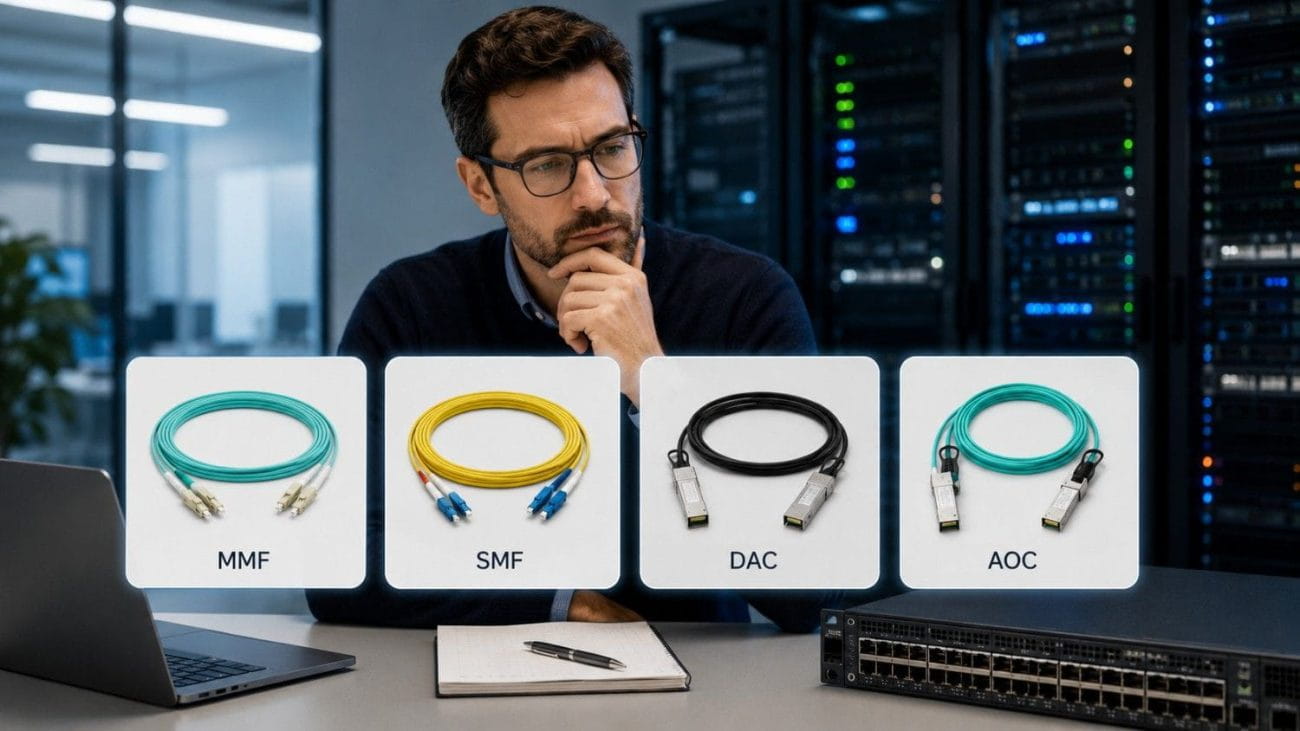
Connectivity choices can change the total cost and success of the project.
Use 25G DAC when the server is close to the switch and the cable path is short. DAC cables can reduce cost and simplify short rack connections.
Use SFP-25G-SR when the server link needs short-reach fiber over MMF. This works well in many data center racks where fiber is already part of the cabling plan.
Use QSFP-100G-SR4 for short-reach 100G multimode fiber links. This often fits same-room or data hall uplink needs.
Use QSFP-100G-LR4 when links need longer reach over SMF. This can matter across larger facilities or structured fiber paths.
Use 100G DAC for short switch-to-switch runs. Use 100G AOC when an active optical cable fits the distance, handling, or pathway needs better.
The main rule is simple: choose the cable or optic based on distance, port type, fiber plant, and budget. Do not treat optics as an afterthought.
What Procurement Issues Should Buyers Plan For?
Switch selection is only one part of the buying process.
Real buyers also need to plan for lead time, part availability, compatible optics, airflow, and spares. They may also need to compare new and refurbished units in the same quote.
Before buying the 7050SX3 or 7050CX3, check:
- Exact switch SKU
- Airflow direction
- Power supply type
- Fan status
- Port count and speed needs
- Supported optics
- Cable distance
- Rack cooling layout
- Warranty and testing process
- New vs refurbished availability
The airflow check deserves special attention. A front-to-rear airflow switch may not fit a rack designed for reverse airflow. A mismatch can create cooling problems even when the switch itself works.
Procurement teams should also check whether the quote includes the full deployment path. That means switches, optics, cables, fiber, and any required spares.
Final Recommendation: Which Arista 7050 Switch Should You Choose?
Choose the Arista 7050SX3 if your main goal is 25G server access with 100G uplinks.
Choose the Arista 7050CX3 if your main goal is dense 100G switching for spine, collapsed spine, aggregation, or high-performance fabric roles.
Use both when you want a practical 25G/100G leaf-spine network. This design gives buyers a clean path for enterprise refresh projects, AI/HPC clusters, virtualization, cloud networking, and storage-heavy environments.
The best decision comes from the full design, not only the switch model. Check port speed, traffic flow, distance, optics, airflow, budget, lead time, and refurbished availability before buying.
For many teams, the strongest outcome is a complete 7050 leaf-spine bundle with the switch, optics, DAC/AOC cables, and MMF or SMF fiber planned together.
How Does Catalyst Data Solutions Help with Arista 7050 Planning?
Catalyst Data Solutions helps buyers compare Arista switch options based on real deployment needs, not just model numbers.
For this topic, that means helping teams decide whether they need a 25G leaf switch, a 100G spine switch, or a complete 7050 leaf-spine bundle. Catalyst can also help source new or refurbished hardware, match optics and cables, and check compatibility before a quote moves forward.
For a 7050 leaf-spine starter bundle, Catalyst can quote:
- Leaf: DCS-7050SX3-48YC8
- Spine: DCS-7050CX3-32S-F
- Server links: SFP-25G-SR or 25G DAC
- Uplinks: QSFP-100G-SR4 / LR4 or 100G DAC / AOC
- Cabling: MMF or SMF fiber based on distance
- Optional refurbished availability and buyback support
This approach helps buyers reduce risk. It also helps teams avoid ordering a switch before they know whether the right optics, airflow, and cable plan can support the deployment.
FAQs:
Is the Arista 7050SX3 a leaf switch?
Yes. The 7050SX3 is commonly a strong fit for leaf or top-of-rack roles where servers need 25G access and the rack needs 100G uplinks.
Is the Arista 7050CX3 a spine switch?
Yes. The 7050CX3 is often a better fit for 100G spine, collapsed spine, aggregation, or high-density interconnect roles.
Which switch is better for 25G servers?
The 7050SX3 is usually the better choice for 25G server access because it matches the access layer use case.
Which switch is better for 100G fabric links?
The 7050CX3 is usually the better choice for 100G fabric links because it gives buyers dense 100G switching.
Can I use 7050SX3 and 7050CX3 together?
Yes. A common design uses 7050SX3 switches as leaf switches and 7050CX3 switches as spine switches.
Which one should I buy refurbished?
Both can make sense refurbished. The 7050SX3 often fits cost-sensitive access refresh projects. The 7050CX3 often fits 100G fabric expansion, AI/HPC, and aggregation needs.
Do I need SR4 or LR4 optics?
Use QSFP-100G-SR4 for short-reach multimode fiber links. Use QSFP-100G-LR4 for longer single-mode fiber links.
Are DAC cables useful in a 7050 design?
Yes. 25G DAC and 100G DAC cables can reduce cost for short rack-level or switch-to-switch connections.