
Data center networks are under pressure to move more traffic with less delay, especially as cloud platforms, virtualization, storage, AI, and HPC workloads continue to grow. For buyers planning a 100G fabric, the Arista DCS-7050CX3-32S-F offers a compact 1RU option for spine, collapsed spine, and high-density interconnect roles.
This Arista DCS-7050CX3-32S-F Review explains where the switch fits, how its 32-port 100G design supports modern network architecture, and which optics or cables make sense for different deployment needs. It also covers when to choose this model over the 7050SX3, how to plan a 100G bundle, and what to check when buying refurbished hardware.
What Is the Arista DCS-7050CX3-32S-F Used For?
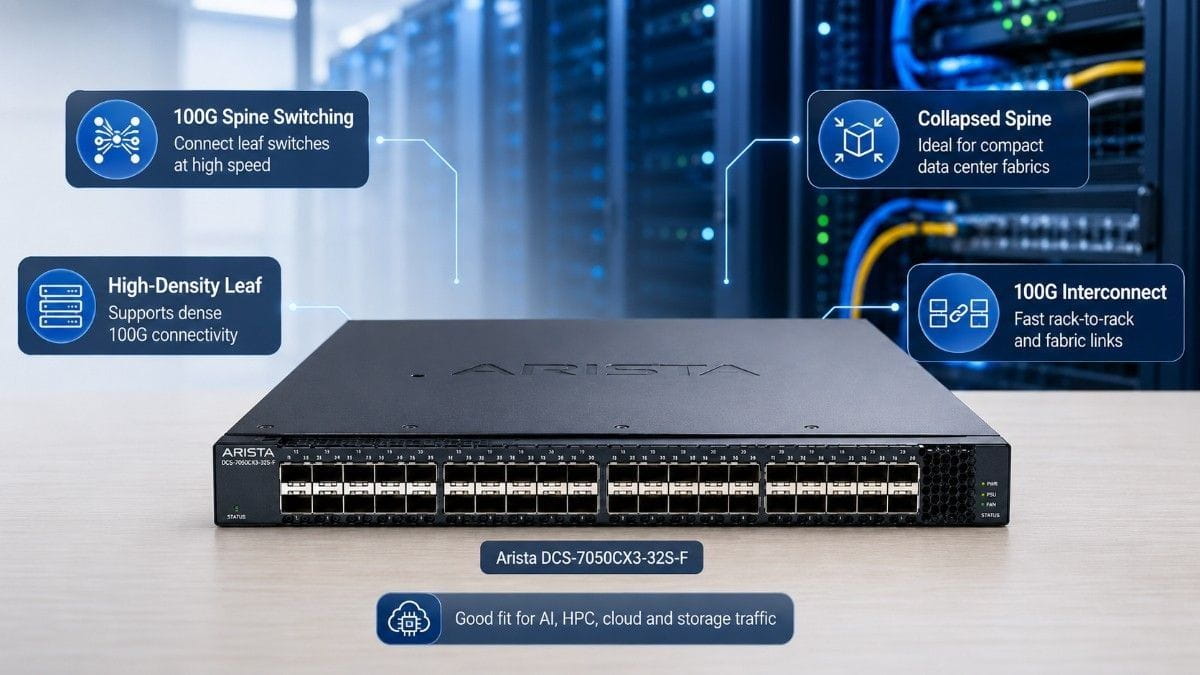
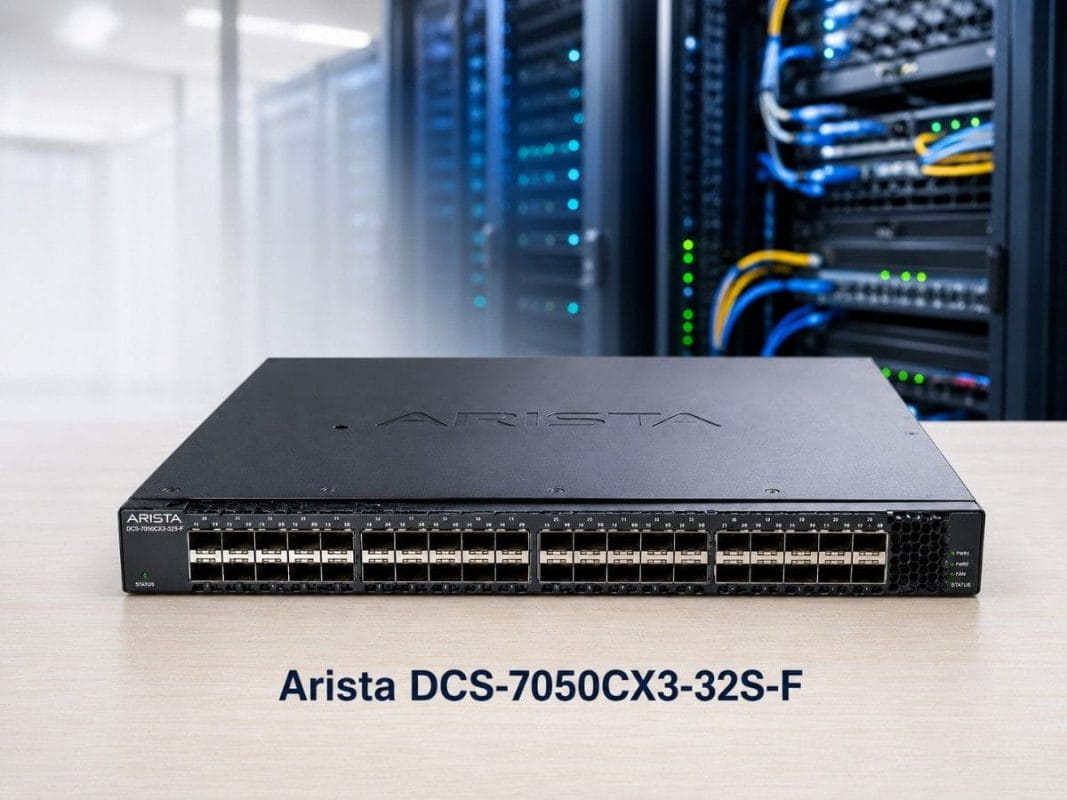
The DCS-7050CX3-32S-F is a high-density 100G data center switch. It fits best in spine, collapsed spine, high-density leaf, and 100G interconnect roles.
Arista lists the 7050CX3-32S as a 1RU switch with 32 100G QSFP ports. Each QSFP port can support flexible modes, including 100GbE, 40GbE, 4x25GbE, 4x10GbE, or 2x50GbE, depending on the design and cable or optic choice.
For many buyers, this switch solves a real architecture problem. Their existing 10G or 40G network may still work, but it may not support higher traffic from virtualization, storage, cloud platforms, or AI workloads.
If your team is also comparing platforms like Juniper QFX5200 or QFX5120, the same question applies: where does the switch fit in the fabric? The 7050CX3-32S-F is best viewed as a 100G fabric switch, not a general access switch for every rack.
| Buyer Question | Practical Answer |
| What is the main role of the 7050CX3-32S-F? | 100G spine, collapsed spine, or high-density interconnect switching |
| Is it a good server access switch? | It can support breakout use cases, but 7050SX3 is usually better for 25G server access |
| Is it useful for AI and HPC? | Yes, especially as a 100G fabric layer for east-west traffic |
| Can it support refurbished buying? | Yes, if testing, airflow, power, optics, and software needs are checked |
| What should buyers source with it? | 100G optics, DACs, AOCs, fiber, power, and airflow-matched units |
Why 32-Port 100G Switching Matters in Modern Data Centers
Modern data centers have a different traffic pattern than older three-tier networks. More traffic now moves east-west between servers, storage, virtual machines, containers, and application clusters.
That shift creates pressure on the fabric. Buyers need more than a switch with high port speed. They need a clear way to connect racks, reduce bottlenecks, and support future growth without overbuilding.
The 7050CX3-32S-F gives buyers 32 ports of 100G QSFP connectivity in a compact 1RU platform. Arista states that the 7050CX3-32S offers up to 6.4 Tbps of bidirectional throughput and wire-speed performance.
This matters when a buyer needs to connect several leaf switches to a spine. It also matters when storage, compute, and high-performance workloads need faster paths across racks.
A 32-port 100G switch can help buyers:
- connect multiple 25G or 100G leaf switches
- reduce oversubscription in the fabric
- support high-throughput storage paths
- improve rack-to-rack traffic flow
- simplify spine or collapsed spine design
- support AI, HPC, and private cloud growth
The switch does not replace good network design. But it gives the architecture a strong 100G layer when the business needs more capacity.
Where Does the Arista 7050CX3 Fit in Spine and Collapsed Spine Architecture?
The 7050CX3-32S-F fits well in a leaf-spine network. In this design, leaf switches connect servers, storage, and appliances. Spine switches connect the leaf layer and help traffic move across the data center.
This model can also work as a collapsed spine in smaller environments. A collapsed spine design combines part of the spine and aggregation role into a smaller switch layer. This can make sense for mid-size enterprise data centers, labs, private cloud racks, and cost-controlled refresh projects.
Arista describes the 7050X3 series as compact, non-blocking data center switches with Layer 2 and Layer 3 features for scalable cloud and leaf-spine designs.
The 7050CX3-32S-F is a strong fit when buyers need:
- 100G leaf-to-spine uplinks
- 100G rack-to-rack interconnects
- high-density spine switching
- storage fabric connectivity
- cloud-style east-west traffic support
- AI or HPC network expansion
- a compact alternative to larger chassis platforms
It may not be the best choice if the main goal is simple 25G server access. In that case, the 7050SX3-48YC8 may be a better fit because it offers many 25G SFP ports with 100G uplinks.
Which 100G Interconnects Should You Use with the 7050CX3-32S-F?
100G Optics and Cable Planning
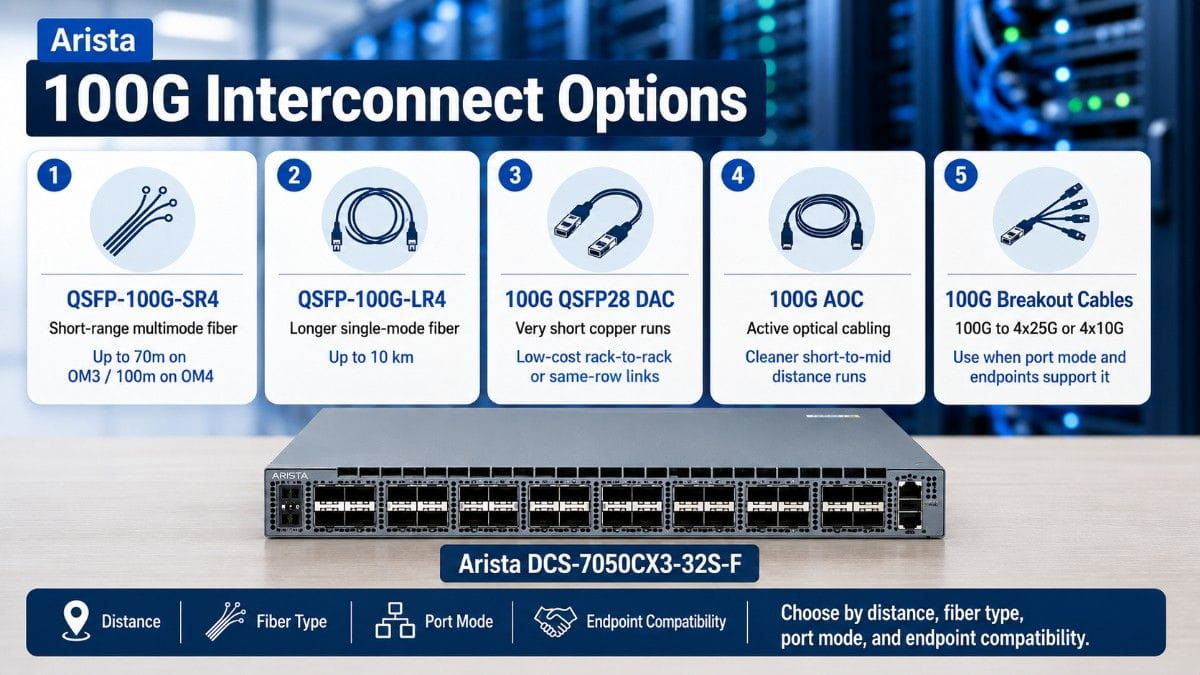
A 100G switch decision is not complete without optics and cables. Many deployment issues happen because buyers source the switch first, then discover that optics, fiber type, or cable length do not match the design.
For short-reach multimode fiber links, the Arista QSFP-100G-SR4 is a common choice. Arista identifies QSFP-100G-SR4 as a 100GBASE-SR4 optic for parallel multimode fiber, with reach up to 70 meters over OM3 or 100 meters over OM4.
For longer single-mode fiber links, the Arista QSFP-100G-LR4 is the better fit. Arista lists QSFP-100G-LR4 for duplex single-mode fiber links up to 10 kilometers.
100G QSFP28 DAC cables are useful for short rack-to-rack connections. They can reduce cost when the distance is short and copper cabling is practical.
100G AOC cables can help when active optical cabling is preferred. These are often used for short-to-mid distance links where pre-terminated optical cabling supports a cleaner deployment.
100G breakout cables may also be useful, but only when the switch port mode, endpoint device, cable type, and EOS support align. Arista’s 7050CX3-32S documentation notes that QSFP ports can support breakout modes such as 4x25G and 4x10G.
| Connectivity Option | Best Use Case | Typical Buyer Need |
| Arista QSFP-100G-SR4 | Short-range multimode fiber | 100G links inside the data center |
| Arista QSFP-100G-LR4 | Longer single-mode fiber | Longer building, room, or campus data center links |
| 100G QSFP28 DAC cables | Very short copper runs | Low-cost rack-to-rack or same-row connections |
| 100G AOC cables | Active optical cabling | Cleaner short-to-mid distance cable runs |
| 100G breakout cables | 100G to 4x25G or 4x10G | Connecting lower-speed endpoints when supported |
The key is to match the optic or cable to distance, fiber type, port mode, and endpoint compatibility. Buyers should not assume that every 100G cable works in every 100G design.
How Does the 7050CX3-32S-F Support AI and HPC Network Fabric?
AI and HPC workloads need fast movement between compute, storage, and network layers. These environments often create heavy east-west traffic because systems pass large data sets across racks and clusters.
The 7050CX3-32S-F can support this need as a 100G spine or interconnect switch. It gives the fabric a high-throughput layer for GPU-adjacent infrastructure, storage-heavy workflows, and private AI clusters.
This does not mean the switch alone creates an AI-ready environment. Buyers still need to plan server links, GPU systems, storage bandwidth, optics, cable distances, and rack airflow.
The 7050CX3-32S-F can support AI and HPC environments by helping with:
- 100G spine connectivity between leaf switches
- high-throughput storage and compute paths
- east-west data movement
- AI lab or secondary cluster expansion
- cost-controlled network upgrades
- mixed new and refurbished sourcing plans
This is where practical planning matters. AI infrastructure is not just compute. It also depends on switching, cabling, optics, power, and lead time.
For buyers trying to manage growth without overspending, a broader network cost control approach can help align performance with budget.
When Should You Choose 7050CX3 Instead of 7050SX3?
The 7050CX3 and 7050SX3 are often part of the same Arista discussion, but they solve different problems.
Choose the 7050CX3-32S-F when the network needs a high-density 100G layer. This usually means spine, collapsed spine, storage fabric, or high-performance interconnect switching.
Choose the 7050SX3-48YC8 when the network needs 25G server access with 100G uplinks. That model fits top-of-rack leaf switching better when many servers connect at 10G or 25G.
Arista lists the 7050CX3-32S with 32 100G QSFP ports. The 7050SX3-48YC8 has 48 25G SFP ports and 8 100G QSFP ports, making it more suitable for dense 25G access with 100G uplinks.
| Decision Point | Choose 7050CX3-32S-F | Choose 7050SX3-48YC8 |
| Main role | 100G spine or interconnect | 25G leaf or top-of-rack access |
| Best port profile | 32 x 100G QSFP | 48 x 25G SFP + 8 x 100G QSFP |
| Server access fit | Better with breakout, if supported | Strong direct fit for 25G servers |
| AI/HPC fit | Strong as 100G fabric layer | Strong as 25G leaf layer |
| Bundle role | 100G spine bundle | 25G leaf bundle |
| Buyer need | More 100G links | More server access ports |
In many real deployments, buyers use both. A 7050SX3 can serve as the 25G leaf switch, while the 7050CX3 acts as the 100G spine.
That combination can support virtualization, storage, AI labs, and private cloud networks. It also gives procurement teams a clean bundle model instead of buying switches and optics as separate pieces.
Is the Arista 7050CX3-32S-F a Good Refurbished Buy?
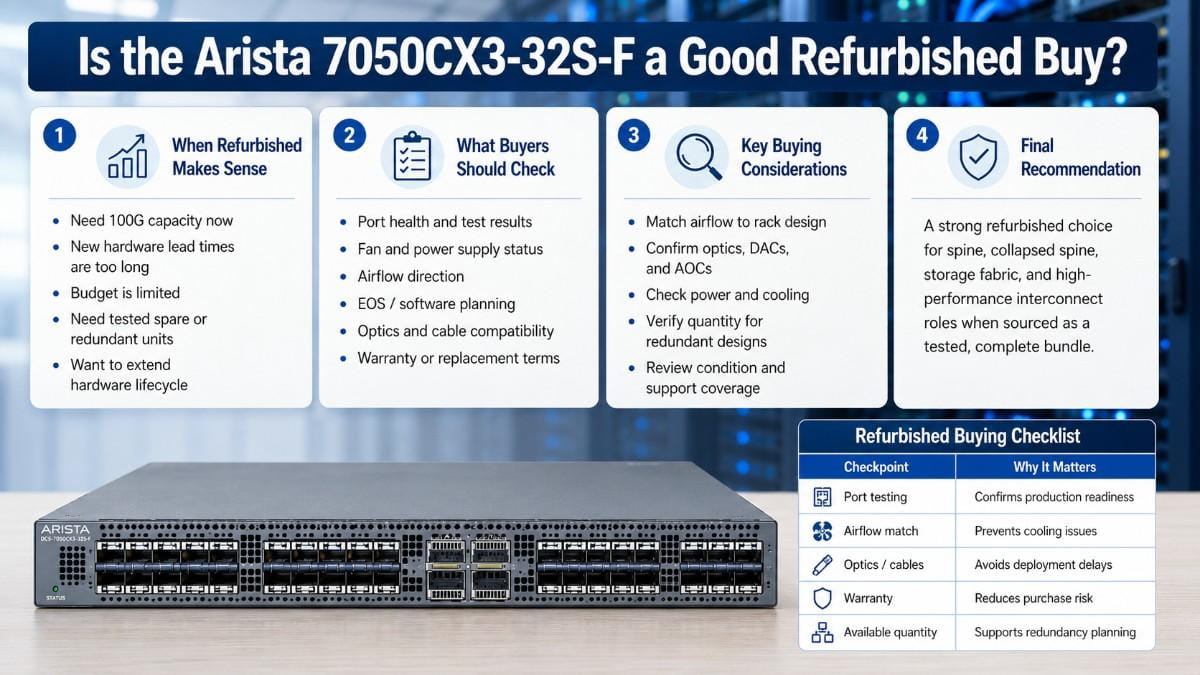
Yes. The Arista DCS-7050CX3-32S-F can be a strong refurbished buy when the unit is properly tested, matched to the network design, and sourced with the right optics, power, airflow, and warranty support. It is especially useful for buyers who need 100G data center switching but want to control cost, reduce lead time, or extend the lifecycle value of enterprise hardware.
1. When Refurbished Makes Sense
A refurbished 7050CX3-32S-F is a good fit when:
- The data center needs 100G capacity now
- New hardware lead times are too long
- The project has a strict budget
- The buyer needs tested spare or redundant units
- The environment can use prior-generation 100G hardware
- The team wants to reduce waste by extending equipment lifecycle
2. What Buyers Should Check Before Purchase
Before buying refurbished, buyers should confirm the following:
| Checkpoint | Why It Matters |
|---|---|
| Port health and test results | Confirms the switch can support production traffic |
| Fan and power supply status | Helps avoid hardware failure after deployment |
| Front-to-rear or rear-to-front airflow | Ensures the switch matches the rack cooling design |
| EOS/software planning | Helps confirm software compatibility and operational needs |
| Optics and cable compatibility | Prevents deployment delays caused by unsupported transceivers or cables |
| Rack power and cooling | Confirms the environment can support the switch properly |
| Warranty or replacement terms | Reduces risk when buying refurbished hardware |
| Available quantity | Important for redundant spine or fabric designs |
| Lead time for switches and optics | Helps avoid delays when building a complete 100G bundle |
3. Key Buying Considerations
The switch SKU alone is not enough. Buyers should look at the full deployment package, including:
- Hardware condition
- Matching airflow direction
- Tested power supplies and fans
- Compatible 100G optics
- DAC or AOC cable requirements
- Fiber type and distance
- Warranty coverage
- Availability for redundant designs
4. Final Recommendation
The Arista DCS-7050CX3-32S-F is a good refurbished buy when the buyer needs dense 100G switching for spine, collapsed spine, storage fabric, or high-performance interconnect roles. The best approach is to buy it as part of a complete, tested bundle rather than sourcing the switch, optics, and cables separately.
What Should Be Included in a 100G Spine / Interconnect Bundle?
A good 100G bundle should include more than the switch. It should include the right connectivity and deployment details.
For the Arista 7050CX3-32S-F, the recommended 100G Spine / Interconnect Bundle includes:
- DCS-7050CX3-32S-F
- QSFP-100G-SR4 for short-range multimode fiber
- QSFP-100G-LR4 for longer single-mode fiber links
- 100G QSFP28 DAC cables for short-distance rack connections
- 100G AOC cables where active optical cabling is preferred
- 100G breakout cables if compatible and useful
- MMF or SMF fiber based on distance
- matching airflow and power
- optional refurbished availability check
This bundle approach helps buyers avoid common procurement gaps. A switch may arrive on time, but the project can still stall if optics, fiber, or cables are missing.
It also helps compare new, refurbished, and mixed sourcing options in one quote. That can support a stronger IT optimization plan when budget, lifecycle, and performance all matter.
How Should Buyers Think About Operations, Security, and Fabric Planning?

A 100G switch can improve capacity, but it does not replace good operations. Buyers should also think about monitoring, segmentation, automation, and change control.
Arista’s 7050X3 platform supports advanced EOS features for software-defined cloud networking and scalable Layer 2 and Layer 3 designs. This can help teams operate a fabric with more consistency.
Security planning should happen at the architecture level. A spine switch does not create a zero trust model by itself. But the right network fabric can support segmentation, visibility, and policy enforcement.
For teams modernizing infrastructure and access control at the same time, zero trust planning can help align the network with broader security goals.
The practical goal is simple. Build a fabric that supports the workload, then make sure operations and security teams can manage it without adding avoidable complexity.
Need Help Building a 100G Arista Fabric Quote?
Catalyst Data Solutions can help buyers source the Arista DCS-7050CX3-32S-F with the right optics, cables, airflow, and bundle plan. This is useful when teams need to compare new and refurbished options, check availability, or build a complete 100G spine or interconnect quote.
Request a quote for a 100G Arista bundle with DCS-7050CX3-32S-F switches, QSFP-100G-SR4 or QSFP-100G-LR4 optics, 100G DAC or AOC cables, and compatibility guidance based on rack distance, fiber type, airflow, budget, and lead time.
Catalyst can also help buyers compare the 7050CX3 against 7050SX3, Cisco Nexus, Juniper QFX, or other data center options without forcing one vendor to answer. The better decision depends on workload, port count, software preference, budget, lifecycle plan, and real inventory availability.
Final Verdict: Is the Arista DCS-7050CX3-32S-F Right for Your Data Center?
The Arista DCS-7050CX3-32S-F is a strong choice for buyers who need dense 100G switching in a compact 1RU platform. It fits best as a spine, collapsed spine, or 100G interconnect switch in data centers that need more east-west bandwidth.
It is not the right switch for every rack. If the main need is 25G server access, the 7050SX3-48YC8 may be the better choice. If the network needs many 100G links between leaf switches, storage, compute, or AI/HPC systems, the 7050CX3-32S-F becomes much more relevant.
The best buying approach is to define the architecture first, then source the switch and connectivity as one bundle. Buyers should confirm optics, DACs, AOCs, breakout needs, fiber type, airflow, software, and refurbished condition before purchase.
For many enterprise teams, the best outcome is not just a lower switch price. It is a cleaner 100G fabric decision, fewer compatibility problems, faster sourcing, and a network plan that supports current workloads without overbuilding the next refresh.
Frequently Asked Questions About the Arista DCS-7050CX3-32S-F
Is the Arista DCS-7050CX3-32S-F a spine switch?
Yes. The Arista DCS-7050CX3-32S-F is commonly used as a 100G spine or collapsed spine switch. Its 32 QSFP ports make it a strong fit for connecting leaf switches and supporting high-density 100G fabric links.
How many 100G ports does the 7050CX3-32S-F have?
The 7050CX3-32S has 32 100G QSFP ports. These ports can support different speeds and breakout modes depending on the optics, cables, and configuration.
Can the 7050CX3-32S-F support 25G connections?
Yes, it can support 25G through breakout configurations when the design and endpoint support it. However, if the main need is direct 25G server access, the Arista 7050SX3-48YC8 is usually the better fit.
What optics work with the 7050CX3-32S-F?
Common 100G options include QSFP-100G-SR4 for short-range multimode fiber and QSFP-100G-LR4 for longer single-mode fiber. DAC and AOC cables can also fit short-distance or structured cabling needs.
Should I use SR4 or LR4 optics?
Use SR4 when the link is short and uses multimode fiber. Use LR4 when the link is longer and uses single-mode fiber. Buyers should confirm distance, fiber type, connector plan, and budget before choosing.
Are 100G DAC cables useful with this switch?
Yes. 100G QSFP28 DAC cables are useful for short rack-to-rack connections. They can be cost-effective when the cable run is short and copper cabling fits the rack layout.
Are 100G AOC cables better than DAC cables?
Not always. DAC cables are often better for very short runs. AOC cables can work better when buyers want active optical cabling for short-to-mid distance links or cleaner cable handling.
Can I use 100G breakout cables with the 7050CX3-32S-F?
Yes, breakout can be useful when connecting a 100G QSFP port to multiple 25G or 10G endpoints. Buyers should confirm port mode, endpoint support, cable compatibility, and software support before ordering.