
Modern data centers are under pressure to move more traffic, support new workloads, and avoid costly hardware mistakes. Standard 100G switching works for many environments, but some networks need more control over how packets move, how traffic is handled, and how specialized services run across the fabric.
This Arista DCS-7170-32CD-R Review looks at where this programmable 100G switch fits best. We’ll cover its role in advanced data center networks, how it works with QSFP-100G-SR4, QSFP-100G-LR4, and 100G DAC/AOC connectivity, and when buyers should choose it instead of a more common Arista 7050, 7060, or 7280 platform.
What Is the Arista DCS-7170-32CD-R?
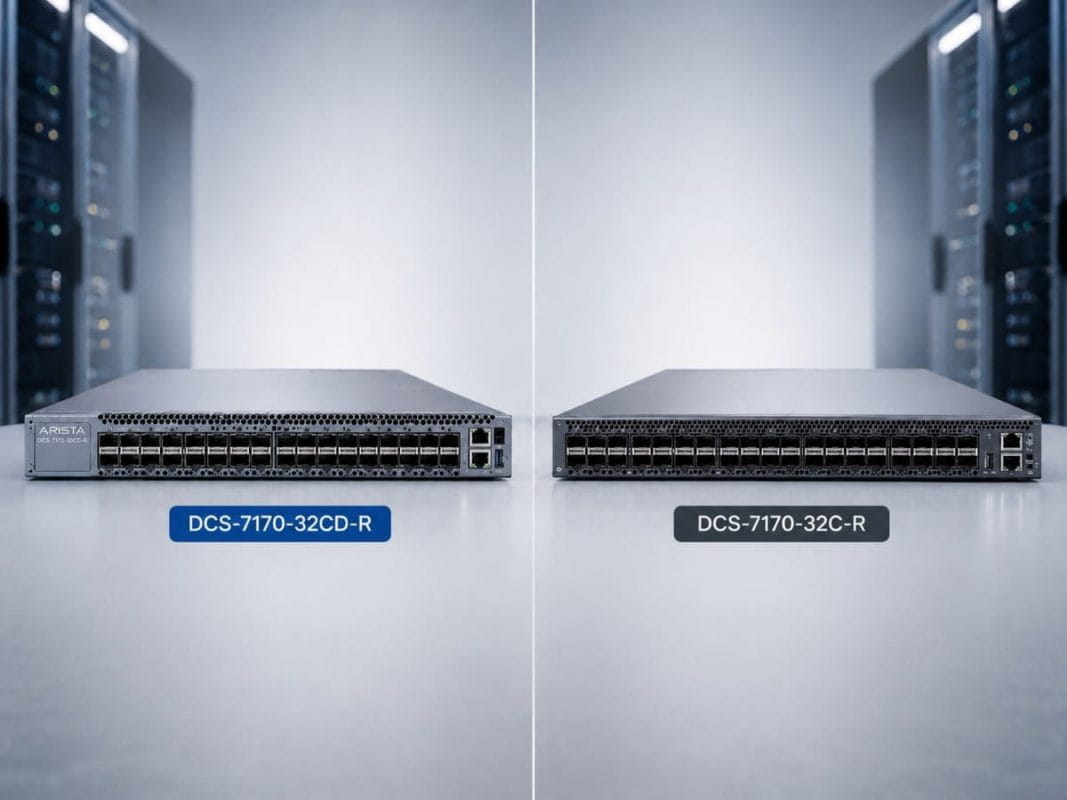
The Arista DCS-7170-32CD-R is a 32-port 100G QSFP data center switch with rear-to-front airflow. It belongs to the Arista 7170 Series, which focuses on programmable switching rather than basic leaf or spine switching alone.
In simple terms, the 7170-32CD-R gives network teams a dense 100G platform with more control over how traffic gets processed. That makes it useful in advanced environments where a normal fixed-function switch may not offer enough flexibility.
| Product | Role in the Network | Best Fit |
| DCS-7170-32CD-R | Programmable 100G data center switch | Advanced cloud, custom packet handling, low-latency designs |
| QSFP-100G-SR4 | Short-reach 100G optic | Multimode fiber inside data centers |
| QSFP-100G-LR4 | Long-reach 100G optic | Single-mode fiber for longer links |
| 100G DAC / AOC | Short-to-mid distance 100G connectivity | Rack-level or nearby rack links |
The 7170-32CD-R should interest buyers who need more than a standard 100G switch. It can fit into high-performance data center networks, advanced test environments, cloud fabrics, service platforms, and specialized packet workflows.
It also needs careful sourcing. Arista has announced end-of-sale timelines for the DCS-7170-32CD Series and broader 7170/7170B Series, so availability, condition, support needs, and lifecycle planning matter during procurement.
Why Are Buyers Looking at Programmable 100G Switches?
Data center teams face a difficult mix of pressure. Traffic keeps growing, refresh budgets remain tight, and lead times can change fast. AI, storage, analytics, virtualization, and cloud workloads also push more traffic east and west between servers.
Many buyers are not only asking, “How many 100G ports do we need?” They are also asking, “Can this platform support the traffic behavior we expect over the next few years?”
That is where programmable switching becomes important. A programmable platform can help advanced teams shape packet handling around specific network needs. It gives engineers more room to support new protocols, custom workflows, monitoring requirements, and low-latency traffic patterns.
For buyers trying to reduce spend without hurting performance, a planned approach to network cost strategy can help decide whether a specialized switch, standard switch, or refurbished option makes the most sense.
What Does Programmable Switching Mean?
Programmable switching means the switch can support more flexible packet processing than a normal fixed-function platform. In a standard switch, the silicon handles packets in a set way. That works well for many enterprise networks, but it can limit teams that need custom behavior.
With programmable switching, advanced teams can change or extend how the switch handles certain traffic flows. This can support new protocols, deeper visibility, special forwarding behavior, or research and testing use cases.
The Arista 7170 Series was designed around this kind of flexibility. Arista positions the 7170 family as purpose-built programmable fixed-configuration switches for dense 100GbE and advanced data center use.
Why Programmability Matters
Programmability matters when the network must support more than standard switching. It can help teams address custom packet paths, unique telemetry needs, new traffic types, or performance-sensitive workloads.
This does not mean every company needs a programmable switch. Many buyers will get better value from a 7050, 7060, or 7280 platform. The 7170 makes the most sense when network behavior, not only port count, drives the purchase.
Common reasons to consider programmable switching include:
- custom packet parsing
- specialized monitoring
- advanced traffic steering
- low-latency packet handling
- lab, research, or cloud platform testing
- high-performance data center fabrics
- specialized financial, service provider, or cloud use cases
What 100G Data Center Use Cases Fit the DCS-7170-32CD-R?
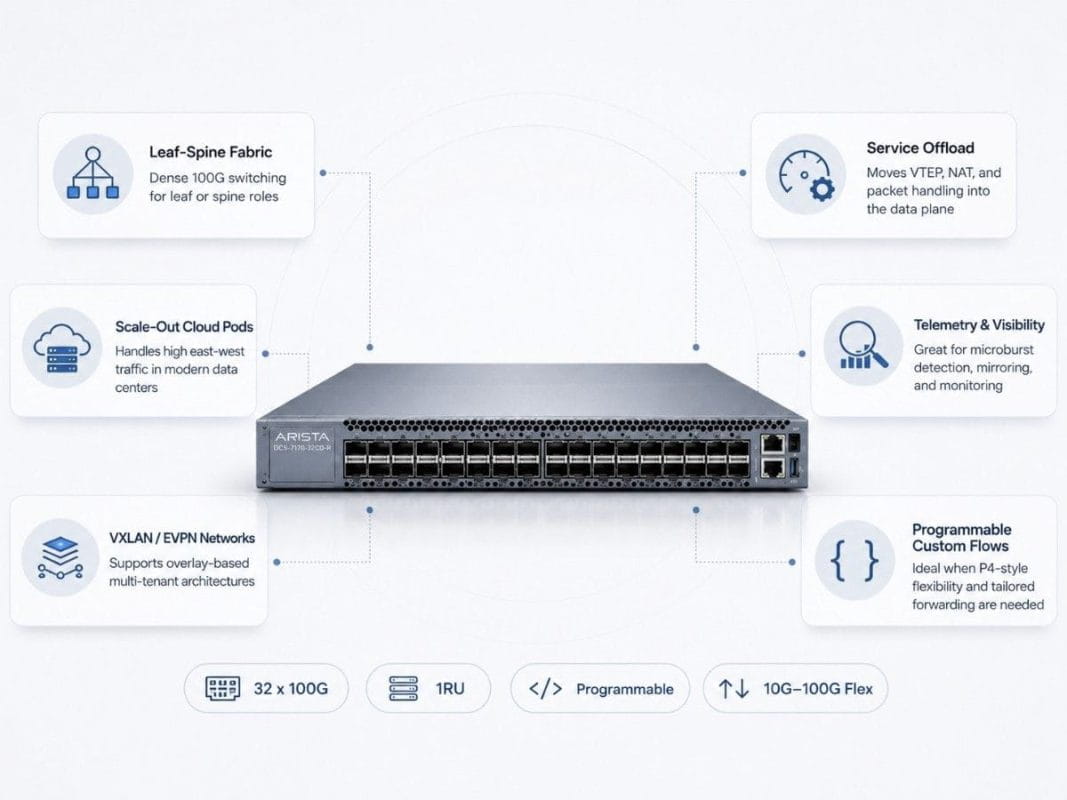
The DCS-7170-32CD-R fits best where 100G density and advanced packet control both matter. It can serve as part of a high-performance fabric, a specialized aggregation point, or a programmable test and service layer.
This switch is not a basic top-of-rack option for every server cabinet. It is better for teams with clear technical reasons for using programmable hardware.
| Use Case | Why the 7170-32CD-R Fits | Buyer Note |
| Advanced cloud networking | Supports dense 100G and flexible packet workflows | Best for skilled network teams |
| Low-latency traffic | Helps support performance-sensitive paths | Validate latency and design needs |
| Specialized packet processing | Useful where packet behavior needs more control | Not needed for basic switching |
| Lab and test environments | Good for protocol, telemetry, and network research | Check software and support needs |
| High-performance fabric layer | 32x100G ports support dense interconnects | Confirm optics, airflow, and power |
For short-reach fiber links, the QSFP-100G-SR4 can fit many multimode data center runs. For longer single-mode fiber links, the QSFP-100G-LR4 may be the better match.
100G DAC and AOC cables can also make sense when switches sit close together. DAC often fits short rack-to-rack links. AOC can work when teams want an active optical cable with more reach and easier cable handling than some passive copper options.
How Does the DCS-7170-32CD-R Support Advanced Cloud Networking?
Cloud-style data centers need fast east-west traffic. Applications often talk across many servers, storage systems, and service layers. This traffic pattern can place heavy demand on the fabric.
The DCS-7170-32CD-R can support advanced cloud networking where dense 100G ports and programmable behavior are both useful. It may fit environments that use custom overlays, special monitoring, traffic engineering, or new protocol work.
This matters because cloud networking is not only about bandwidth. It also involves control, visibility, and fast response when workloads shift. A programmable switch can help advanced operators test and support new traffic models before they become standard.
For AI environments, the network challenge grows even more. GPU clusters can create heavy east-west traffic between compute nodes, storage, and training workloads. A clear view of AI networking challenges helps teams decide where a 100G programmable switch may fit and where a simpler switch may be enough.
What Low-Latency and Specialized Packet Processing Needs Can the 7170 Support?
Low-latency networks need predictable paths, fast forwarding, and careful design. The 7170-32CD-R may fit cases where packet behavior needs close control.
This can include financial networks, research networks, cloud service platforms, advanced monitoring fabrics, or custom data center services. In these cases, the buyer may care about how the switch processes traffic as much as how many ports it has.
Specialized packet processing can support:
- custom protocol handling
- packet inspection workflows
- advanced telemetry
- traffic sampling
- packet modification
- service insertion
- performance testing
- non-standard network designs
A standard 100G switch can move traffic quickly, but it may not support the same level of packet-level flexibility. That is the main reason buyers review the 7170 instead of only looking at port count.
Still, the design must justify the platform. If the network only needs 25G server access and 100G uplinks, a standard Arista leaf switch may be a better fit.
Which Optics and Cables Work Best with the DCS-7170-32CD-R?
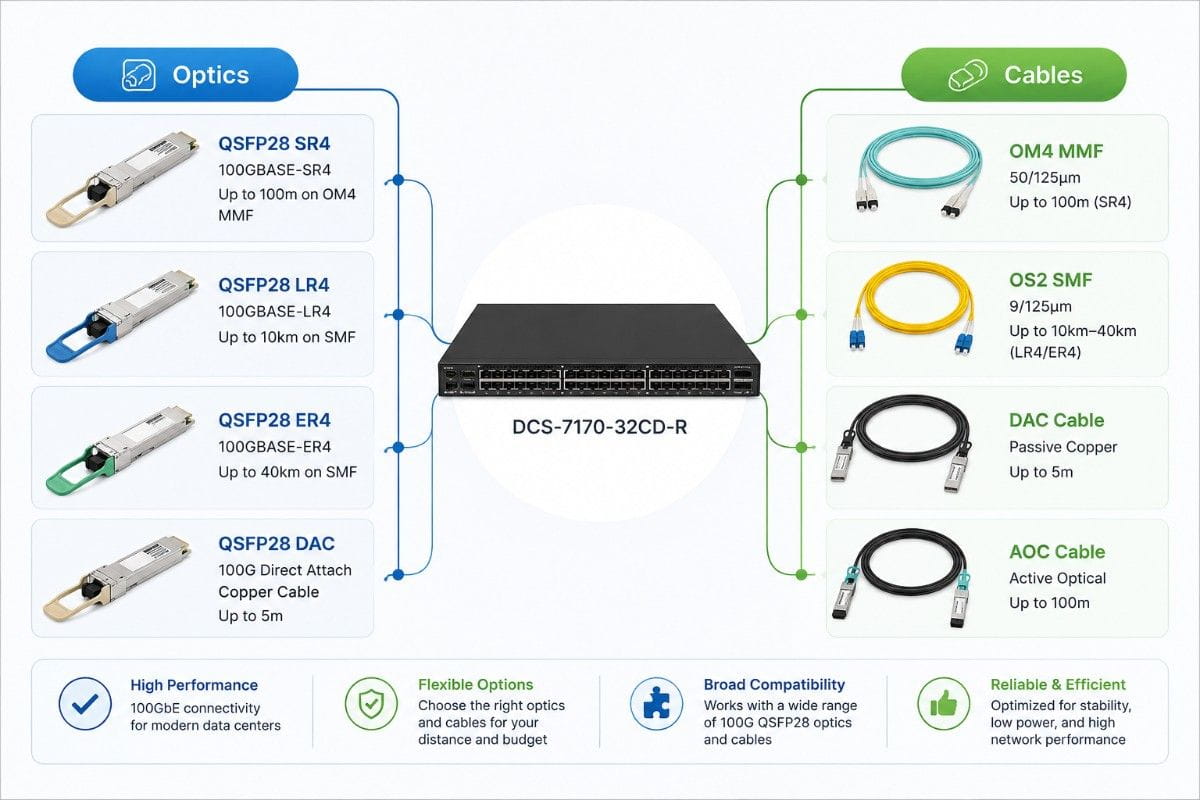
The right optic or cable depends on distance, fiber type, rack layout, and budget. Buyers should not quote the switch alone. They should quote the switch, optics, cables, airflow, and support needs together.
| Connectivity Option | Best Use | Typical Buyer Question |
| QSFP-100G-SR4 | Short-reach 100G over multimode fiber | Are the links inside the same data hall? |
| QSFP-100G-LR4 | Longer 100G over single-mode fiber | Do links cross rooms, rows, or buildings? |
| 100G DAC | Short direct copper links | Are switches close enough for passive cabling? |
| 100G AOC | Active optical cable links | Do we need easier handling or longer reach than DAC? |
| Fiber cabling | Structured data center cabling | Is the plant MMF or SMF? |
For many data center buyers, optics and cabling create hidden cost and delay. A switch may be available, but the correct optics, cable length, and fiber type may not be ready. This can slow a deployment even after the core hardware arrives.
Catalyst Data Solutions can help buyers align the DCS-7170-32CD-R with SR4 or LR4 optics, 100G DAC/AOC, and fiber cabling based on real distance and rack design.
How Is the 7170 Different from Arista 7050, 7060, and 7280 Switches?
The 7170 differs from Arista’s more common data center switching families because it targets programmable and specialized use cases. The 7050, 7060, and 7280 families may fit broader leaf, spine, and routing needs.
The key question is simple: do you need programmable packet behavior, or do you need standard high-performance switching?
| Arista Family | Main Role | How It Differs from 7170 |
| 7050 | Leaf, spine, 25G/100G data center switching | Better for standard leaf-spine builds |
| 7060 | Flexible high-performance data center switching | Better for many 25G/100G cloud networks |
| 7280 | Switch routing, aggregation, L2/L3 scale | Better for routing-heavy environments |
| 7170 | Programmable 100G switching | Better for specialized packet processing |
The 7050SX3 may make more sense for 25G server access with 100G uplinks. The 7050CX3 or 7060CX may make more sense for 100G-heavy spine designs. The 7280SR may make more sense when the need centers on routing, scale, or aggregation.
The 7170 should enter the conversation when a buyer needs advanced packet control, custom workflows, or programmable data plane behavior.
Who Should Buy the Arista DCS-7170-32CD-R?
The best buyer for the DCS-7170-32CD-R has a clear technical use case. This is not a switch to buy only because it has 100G ports.
It fits teams that understand why programmability matters in their network.
Good-fit buyers include:
- cloud operators with advanced traffic needs
- labs testing new protocols or packet workflows
- enterprises with specialized 100G network services
- research teams building custom network behavior
- low-latency environments with strict design needs
- advanced monitoring or telemetry teams
- buyers replacing or expanding an existing 7170 design
The switch can also make sense for organizations that already use Arista EOS and want to extend a specialized 100G platform. Arista’s broader positioning around cloud networking, automation, and high-performance data center networks supports this kind of use case.
A refurbished or secondary-market unit may help when the buyer needs this exact platform but faces limited new supply. This is where a practical refurbished networking guide can help procurement teams check condition, airflow, optics, testing, and warranty terms before purchase.
Who Should Avoid the DCS-7170-32CD-R?
Some buyers should avoid the 7170-32CD-R because they will not use its core value. If the environment only needs standard leaf switching, this platform may add cost and complexity without a clear return.
It may not be the best fit for:
- basic enterprise access networks
- simple top-of-rack deployments
- buyers that only need 10G/25G server access
- teams without programmable switching skills
- networks where routing scale matters more than packet control
- buyers who need the easiest long-term lifecycle path
- environments that can use a more common 7050, 7060, or 7280 model
The 7170 can be valuable, but only when the use case supports it. A buyer should not choose it just because it is available or priced well. The design must need the features.
What Should Buyers Check Before Purchasing a DCS-7170-32CD-R?
Procurement teams should check more than price. This platform needs a careful review before purchase because it often supports advanced environments.
Use this checklist before quoting or buying:
| Checkpoint | Why It Matters |
| Airflow direction | The “-R” model uses rear-to-front airflow |
| Power supply type | Must match rack and facility requirements |
| Optics compatibility | SR4, LR4, DAC, and AOC choices affect deployment |
| Software and EOS needs | Advanced use cases may depend on software support |
| Condition and testing | Refurbished units should be tested before shipping |
| Port requirements | Confirm 32x100G is the right fit |
| Fiber type | MMF and SMF require different optics |
| Lifecycle status | End-of-sale notices can affect sourcing plans |
| Support expectations | Confirm warranty, replacement, and service options |
Buyers also need to consider sustainability and asset lifecycle. Refurbished networking can reduce waste and extend hardware value when the platform still fits the job. That connects directly to circular economy IT planning, especially during refresh projects.
What Is the Best Bundle for the DCS-7170-32CD-R?
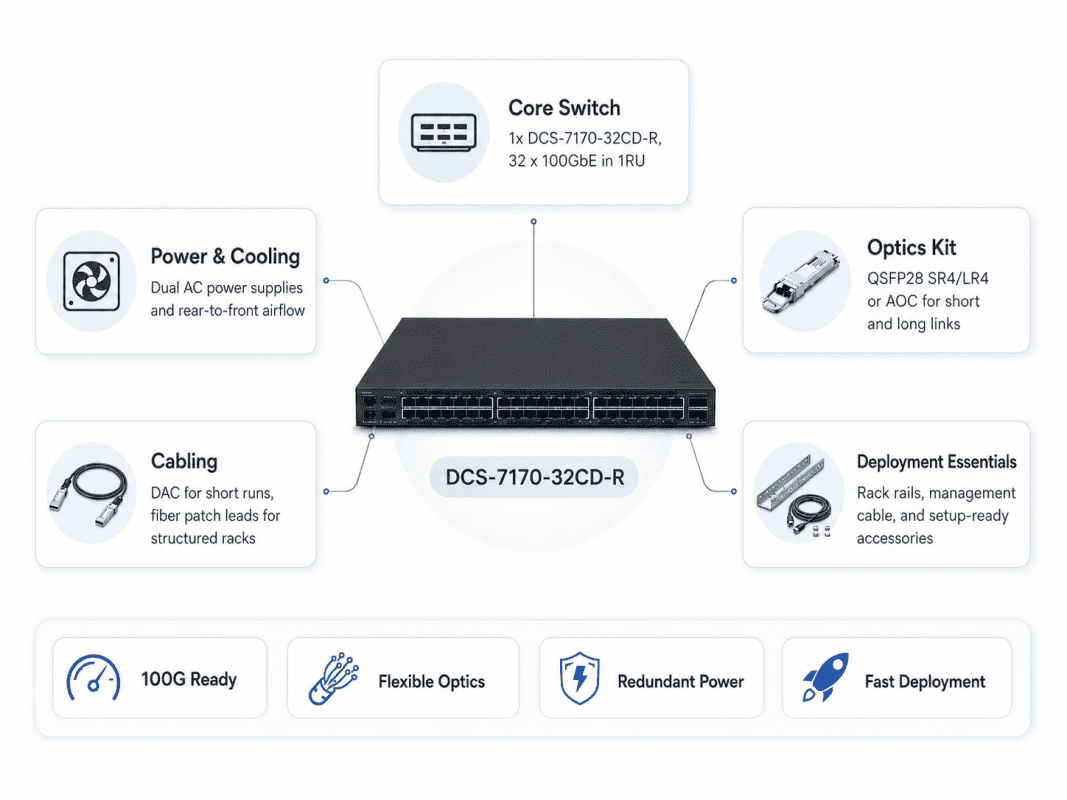
A switch-only quote often misses key deployment needs. For this platform, buyers should think in terms of a full 100G programmable switching bundle.
Advanced 100G Programmable Switching Bundle
- DCS-7170-32CD-R
- QSFP-100G-SR4 optics for short-reach multimode fiber
- QSFP-100G-LR4 optics for longer single-mode fiber links
- 100G DAC cables for short direct links
- 100G AOC cables for flexible active optical cabling
- MMF or SMF fiber cabling based on distance
- power supplies and airflow validation
- optional refurbished availability check
- compatibility review before shipment
This bundle fits buyers who need a ready-to-deploy solution, not just a single SKU. It also helps avoid late-stage delays caused by missing optics or mismatched cable types.
For AI and high-performance networks, teams should also review how switch selection affects the full cost of the fabric. Better planning around AI network costs can help buyers avoid paying for features they do not need while protecting performance where it matters.
Is the Arista DCS-7170-32CD-R the Right Switch?
The Arista DCS-7170-32CD-R is a strong fit for advanced buyers who need programmable 100G switching in a compact data center platform. It works best in environments that need custom packet behavior, specialized traffic handling, low-latency design, advanced cloud networking, or lab and service platform flexibility.
It is not the right choice for every network. If the goal is simple 25G access, standard 100G spine switching, or routing-heavy aggregation, another Arista family may be better. But when programmability is part of the design, the 7170-32CD-R deserves serious review.
The best buying decision comes from matching the switch to the workload, port plan, optics, cable distance, airflow, support needs, and budget. That approach helps teams avoid overbuying, reduce deployment risk, and build a 100G network that fits the real job.
Need Help Building an Advanced 100G Arista Bundle?
Catalyst Data Solutions helps enterprise buyers source data center switches, optics, cabling, and related hardware across new, refurbished, and hard-to-find inventory. For the DCS-7170-32CD-R, that means helping buyers confirm whether the platform fits the design, then matching it with the right 100G optics, DAC/AOC cables, fiber, airflow, and availability.
Catalyst can also help compare the 7170 against Arista 7050, 7060, and 7280 options when the buyer is still deciding between programmable switching, standard leaf-spine switching, or routing-heavy aggregation.
FAQs
What is the Arista DCS-7170-32CD-R used for?
The Arista DCS-7170-32CD-R is used for advanced 100G data center switching, programmable packet processing, cloud networking, low-latency use cases, and specialized network designs.
Is the DCS-7170-32CD-R a normal leaf switch?
Not exactly. It can sit in advanced data center designs, but it is not a basic access switch. Buyers usually choose it for programmable 100G switching rather than simple server access.
What optics should I use with the DCS-7170-32CD-R?
Use QSFP-100G-SR4 for short-reach multimode fiber and QSFP-100G-LR4 for longer single-mode links. For short nearby connections, 100G DAC or AOC cables may also fit.
How many 100G ports does the 7170-32CD have?
The Arista 7170-32CD provides 32 QSFP100 ports in a 1RU fixed configuration, with two additional SFP+ ports for 1/10GbE operation.
Who should avoid this switch?
Buyers should avoid it if they only need basic 25G server access, simple 100G uplinks, or a standard leaf-spine design. A 7050, 7060, or 7280 model may offer a better fit in those cases.
Is refurbished 7170 hardware a good option?
It can be, if the switch matches the technical need and the unit is properly tested. Buyers should check airflow, power, optics, software needs, warranty terms, and lifecycle status before purchase.