
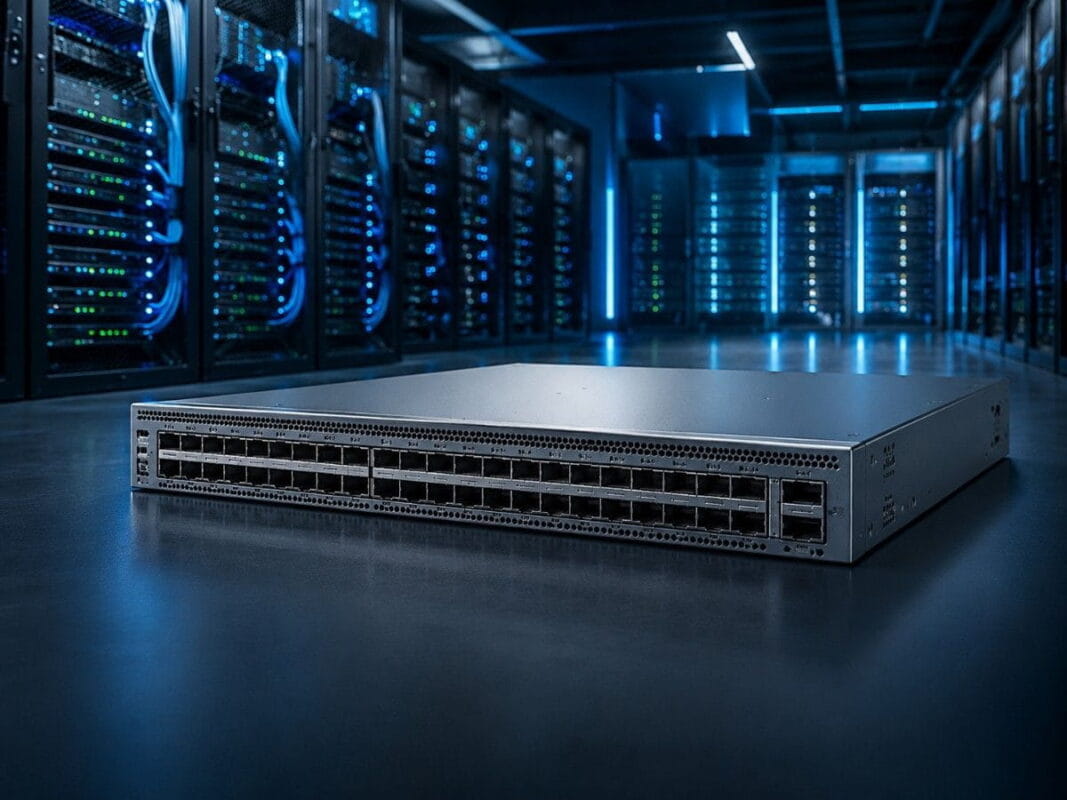
Data center networks are getting harder to plan. AI, cloud apps, and storage traffic need more speed, while buyers still have to manage cost, lead time, and hardware availability.
That is why more teams are looking beyond one default vendor. They need 25G access, 100G uplinks, reliable optics, and sourcing options that fit real project timelines.
This is where Arista’s Growth in Data Center Switching becomes important. Arista is now part of more conversations alongside Cisco Nexus and Juniper QFX because buyers want performance, flexibility, and smarter refresh options.
Why is Arista’s Growth in Data Center Switching getting more attention?
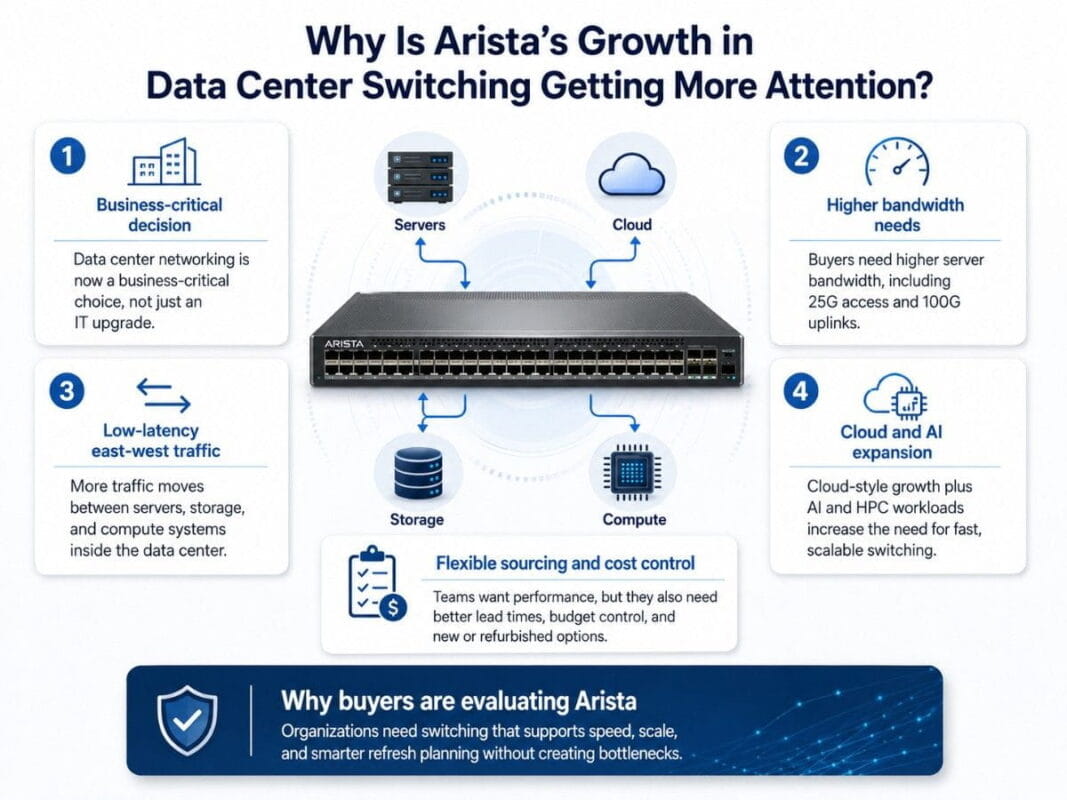
Arista’s Growth in Data Center Switching is getting more attention because the data center network has become a business-critical decision, not just an IT upgrade. As applications move faster, server traffic grows, and AI workloads expand, the switch fabric can either support growth or create bottlenecks.
Many buyers now need networks that support:
- higher server bandwidth
- 25G access and 100G uplinks
- low-latency east-west traffic
- AI and HPC expansion
- cloud-style automation
- flexible sourcing
- new and refurbished options
These needs have made Ethernet switching a cost, capacity, and planning issue for many organizations. Teams want faster networks, but they also want to avoid overbuying. That is why procurement and engineering teams often pair technical planning with network cost control before starting a refresh.
Cloud networks need scale
Cloud-style data centers need predictable scale. Applications move between servers, storage, and virtual systems all day. This traffic does not only move in and out of the data center; it also moves east and west across the network.
Leaf-spine architecture helps reduce bottlenecks by connecting server-facing leaf switches to spine switches across the fabric. Arista has gained attention here because many buyers connect the brand with high-performance Ethernet and modern fabric design. Platforms such as the 7050SX3 leaf switch fit this use case with dense 25G server access and 100G uplink planning.
AI workloads need more east-west traffic
AI and HPC clusters move large amounts of data between GPUs, servers, storage, and management systems. This creates more demand for fast, low-latency Ethernet and puts more pressure on optics, cabling, airflow, and port planning.
A network built for older virtualization workloads may not support AI training, inference, or data-heavy analytics well. Buyers now compare switch refresh plans against AI network design needs before choosing hardware. This is one reason Arista is now part of more AI infrastructure and GPU cluster discussions.
Procurement teams need more sourcing options
The market has also changed because buyers cannot always source hardware quickly or affordably. Long lead times, tight budgets, and shifting project dates make network upgrades harder to plan.
Some teams need new switches for core production builds. Others need tested refurbished Arista equipment for expansion, labs, secondary clusters, or urgent replacements. This mix creates demand for both new and secondary-market Arista hardware, while making compatibility checks for switches, optics, cables, airflow, power, and support even more important.
What market signals show Arista’s rise in data center switching?
Arista’s rise is visible in both company performance and market demand. Arista reported record 2024 revenue of $7.003 billion, up 19.5% from fiscal year 2023. The company also framed that year around AI, data center, campus, and routing growth.
Dell’Oro also reported that Ethernet data center switch sales reached record levels in 3Q 2024, helped by AI infrastructure buildouts. In 2Q 2025, Dell’Oro reported record front-end data center switch sales, with Arista sustaining leadership in both front-end networks and the overall data center switch market.
| Market signal | What it means for buyers | Why it matters |
| Arista record 2024 revenue | Strong business momentum | Buyers see Arista as a serious data center vendor |
| Record 3Q 2024 Ethernet switch sales | AI drove more network spending | Network fabrics are now part of AI planning |
| Record 2Q 2025 front-end switch sales | General server networks still matter | AI does not remove front-end network demand |
| Growth in 100G and faster speeds | Higher bandwidth is now common | Buyers must plan optics, cables, and port density |
| More interest in secondary-market gear | Cost and lead time pressure remain | Refurbished Arista can support budget control |
These data points do not mean every buyer should choose Arista. They mean Arista now belongs in more evaluations, especially when the project involves cloud-style design, 25G/100G Ethernet, AI capacity, or data center refresh planning.
Why do 25G and 100G fabrics matter for Arista buyers?
25G and 100G fabrics matter because many data centers need a practical bridge between older 10G networks and newer high-speed AI or cloud environments. A 25G server connection gives more bandwidth than 10G without forcing every buyer into the highest-cost architecture. A 100G uplink or spine layer gives the fabric room to move more traffic between racks.
This is where Arista’s 7050 and 7060 families often enter the discussion.
The Arista 7050 Series can support dense data center switching needs, including 25G leaf and 100G-focused roles depending on the model. The Arista 7060 Series also fits cloud and high-performance environments, with models that support 25G access and 100G uplink designs. A platform such as the 7060SX2 access switch can help buyers plan server access while keeping a path toward 100G fabric connectivity.
| Fabric layer | Common speed need | Arista product fit | Buyer question |
| Server access | 25G | Arista 7050 Series, Arista 7060 Series | How many 25G server links are needed? |
| Leaf uplinks | 100G | Arista 7050 / 7060 models | How much uplink capacity will each rack need? |
| Spine / interconnect | 100G and above | Arista 7050CX / 7060CX style roles | Will the spine handle future east-west traffic? |
| Routing / aggregation | 100G-heavy | Arista 7280 Series | Does the design need deeper routing features? |
| Specialized switching | 100G | Arista 7170 Series | Does the environment need programmable switching? |
The important point is not just switch speed. Buyers also need to plan optics, fiber type, cable distance, airflow, and rack layout. A switch can look like the right fit on paper but fail the project if the optics or airflow direction do not match the environment.
How do Arista 7050, 7060, 7280, and 7170 Series fit different use cases?
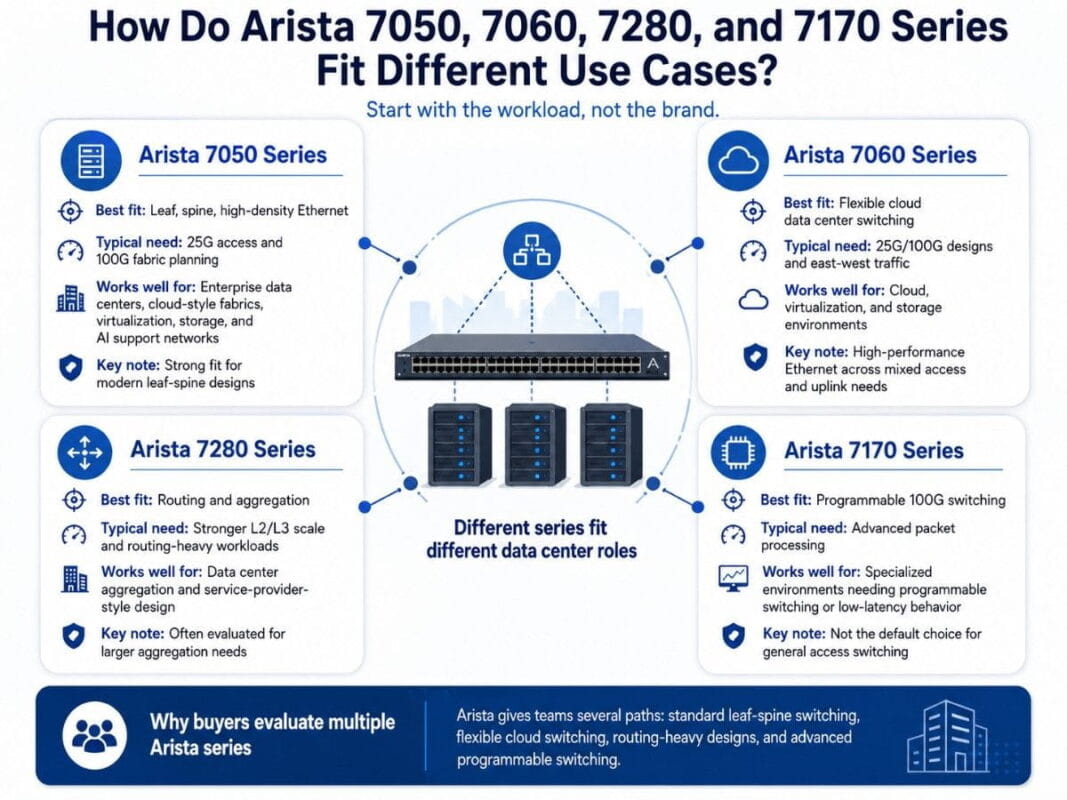
Arista’s growth has also gained attention because buyers can evaluate different product families for different data center roles. Not every Arista switch serves the same purpose. A better evaluation starts with the workload, not the brand.
The Arista 7050 Series often fits high-density leaf-spine designs, including 25G server access and 100G uplink planning. It can make sense for enterprise data centers, cloud-style fabrics, virtualization, storage, and AI support networks.
The Arista 7060 Series fits flexible data center designs where buyers need high-performance Ethernet across mixed access and uplink needs. It is common to evaluate 7060 models when planning 25G access, 100G uplinks, and cloud-style east-west traffic.
The Arista 7280 Series fits routing-heavy and aggregation-focused designs. For example, the 7280SR aggregation switch belongs in conversations where buyers need stronger L2/L3 scale, data center aggregation, or service-provider-style design.
The Arista 7170 Series serves a more specialized role. It fits advanced environments that need programmable switching, low-latency behavior, or custom packet processing. A buyer evaluating a 7170 programmable switch should have a clear technical reason, because it is not the default choice for general access switching.
| Product family | Best-fit role | Typical buyer need | Notes |
| Arista 7050 Series | Leaf, spine, high-density Ethernet | 25G access and 100G fabric planning | Strong fit for modern leaf-spine designs |
| Arista 7060 Series | Flexible cloud data center switching | 25G/100G designs and east-west traffic | Useful for cloud, virtualization, and storage |
| Arista 7280 Series | Routing and aggregation | L2/L3 scale and routing-heavy workloads | Often compared against larger aggregation needs |
| Arista 7170 Series | Programmable 100G switching | Advanced packet processing | Best for specialized teams and niche use cases |
This product spread helps explain why more buyers are evaluating Arista Networks. It gives teams several paths, from standard leaf-spine switching to routing-heavy and advanced programmable designs.
Why are optics and transceivers central to Arista data center planning?
Optics and transceivers are central because the switch does not operate alone. The right switch still needs the right connectivity. A poor optics plan can create delays, compatibility issues, and extra cost.
For 25G server access, the SFP-25G-SR optic supports short-reach multimode fiber links. It often fits rack-level or row-level server connectivity where 25G makes sense.
For 100G connectivity, buyers often compare SR4 and LR4 options. The QSFP-100G-SR4 optic supports short-reach multimode fiber use cases inside the data center. The QSFP-100G-LR4 module supports longer-reach single-mode fiber use cases.
Buyers should check these items before quoting:
- port type and supported speed
- MMF vs SMF fiber
- cable distance
- DAC, AOC, or optical transceiver fit
- switch compatibility
- airflow direction
- spare optics needs
- future port growth
This is where procurement and engineering teams need to work together. A bill of materials should match the rack plan, not just the switch model.
Why are buyers evaluating Arista alongside Cisco Nexus and Juniper QFX?
Many buyers evaluate Arista alongside Cisco Nexus and Juniper QFX because each platform has strengths. A neutral comparison helps teams avoid brand-first decisions and focus on workload, operations, budget, and lifecycle.
Cisco Nexus remains strong in many enterprise data centers. It often fits organizations that already rely on Cisco architecture, ACI, Cisco support models, and a broad Cisco operating environment. A buyer may compare an Arista leaf switch against a Cisco Nexus platform when planning 25G server access and 100G uplinks.
Juniper QFX also remains relevant, especially for teams with Juniper skills, EVPN/VXLAN designs, routing depth, or service-provider-style requirements. A Juniper QFX switch may make sense where the network team already runs Juniper or wants that operating model.
| Platform | Where it often fits well | Buyer consideration |
| Arista | Cloud-style data centers, leaf-spine fabrics, high-performance Ethernet | Strong fit for 25G/100G and operations-focused teams |
| Cisco Nexus 9000 | Cisco-heavy enterprises, ACI environments, broad Cisco ecosystems | Strong fit where Cisco standards already drive architecture |
| Juniper QFX | EVPN/VXLAN designs, routing-focused teams, service-provider influence | Strong fit where Juniper operations and routing depth matter |
| Mixed evaluation | Refresh projects, supply constraints, cost optimization | Compare availability, lead time, optics, support, and lifecycle |
The best choice depends on the environment. Arista may fit a cloud-style data center very well, but Cisco or Juniper may fit better in another network. A vendor-agnostic process gives buyers a stronger result.
Why is refurbished Arista hardware gaining interest?
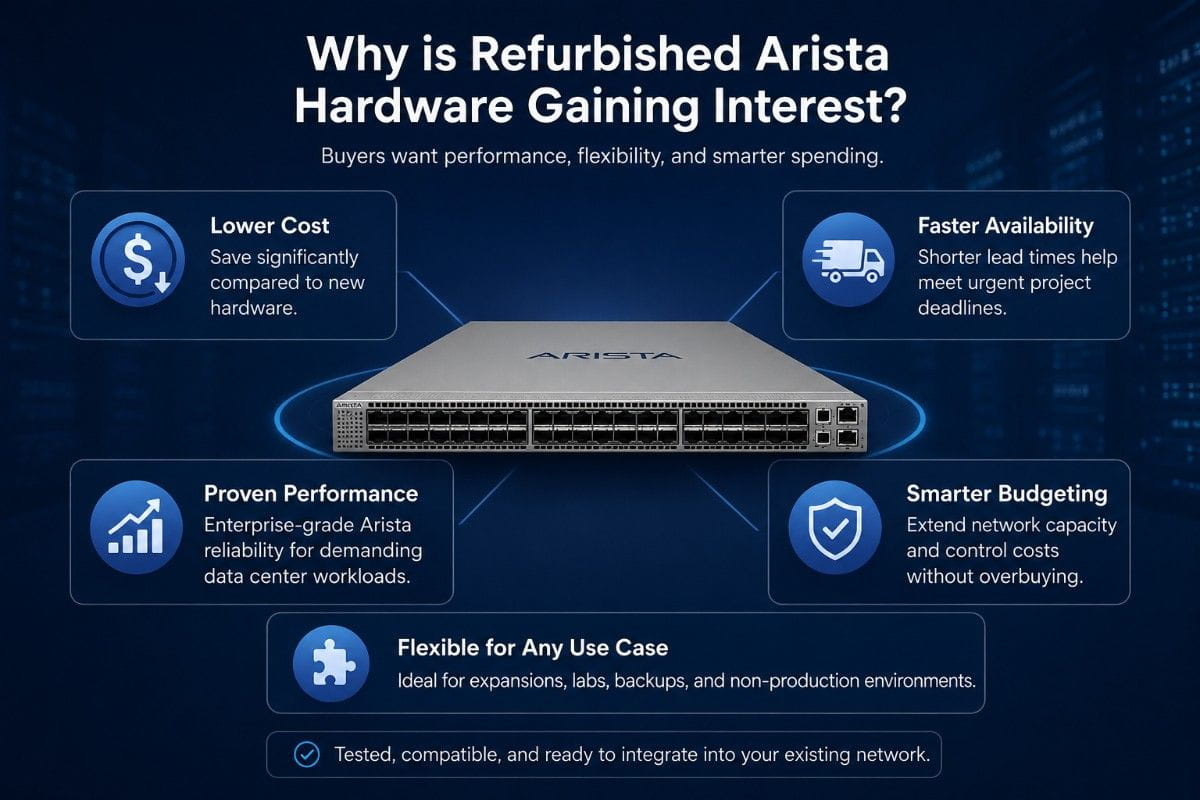
Refurbished Arista hardware is gaining interest because many teams need to upgrade without waiting on long lead times or paying new-hardware pricing for every part of the network. This is especially true in refresh projects, lab builds, secondary AI clusters, DR sites, and expansion phases.
Refurbished equipment can also support a broader sustainability goal. When buyers extend the life of tested equipment, they reduce waste and avoid unnecessary replacement. This connects network refresh planning with a more practical circular IT strategy.
Still, buyers should not treat refurbished hardware as a shortcut. They should check testing standards, condition, airflow, optics compatibility, power supplies, fans, warranty terms, and support expectations. A strong refurbished buying process reduces risk.
| Buying option | Best use case | Main advantage | Key risk to check |
| New Arista hardware | New production builds and long lifecycle plans | Latest availability, lifecycle, and support alignment | Higher cost or lead time |
| Refurbished Arista hardware | Refresh, expansion, lab, and cost-controlled projects | Lower cost and faster sourcing in some cases | Condition, testing, warranty, and compatibility |
| Mixed new/refurbished bundle | Phased upgrades and budget-sensitive builds | Balances cost, timing, and lifecycle | Requires careful BOM planning |
| Trade-in / buyback | Decommissioned Cisco, Arista, or other gear | Offsets refresh cost | Asset value depends on condition and demand |
A strong buying guide should compare more than price. It should explain what the buyer gains, what they must verify, and when refurbished makes more sense than new. This is why many teams start with a refurbished network guide before finalizing a refresh plan.
How does AI demand create new and secondary-market Arista demand?
AI demand creates two types of Arista demand at the same time.
First, large AI and cloud builds drive demand for new high-performance Ethernet infrastructure. These projects often need current platforms, lifecycle alignment, vendor support, and high-speed optics. They may also require tight coordination between compute, storage, and network teams.
Second, AI growth creates secondary pressure across the rest of the data center. When a company invests in GPU servers and AI infrastructure, it may also need to upgrade support networks, storage networks, test environments, staging clusters, and older data center fabrics. Not every one of those areas needs brand-new hardware.
That mix increases demand for new and refurbished Arista inventory. It also increases demand for optics, DACs, AOCs, fiber, and spare parts. Buyers planning AI cost reduction should evaluate the full network bill of materials, not only the switch line item.
For example, a project may use new hardware for a primary AI fabric but refurbished Arista switches for a lab, backup environment, or expansion rack. Another buyer may use refurbished switching for a data center refresh while reserving budget for GPUs, storage, or security upgrades.
This is why Arista’s market growth matters beyond the new-equipment market. Growth in one area often increases demand across the full lifecycle of hardware.
What should buyers check before choosing Arista for a data center refresh?
Buyers should start with the workload. A switch decision should follow the application, traffic pattern, port count, and lifecycle need.
Before choosing Arista, Cisco Nexus, Juniper QFX, or a mixed approach, buyers should check:
- current and future server speed
- 10G, 25G, 40G, or 100G migration needs
- leaf-spine design goals
- rack count and cable distance
- MMF and SMF fiber requirements
- DAC or AOC fit
- airflow direction
- power and cooling limits
- EOS/software planning
- support expectations
- new vs refurbished budget
- lead time and availability
- trade-in or buyback value
This process helps buyers avoid two common mistakes. The first mistake is underbuying and creating a fabric that cannot support growth. The second mistake is overbuying and locking budget into capacity the business does not need yet.
A good refresh plan should also include asset recovery. Retired Cisco, Juniper, Arista, and other network equipment may still hold resale or trade-in value. That value can help offset upgrade costs.
Need a Practical Way to Evaluate Arista Availability and Fit?
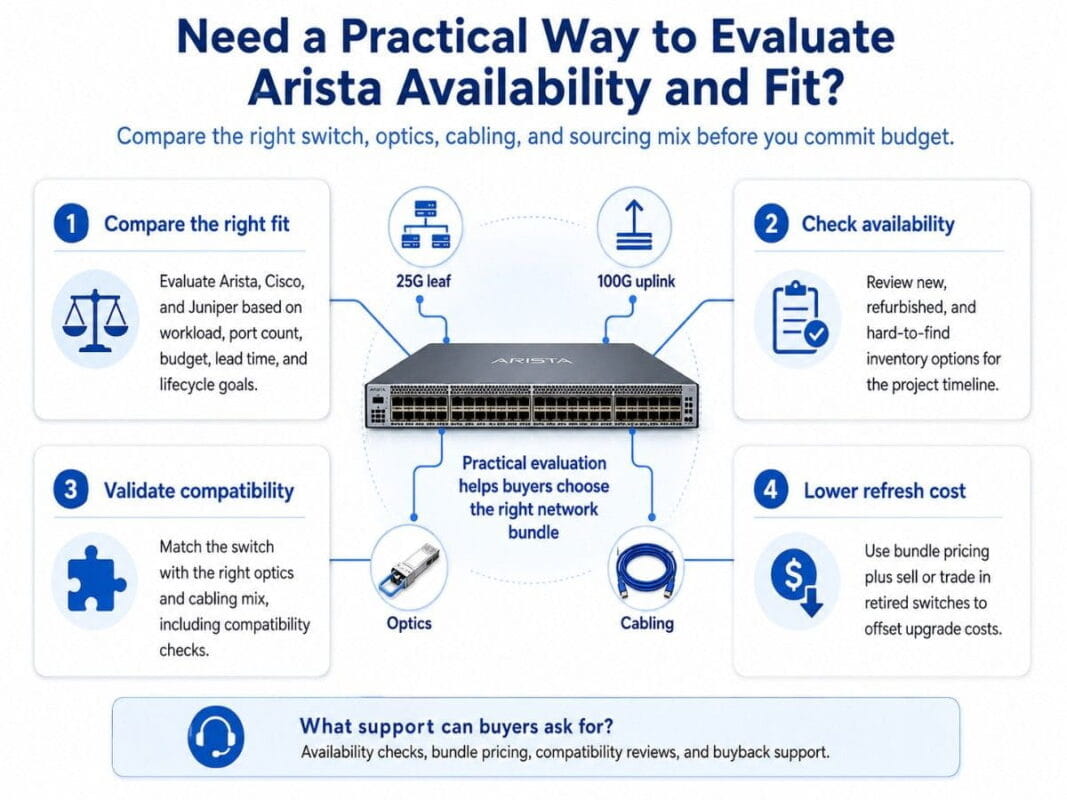
Catalyst Data Solutions helps buyers compare Arista, Cisco, Juniper, and related data center networking options based on workload, port count, budget, lead time, and lifecycle goals. The goal is not to force one vendor. The goal is to help buyers source the right switch, optics, and cabling mix for the environment.
Ask Catalyst for refurbished Arista availability, bundle pricing, compatibility checks, and options to sell or trade in decommissioned switches. Catalyst can also help structure new, refurbished, and hard-to-find inventory into practical data center bundles.
A typical Arista growth-aligned bundle may include:
- 25G leaf switching with Arista 7050 or 7060 models
- 100G spine or uplink switching
- Arista SFP-25G-SR server optics
- Arista QSFP-100G-SR4 or LR4 uplink optics
- DAC, AOC, MMF, or SMF cabling
- refurbished availability checks
- Cisco or Juniper comparison options
- buyback support for retired hardware
This type of planning helps buyers make better decisions before they commit a budget.
Final Takeaway: Arista’s growth is a signal for smarter network planning
Arista’s Growth in Data Center Switching shows how much the market has changed. Buyers now need networks that can support cloud platforms, AI workloads, virtualization, storage, and high-speed data movement. They also need practical sourcing options when budgets, lead times, and lifecycle goals do not align perfectly.
Arista has gained visibility because it fits many of these needs. Cisco Nexus and Juniper QFX still remain strong choices in the right environments. The best decision depends on workload, operations, support model, availability, and total cost.
For buyers, the outcome should be simple: choose the switch platform, optics, cabling, and sourcing model that supports the network today and gives the business room to grow tomorrow.
FAQs
Why is Arista growing in data center switching?
Arista is growing because more buyers need high-performance Ethernet for cloud, AI, and large data center environments. Its visibility has increased in leaf-spine networking, 25G/100G fabrics, and software-driven operations.
Is Arista better than Cisco Nexus?
Arista is not automatically better than Cisco Nexus. Arista often fits cloud-style data centers and high-performance Ethernet fabrics. Cisco Nexus may fit better in Cisco-heavy enterprises, ACI environments, and broader Cisco ecosystems.
Where does Juniper QFX fit in the comparison?
Juniper QFX remains a strong option for buyers with Juniper skills, EVPN/VXLAN needs, routing-focused teams, or service-provider-style network designs. Buyers should compare Juniper, Cisco, and Arista based on architecture and operations.
Why do 25G and 100G matter in modern data centers?
25G supports higher-speed server access, while 100G supports uplinks, spine connections, and high-capacity interconnects. Together, they help data centers handle more east-west traffic, AI workloads, and cloud-style application growth.
Should buyers consider refurbished Arista switches?
Yes, when the use case fits. Refurbished Arista switches can support refresh projects, lab builds, expansion, backup environments, and cost-controlled deployments. Buyers should verify testing, warranty, airflow, optics, and compatibility before purchase.
Which Arista series should buyers evaluate first?
Buyers should start with the workload. The Arista 7050 and 7060 Series often fit 25G/100G leaf-spine designs. The 7280 Series fits routing and aggregation. The 7170 Series fits specialized programmable switching needs.