
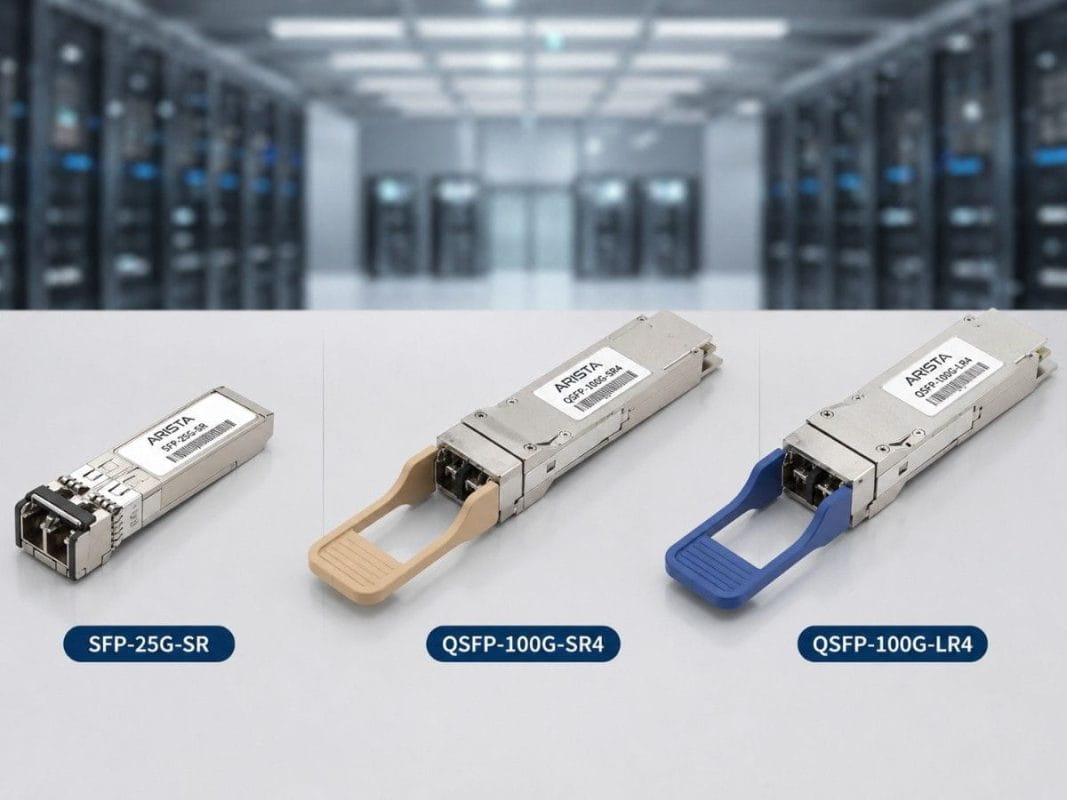
Modern data centers are handling more traffic than ever, especially as cloud platforms, storage systems, and AI workloads grow. But a faster switch alone does not guarantee a stronger network. Buyers also need the right optics, cables, fiber type, airflow plan, and compatibility checks before deployment.
This Arista Transceiver Guide helps you match 25G and 100G Arista connectivity with the right data center use case. It explains where SFP-25G-SR, QSFP-100G-SR4, QSFP-100G-LR4, DACs, AOCs, breakout cables, and MMF / SMF fiber fit, so you can plan a cleaner Arista build with fewer sourcing and deployment risks.
What Is the Quick Answer for Arista Transceiver Selection?
For most 25G / 100G Arista data center builds, use SFP-25G-SR for short-reach 25G server links over multimode fiber, QSFP-100G-SR4 for short-reach 100G links over multimode fiber, and QSFP-100G-LR4 for longer 100G links over single-mode fiber. Use DAC cables for short in-rack or near-rack copper links. Use AOC cables when you need optical reach with simpler cable handling.
The best choice depends on five questions:
- What switch ports do you have: SFP28 or QSFP28?
- What speed do you need: 25G, 100G, or 100G breakout?
- What distance must the link cover?
- Does the rack design require MMF, SMF, DAC, or AOC?
- Do you need a standard leaf-spine network or a more specialized programmable switching design?
When buyers want to reduce cost without giving up performance, they should also consider refurbished switches and tested optics.
Catalyst Data Solutions often helps buyers compare new, refurbished, and hard-to-find inventory when projects face budget or supply pressure. That approach also supports smarter lifecycle planning, which connects well with broader network cost control goals.
Which Arista Transceivers and Cables Fit 25G and 100G Networks?
Arista environments usually need a mix of optics and cables. A 25G leaf switch may connect down to servers with SFP28 optics or DACs, then uplink to a 100G spine with QSFP28 optics, DACs, or AOCs. A high-density 100G switch may use QSFP28 ports for spine, storage, cluster interconnect, or specialized packet processing roles.
| Connectivity option | Common speed | Best fit | Typical media | Buyer note |
| SFP-25G-SR | 25G | Server access | MMF | Good for short-reach 25G fiber links |
| QSFP-100G-SR4 | 100G | Short 100G uplinks | MMF | Common for short data center links |
| QSFP-100G-LR4 | 100G | Longer 100G uplinks | SMF | Better when distance is beyond SR4 design |
| 25G DAC | 25G | In-rack server links | Copper | Cost-effective for short links |
| 100G DAC | 100G | Short rack links | Copper | Useful for spine or near-rack connections |
| 100G AOC | 100G | Flexible optical cabling | Active optical | Helpful when DAC is too bulky or short |
| Breakout cables | 100G to 4x25G | Port fanout | DAC or fiber | Must verify switch and port support |
| MMF / SMF fiber | 25G / 100G | Structured cabling | Fiber | Match fiber type to optic type |
The 100G SR4 optic fits short-reach 100G multimode fiber designs. The 100G LR4 optic fits longer 100G single-mode runs. Buyers should not treat SR4 and LR4 as interchangeable. They solve different distance and cabling needs.
How Do Arista SFP-25G-SR, QSFP-100G-SR4, and QSFP-100G-LR4 Differ?
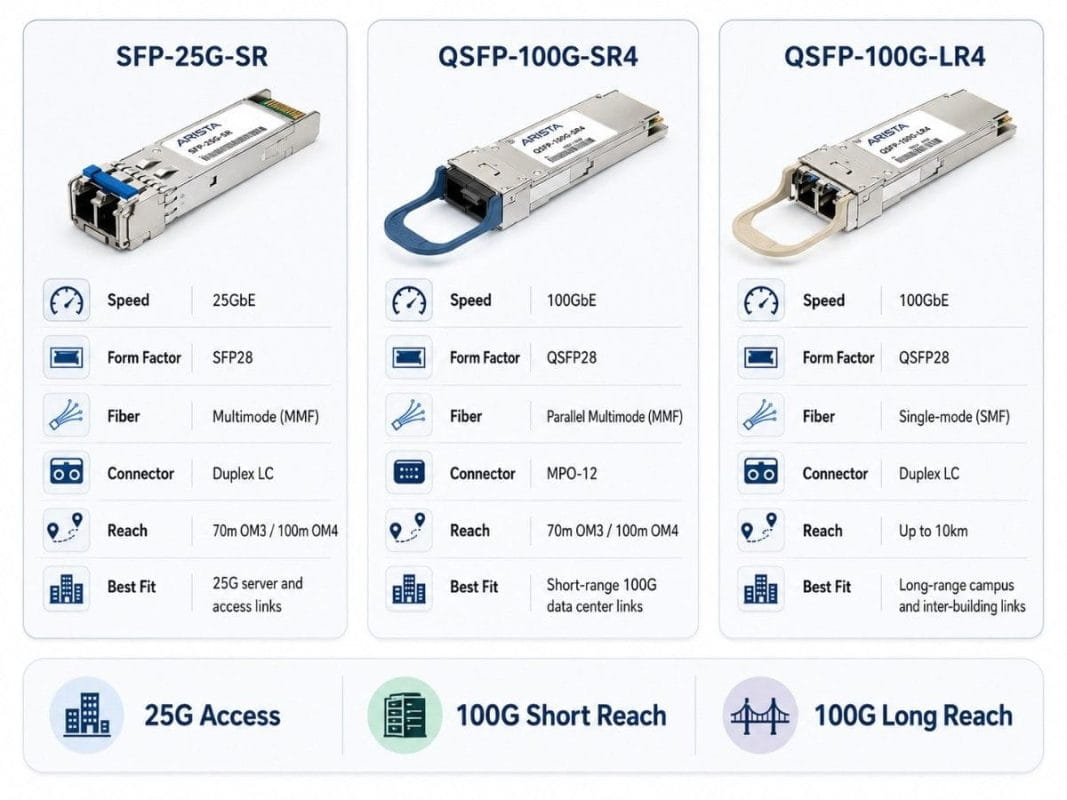
The main difference is speed, port type, reach, and fiber type. SFP-25G-SR supports 25G server access. QSFP-100G-SR4 supports 100G short-reach links. QSFP-100G-LR4 supports 100G longer-reach links.
| Product | Port form factor | Speed | Fiber type | Best use case |
| Arista SFP-25G-SR | SFP28 | 25G | MMF | Server-to-leaf access links |
| Arista QSFP-100G-SR4 | QSFP28 | 100G | MMF | Short 100G leaf-spine or switch-to-switch links |
| Arista QSFP-100G-LR4 | QSFP28 | 100G | SMF | Longer 100G links across rows, rooms, or facilities |
| 25G DAC | SFP28 | 25G | Copper | Short server connections in or near the rack |
| 100G DAC | QSFP28 | 100G | Copper | Short 100G interconnects |
| 100G AOC | QSFP28 | 100G | Optical | Flexible 100G links when DAC is not ideal |
The optic decision should follow the cabling plan, not the other way around. For example, a buyer planning short server access over existing multimode fiber may choose SFP-25G-SR. A buyer linking spine switches across a larger data hall may need LR4 over single-mode fiber.
In refresh projects, this step can prevent waste. Reusing the wrong fiber plant can create delays, while replacing usable cabling can increase cost. Many teams combine new optics with refurbished switches, especially when the project needs proven hardware at a lower cost. A practical refurbished networking guide can help teams define what to inspect before purchase.
Which Arista Switches Should Buyers Match With These Optics?
The right optic depends on the switch role. A leaf switch usually needs many 25G access links and a smaller number of 100G uplinks. A spine switch usually needs dense 100G ports. A routing or programmable switch may need more careful port planning because the use case can be more specialized.
| Arista switch | Common role | Connectivity focus | Good match |
| DCS-7050SX3-48YC8 | 25G leaf | 25G server access + 100G uplinks | SFP-25G-SR, 25G DAC, QSFP-100G-SR4 / LR4 |
| DCS-7050CX3-32S-F | 100G spine or interconnect | Dense 100G QSFP | QSFP-100G-SR4 / LR4, 100G DAC, 100G AOC |
| DCS-7060SX2-48YC6-F / R | Flexible 25G leaf | 25G access + 100G uplinks | SFP-25G-SR, 25G DAC, QSFP-100G-SR4 |
| DCS-7060CX-32S-F | 100G-heavy switch | Spine, fabric, interconnect | QSFP-100G-SR4 / LR4, 100G DAC / AOC |
| DCS-7280SR-48C6-F | Switch router / aggregation | Routing and aggregation | QSFP-100G-SR4 / LR4, fiber, 100G DAC / AOC |
| DCS-7170-32CD-R | Programmable 100G switching | Specialized packet processing | QSFP-100G-SR4 / LR4, 100G DAC / AOC |
The 7050SX3 leaf switch makes sense when the network needs dense 25G server access with 100G uplinks. The 7050CX3 spine switch fits buyers who need a high-density 100G layer.
For flexible 25G access, buyers may compare the 7060SX2 front-airflow model with the 7060SX2 rear-airflow model. Airflow matters during procurement because a wrong airflow direction can block deployment even when the port count looks correct.
How Do Optics Support Leaf-Spine Data Center Design?
Leaf-spine design reduces bottlenecks by giving every leaf switch predictable paths to the spine layer. In many builds, leaf switches connect to servers at 25G, then uplink to spine switches at 100G. This design supports virtualization, storage traffic, cloud platforms, and AI workloads that move large volumes of east-west traffic.
A common layout looks like this:
- Servers connect to a DCS-7050SX3-48YC8 or DCS-7060SX2-48YC6 with SFP-25G-SR or 25G DAC.
- Leaf switches uplink to a DCS-7050CX3-32S-F or DCS-7060CX-32S-F with QSFP-100G-SR4, QSFP-100G-LR4, 100G DAC, or 100G AOC.
- Longer rows, rooms, or campus-style links use LR4 and SMF where short-reach SR4 does not fit.
- Breakout cables may help when a 100G port needs to fan out to multiple 25G links, but compatibility must be checked first.
This structure gives buyers a clean way to plan bundles. Instead of quoting switches first and optics later, teams can define the full path: server NIC speed, switch role, port type, fiber type, cable distance, airflow, and spare requirements.
What Should Buyers Know About 25G DAC, 100G DAC, 100G AOC, and Breakout Cables?
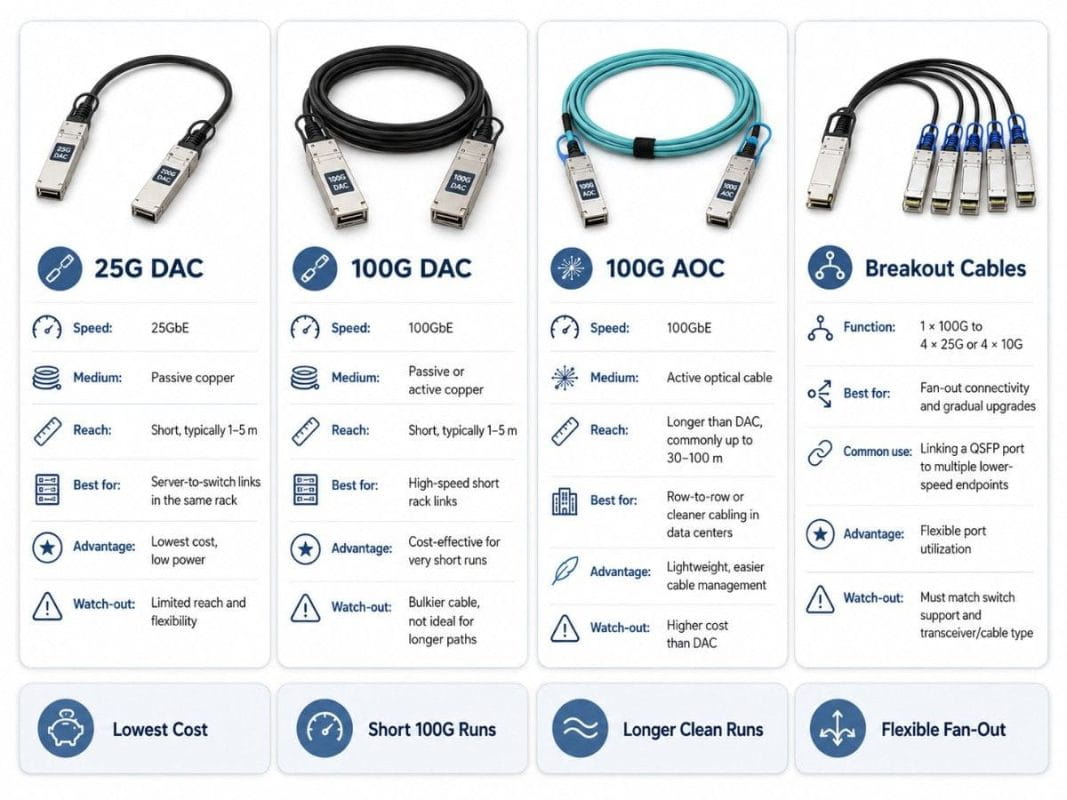
DAC and AOC cables often help buyers reduce cost or simplify deployment, but each has limits. DAC uses copper and works best for short links. AOC uses active optical cabling and can support longer or more flexible cable paths. Breakout cables can split a 100G port into lower-speed links when the switch and configuration support it.
| Cable type | Strength | Limitation | Best buyer use |
| 25G DAC | Low cost for short links | Short reach | Server-to-leaf inside the rack |
| 100G DAC | Simple short 100G link | Bulk and reach limits | Near-rack spine or switch interconnects |
| 100G AOC | More flexible than DAC | Higher cost than DAC | 100G links where copper is not practical |
| Breakout cable | Better port use | Compatibility sensitive | 100G to 4x25G fanout designs |
| MMF fiber | Common in data centers | Reach depends on optic and fiber grade | SR and SR4 designs |
| SMF fiber | Better for longer reach | Often higher optics cost | LR4 designs |
Buyers should avoid ordering cables based only on speed. The physical rack path matters. Cable bend radius, airflow, tray capacity, distance, and service access can change the better choice.
This matters even more in AI and HPC environments. GPU clusters need high-throughput networks, but they also create dense racks and complex cabling. Teams planning AI builds should account for power, cooling, east-west traffic, and optics together, not as separate projects. Catalyst covers these concerns in its work around AI network challenges.
Why Does Programmable Switching Matter in an Arista Transceiver Guide?
Most transceiver guides focus only on speed and distance. That is not enough when buyers evaluate the Arista DCS-7170-32CD-R. The 7170 belongs in more advanced designs where switching behavior, packet handling, and network visibility may matter as much as raw port count.
Programmable switching allows teams to adapt parts of the packet processing pipeline for specialized use cases. In simple terms, it can support networks that need more control over how traffic gets parsed, matched, modified, scheduled, or monitored.
This does not mean every buyer needs programmable switching. Many enterprise and cloud-style networks can use 7050, 7060, or 7280 platforms without needing the 7170. The 7170 makes more sense when a team has a clear reason to use programmable 100G switching.
Programmable switching concept
Programmable switching gives advanced teams more flexibility than standard fixed-function switching. It can support custom traffic handling, special telemetry needs, and more detailed control over packet behavior.
In a normal leaf-spine deployment, the main question is often port count and bandwidth. In a programmable environment, the question becomes: what does the network need to do with the traffic?
That changes the optic plan. The 7170 programmable switch uses 100G connectivity, so QSFP-100G-SR4, QSFP-100G-LR4, 100G DAC, and 100G AOC choices should match the test, production, or specialized traffic path.
What Are the Best 100G Data Center Use Cases for These Products?
100G is no longer only for the largest cloud providers. Many enterprise buyers now use 100G for spine layers, storage fabrics, virtualization clusters, AI infrastructure, and aggregation.
The 7060CX 100G switch fits environments that need 100G-heavy switching. The 7280SR aggregation switch fits routing-heavy and aggregation needs. The 7170 fits more specialized 100G use cases where packet behavior and programmability matter.
Strong 100G use cases include:
- Spine switching in leaf-spine fabrics
- Storage and backup networks with high east-west traffic
- AI and HPC clusters with GPU-to-GPU communication needs
- High-density virtualization platforms
- Routing and aggregation between data center layers
- Lab, test, monitoring, and specialized packet processing environments
For AI buyers, 100G planning should also connect to compute growth. A GPU refresh can create new pressure on the network layer. Catalyst’s guidance on AI cost optimization helps teams think about where to invest and where refurbished or secondary-market hardware may fit.
Advanced cloud networking
Advanced cloud networking needs predictable performance, clean operations, and scalable design. Arista switches often appear in these discussions because buyers want high-performance Ethernet fabrics with consistent operations across the data center.
In this model, optics and cables should support the fabric plan. A 25G leaf layer with 100G uplinks gives many buyers a practical growth path. A dense 100G spine layer can support more traffic without a full redesign.
Buyers should also think about the lifecycle. A refresh project may combine new optics, refurbished switches, and buyback of retired assets. This supports cost control and can reduce waste. It also fits broader circular IT goals, including the principles behind circular economy IT.
How Does the Arista 7170 Differ From 7050, 7060, and 7280 Switches?
The 7170 is not a generic access switch. It is a specialized 100G platform for buyers who need programmable switching or advanced packet processing. The 7050 and 7060 families more often fit leaf, spine, and cloud-style data center switching. The 7280 series fits routing-heavy and aggregation roles.
| Platform | Main strength | Typical buyer | Key difference |
| Arista 7050SX3 / 7050CX3 | Efficient 25G / 100G data center switching | Leaf-spine buyers | Practical fabric building block |
| Arista 7060SX2 / 7060CX | Flexible 25G / 100G cloud networking | Cloud, storage, virtualization teams | Strong fit for east-west traffic designs |
| Arista 7280SR | Switch routing and aggregation | Large enterprise or service provider-style buyers | More routing and aggregation focus |
| Arista 7170 | Programmable 100G switching | Advanced networking teams | Specialized packet processing and programmability |
The main buying mistake is treating all 100G switches the same. A 100G port count does not tell the full story. Buyers should compare role, airflow, software needs, programmability, optics, cabling, and lifecycle plan.
Low-latency and specialized packet processing use cases
Low-latency and specialized packet processing use cases need closer review before quoting. These environments may include financial systems, advanced monitoring, research networks, custom cloud platforms, or lab environments where traffic handling needs more control.
The 7170 may fit when the buyer has a defined need for programmable packet handling. It may not fit when the buyer only needs standard 25G access, 100G spine, or basic aggregation. In those cases, 7050, 7060, or 7280 options may create a cleaner and more cost-effective design.
Who Should Buy the Arista 7170 Bundle, and Who Should Avoid It?
The Advanced 100G Programmable Switching Bundle should fit buyers who know why they need programmable switching. It should not become a default bundle for every 100G requirement.
Advanced 100G Programmable Switching Bundle:
- DCS-7170-32CD-R
- QSFP-100G-SR4 or QSFP-100G-LR4 optics
- 100G DAC or 100G AOC
- MMF or SMF fiber cabling based on reach
- Optional spare optics and cables for failover or lab validation
Good fit for buyers who need:
- Programmable 100G switching
- Specialized packet processing
- Advanced traffic monitoring
- Low-latency or custom network behavior
- Lab, research, or niche cloud infrastructure
- A controlled 100G test or production fabric
Poor fit for buyers who only need:
- Basic 25G server access
- Standard leaf-spine switching
- Simple 100G uplinks
- Lowest-cost 100G port density
- A general enterprise access switch
- A routing-heavy aggregation switch
For standard 25G leaf and 100G spine designs, a 7050SX3 or 7060SX2 leaf with a 7050CX3 or 7060CX spine may offer a better fit. For routing-heavy aggregation, the 7280SR may make more sense.
How Should Buyers Verify Arista Optics Compatibility Before Ordering?
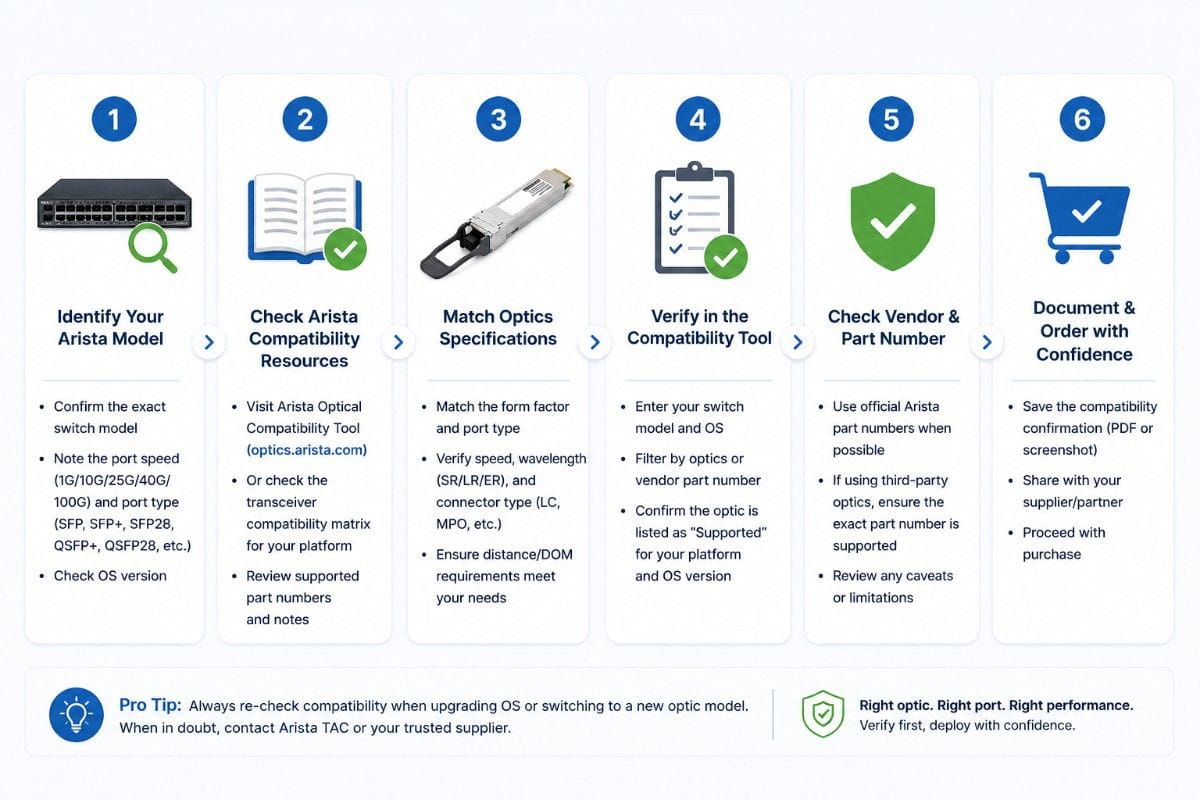
Compatibility checks protect the project. Buyers should verify the switch model, port form factor, supported speeds, media type, software requirements, airflow, and cable distance before purchase.
A simple pre-order checklist should include:
- Confirm switch model and exact suffix, including airflow direction.
- Confirm port type: SFP28 or QSFP28.
- Match optic type to fiber type: MMF for SR/SR4, SMF for LR4.
- Confirm DAC or AOC length and routing path.
- Check breakout support before ordering fanout cables.
- Confirm new vs refurbished requirements.
- Plan spare optics and cables for critical links.
- Validate warranty, testing, and return expectations.
This is where sourcing experience matters. Buyers often know the target speed but still need help with the full bill of materials. Catalyst Data Solutions can help align switches, optics, DACs, AOCs, fiber, airflow, and availability before the order becomes a deployment problem.
Better Arista Transceiver Decisions Start With the Full Design
A strong Arista transceiver plan starts with the workload, not the part number. Buyers need to know the switch role, link speed, distance, fiber type, airflow, cable path, and lifecycle plan before choosing optics or cables.
For 25G access, SFP-25G-SR and 25G DAC cover many server connections. For 100G designs, QSFP-100G-SR4, QSFP-100G-LR4, 100G DAC, and 100G AOC each solve a different problem. For advanced programmable switching, the DCS-7170-32CD-R needs a more careful fit check than a standard leaf or spine switch.
Catalyst Data Solutions helps buyers make these choices with practical sourcing support, compatibility review, and bundle planning. The outcome is a cleaner quote, fewer deployment surprises, and a better path to scaling 25G and 100G Arista networks.
Need Help Building the Right Arista Optics Bundle?
Catalyst Data Solutions helps buyers turn an Arista transceiver plan into a complete, deployment-ready bundle. Instead of sourcing switches, optics, DACs, AOCs, breakout cables, and fiber from separate suppliers, Catalyst can help align the full bill of materials around port count, cable distance, airflow direction, workload, budget, and availability.
For standard 25G / 100G fabrics or advanced programmable switching environments, Catalyst can help match Arista switches with SFP-25G-SR, QSFP-100G-SR4, QSFP-100G-LR4, 25G DACs, 100G DACs, 100G AOCs, and MMF / SMF fiber. This gives buyers a cleaner quote, fewer compatibility risks, and a bundle that fits the real network design.
Frequently Asked Questions
What is the best Arista transceiver for 25G server access?
The best common option for 25G server access over short multimode fiber is Arista SFP-25G-SR. For very short links inside or near the rack, 25G DAC may provide a lower-cost option if the server NIC and switch support it.
What is the difference between QSFP-100G-SR4 and QSFP-100G-LR4?
QSFP-100G-SR4 supports short-reach 100G links over multimode fiber. QSFP-100G-LR4 supports longer 100G links over single-mode fiber. The right choice depends on distance and fiber plant.
When should a buyer use 100G DAC instead of 100G optics?
A buyer should use 100G DAC for short 100G links where copper reach and cable handling work well. DAC can reduce cost, but it may not fit longer paths or dense cable routes.
When does 100G AOC make sense?
100G AOC makes sense when buyers want optical-style reach and easier handling than bulky copper DACs. It can help in dense racks or short-to-mid distance links where separate optics and fiber are not preferred.
Can a 100G QSFP port break out into four 25G links?
Some 100G QSFP ports can support breakout into four 25G links, but buyers must verify switch support, port configuration, cable type, and software behavior before ordering breakout cables.
Is the Arista 7170 right for normal leaf-spine switching?
Usually, no. The Arista 7170 is better for programmable 100G switching and specialized packet processing. Standard leaf-spine networks often fit better on 7050 or 7060 platforms.
What should buyers check before buying refurbished Arista switches?
Buyers should check port count, airflow, power supplies, fans, software needs, optics compatibility, testing status, warranty terms, and available spares. They should also confirm the full bundle, not only the switch chassis.