
Enterprise data center teams are under pressure to upgrade faster while controlling hardware costs, lead times, and lifecycle risk. As cloud, AI, virtualization, and storage workloads create more east-west traffic, many buyers are rethinking how they source switches, optics, and cabling for 25G / 100G network designs.
That is why Arista vs Cisco data center switching has become an important topic in modern network refresh planning. Arista gained attention in cloud-style environments because of its software-driven networking model, EOS consistency, automation, telemetry, and strong leaf-spine switching portfolio. At the same time, Cisco Nexus 9000 remains a strong choice for enterprise teams that rely on Cisco architecture, ACI, and broader Cisco operations.
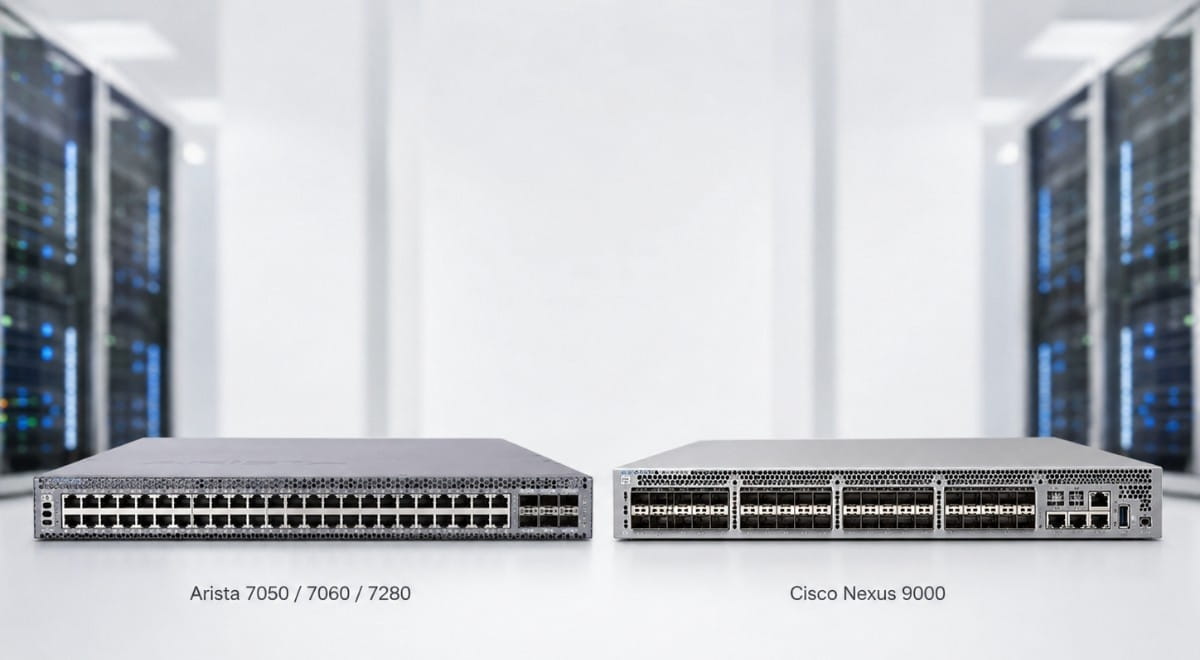
This guide explains how Arista gained ground against Cisco in cloud-style data center switching, where Cisco still makes sense, and how buyers should evaluate Arista 7050, Arista 7060, Arista 7280, Cisco Nexus 9000, optics, and cables when planning a data center refresh.
Why Are Buyers Comparing Arista and Cisco During Data Center Refresh Projects?
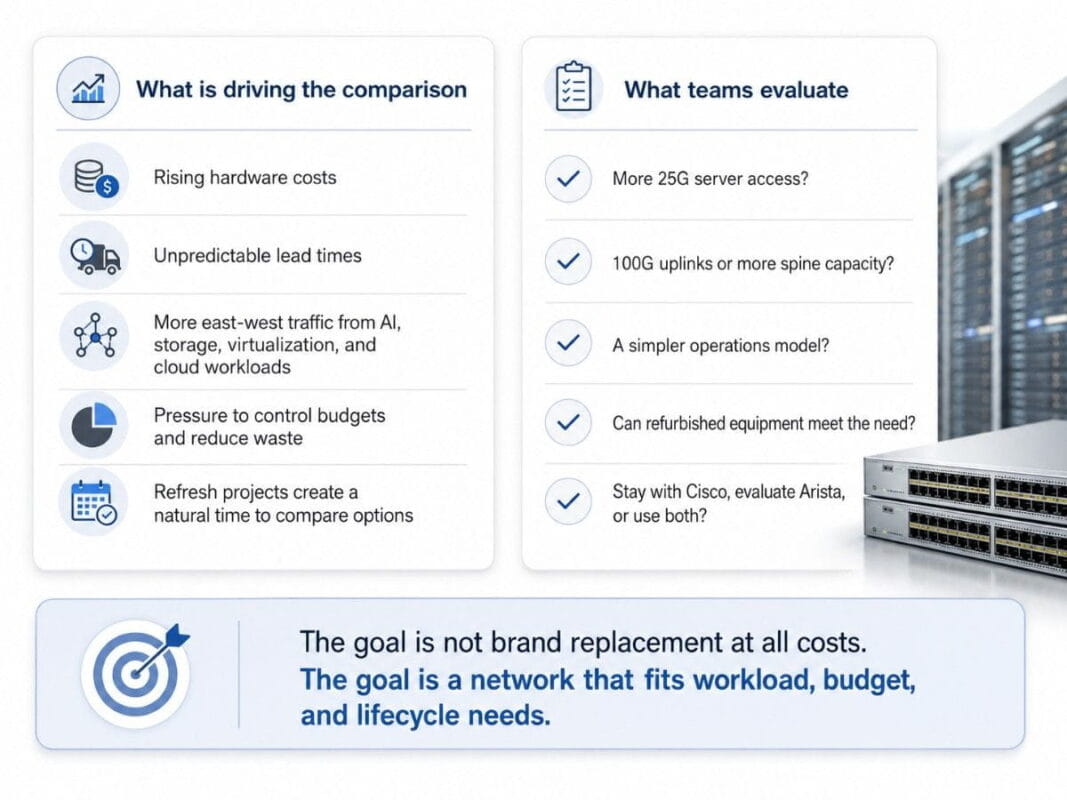
Data center teams face pressure from several sides at once. Hardware costs keep rising. Lead times can shift without much warning. AI, storage, virtualization, and cloud workloads keep pushing more east-west traffic across the network.
At the same time, many companies need to control budgets and reduce waste. That makes refurbished hardware checks more important during refresh planning.
A switch refresh is no longer just a replacement cycle. It is a chance to ask better questions:
- Do we need more 25G server access?
- Do we need 100G uplinks or spine capacity?
- Do we need a simpler operations model?
- Can refurbished equipment meet the need?
- Should we keep Cisco, evaluate Arista, or use both where each fits?
Many buyers compare Arista and Cisco because refresh projects create a natural decision point. When teams already plan to change cabling, optics, rack airflow, and uplink speeds, they can also compare the operating model.
| Buyer Pressure | What Buyers Need | How Arista Often Helps | Where Cisco Still Helps |
| Rising network costs | Cost control without weak performance | Strong refurbished options for 25G / 100G fabrics | Broad enterprise contracts and support models |
| Long lead times | Faster sourcing | Secondary-market availability for common data center models | Established enterprise procurement channels |
| Upgrade pressure | 25G access and 100G uplinks | Dense leaf-spine switching options | Mature Nexus 9000 portfolio |
| Operational complexity | Simpler network operations | EOS consistency and CloudVision workflows | Cisco Nexus Dashboard and ACI for Cisco-standardized teams |
| E-waste concerns | Longer hardware life | Refurbished deployment and trade-in paths | Lifecycle programs in Cisco environments |
For many buyers, the goal is not to replace one brand with another at all costs. The goal is to build a network that fits real workload, budget, and lifecycle needs.
Why Did Cloud Data Centers Like Arista Switching?
Cloud data centers liked Arista because Arista built its switching story around scale, speed, and operational consistency. That matched the needs of teams running large leaf-spine fabrics with heavy east-west traffic.
Cloud environments do not behave like older three-tier enterprise networks. Traffic often moves between servers, storage, virtual machines, containers, and application layers inside the data center.
This shift made leaf-spine designs more attractive. It also made consistent automation and visibility more important.
Arista became attractive because it offered:
- High-density Ethernet switching
- Consistent EOS software across platforms
- Strong 25G / 100G data center options
- Practical support for leaf-spine designs
- Automation and telemetry through CloudVision
- A software-driven approach that appealed to cloud operators
This is why Arista models such as the 7050, 7060, and 7280 became relevant in refresh projects. Buyers could use them for leaf, spine, routing, or aggregation roles depending on the design.
Cisco Nexus 9000 also serves modern data centers well. But Arista gave many cloud-style buyers a strong alternative when they wanted a simpler and more consistent operating model.
How Does EOS Consistency Help Network Teams Reduce Complexity?
EOS consistency is one of Arista’s strongest advantages in cloud-style environments. Network teams prefer platforms that behave in a predictable way across switches, especially when they manage many devices.
Arista EOS gives teams a common software experience across many switching families. That helps reduce the learning curve when engineers work across leaf, spine, and aggregation layers.
This matters because many data center teams deal with lean staffing. They need fewer surprises, faster change windows, and cleaner troubleshooting.
EOS consistency can help with:
- Common workflows across switching platforms
- Faster configuration review
- More predictable upgrade planning
- Easier automation across multiple switch models
- Better alignment between operations and design teams
Operational simplicity does not mean a network is basic. It means the team can manage complex infrastructure with less friction.
For refurbished buyers, this point matters even more. A company may source a mix of Arista 7050, 7060, and 7280 switches based on availability. A consistent software model can make that mixed sourcing plan easier to manage.
How Does Leaf-Spine Architecture Make Arista a Strong Cloud-Style Option?
Leaf-spine architecture changed how many buyers think about data center switching. Instead of relying on older hierarchical designs, leaf-spine networks create a flatter structure that supports predictable paths and scalable east-west traffic.
In this model, leaf switches connect to servers, storage, and appliances. Spine switches connect the leaf layer and provide high-speed fabric capacity.
Arista gained attention because its portfolio fit this model well. The Arista 7050 and 7060 families often fit leaf or spine roles depending on port needs. The 7280 family can support routing, aggregation, and higher-scale data center roles.
A practical 25G / 100G design may look like this:
- 25G server links at the leaf layer
- 100G uplinks from leaf to spine
- QSFP-100G optics or DAC/AOC cables for uplinks
- SFP-25G optics or DAC cables for server access
- MMF or SMF fiber based on distance
This design helps buyers add capacity in stages. A company can expand the leaf layer for more servers, add 100G spine capacity, or source refurbished hardware when new equipment does not fit the budget.
Teams planning AI or high-density compute should also review AI network challenges because east-west traffic can grow faster than expected.
Where Do Arista 7050, 7060, 7280, and Cisco Nexus 9000 Fit?
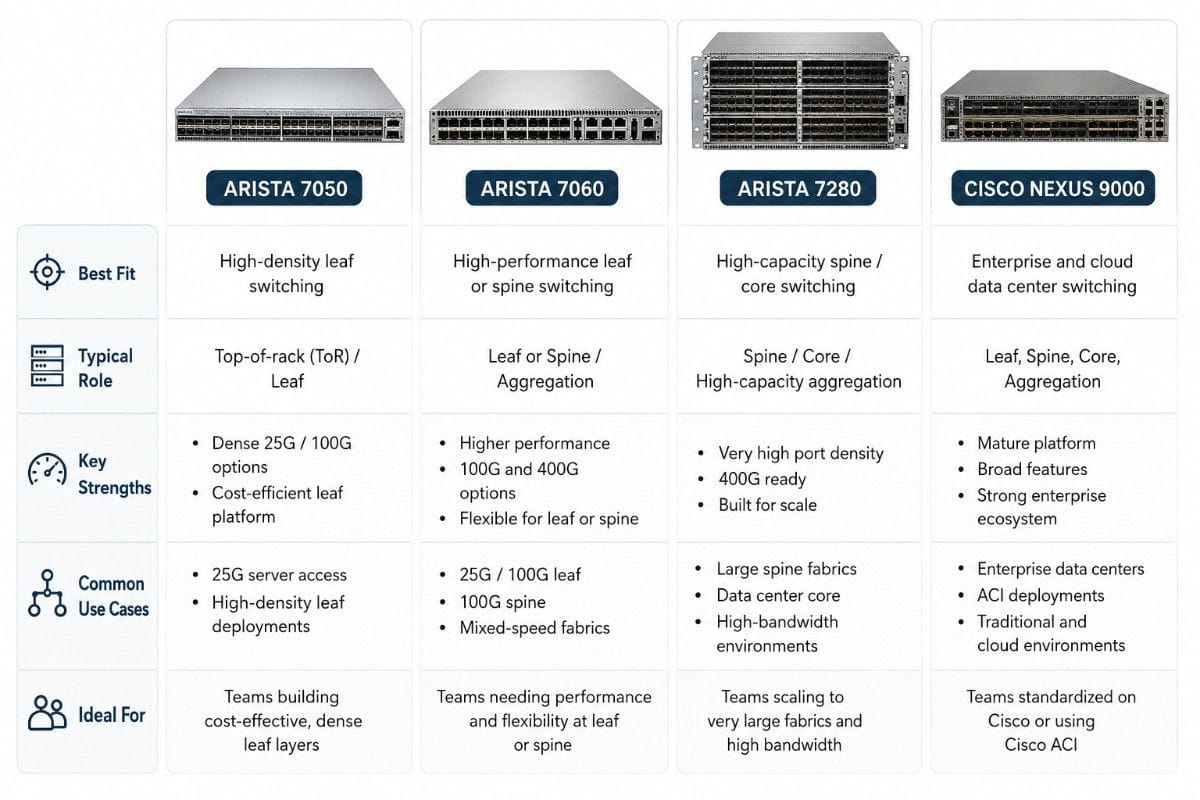
Each platform has a different role in a data center refresh. Buyers should map models to workloads instead of choosing based on brand alone.
| Platform | Common Fit | Buyer Use Case | Refurbished Buying Note |
| Arista 7050 | Leaf or fixed spine switching | 25G server access and 100G uplinks in cloud-style designs | A 7050SX3 leaf switch can fit 25G refresh projects well |
| Arista 7060 | High-performance leaf, spine, or interconnect | Dense 25G / 100G switching for virtualization, storage, and cloud workloads | A 7060SX2 access switch can support flexible server access |
| Arista 7060CX | 100G-heavy switching | Spine, interconnect, or high-density fabric designs | A 7060CX spine model can support 100G-focused environments |
| Arista 7280 | Switch router, aggregation, routing-heavy roles | Large enterprise, service provider, and routing-focused environments | A 7280SR aggregation switch can fit higher-scale routing needs |
| Cisco Nexus 9000 | Enterprise data center leaf, spine, and ACI environments | Cisco-standardized teams, ACI deployments, and hybrid cloud designs | A Nexus 9000 switch may fit buyers staying with Cisco operations |
This table does not rank one platform above another. It helps buyers match the switch to the job.
A strong refresh plan may include Arista, Cisco, or both. The best answer depends on the current network, software model, cabling, staff skills, and lifecycle goals.
How Do Automation and Telemetry Affect Refurbished Arista Buying Decisions?
Automation and telemetry now shape many switching decisions. Buyers do not only ask whether a switch has enough ports. They also ask whether the network team can operate it at scale.
Arista CloudVision gives teams a management layer for EOS networks. It supports automation, visibility, policy-related workflows, and integration with orchestration tools.
That matters because cloud-style environments change often. Server teams add capacity. Storage teams move workloads. AI teams request new clusters. Application teams need stable performance.
Good telemetry helps teams see issues before they become outages. Automation helps teams reduce manual work during provisioning and change windows.
For refurbished buyers, automation and telemetry also reduce risk. A properly tested refurbished switch can deliver value, but the team still needs clean configuration, compatible optics, correct airflow, and strong monitoring.
When buyers compare total cost, they should include operational cost. A cheaper switch that adds manual work may not save money over time. A refurbished Arista switch that fits the operating model may help reduce both capital cost and daily friction.
Why Does Arista’s 25G / 100G Portfolio Matter for Modern Buyers?
Many enterprise data centers still move from 10G to 25G server access and from 40G to 100G uplinks. That makes the 25G / 100G generation very important for refresh projects.
The Arista 7050 and 7060 families fit this need well. They support the type of dense Ethernet switching buyers need for cloud, virtualization, storage, and AI-adjacent workloads.
A practical design may use 25G at the server edge and 100G across uplinks. That can improve bandwidth without forcing every buyer into the newest 400G or 800G design.
This is where Buying Refurbished Arista Switches can make sense. Many organizations do not need the newest platform for every rack. They need reliable capacity at the right price and speed.
This approach can help teams:
- Extend the life of useful data center infrastructure
- Reduce refresh cost
- Build lab or secondary clusters
- Expand virtualization capacity
- Support AI/HPC growth in stages
- Avoid overbuying when 25G / 100G meets the need
For teams trying to balance performance and budget, network cost control should guide the refresh plan from the start.
Where Does Cisco Nexus 9000 Still Make Strong Business Sense?
Cisco Nexus 9000 remains a strong choice in many enterprise data centers. This is especially true for organizations already invested in Cisco architecture, tools, support, and staff training.
Cisco can make strong business sense when a buyer has:
- Existing Cisco Nexus operations
- Cisco ACI deployment plans
- Enterprise agreements or support structures
- Internal teams trained on NX-OS and Cisco tools
- Broader Cisco campus, security, or data center standards
- A need for consistent vendor alignment across the enterprise
Cisco also continues to invest in automation, telemetry, AI/ML fabric support, and Nexus Dashboard operations. Buyers should not dismiss Cisco simply because Arista gained traction in cloud-style networks.
A neutral view works best. Arista may offer a simpler fit for some cloud-style Ethernet fabrics. Cisco may offer a stronger fit for buyers that depend on Cisco’s broader enterprise ecosystem.
The right decision depends on strategy, not brand loyalty.
How Should Buyers Decide Between Arista and Cisco?
Buyers should decide between Arista and Cisco by looking at workload, network design, operations model, budget, and sourcing reality. A spec sheet alone will not answer the full question.
Where Arista Fits Best
Arista often fits buyers that want cloud-style operations, predictable EOS behavior, and high-performance Ethernet leaf-spine designs.
It can make sense for:
- 25G / 100G data center refreshes
- Cloud-style networks with heavy east-west traffic
- AI, HPC, virtualization, and storage fabrics
- Buyers that value consistent operations across switch families
- Teams that want practical automation and telemetry
- Organizations open to refurbished sourcing
Arista can also fit cost-sensitive expansion projects. A company may not need all-new switching to support every rack. Refurbished Arista can help buyers add capacity where the architecture already supports it.
Where Cisco Still Fits Best
Cisco often fits buyers that already run Cisco-heavy environments. If a team uses Cisco ACI, Cisco support processes, and Cisco operations tools, staying with Nexus can reduce change risk.
Cisco can make sense for:
- ACI-heavy data centers
- Enterprise-standardized Cisco environments
- Teams with deep Cisco operations knowledge
- Buyers that need alignment with broader Cisco agreements
- Hybrid environments built around Cisco tools
- Organizations that prefer one-vendor lifecycle management
Cisco also offers strong data center switching options for modern workloads. In many cases, the issue is not technical weakness. The issue is whether the platform fits the buyer’s operating model and cost plan.
Where Refurbished Sourcing Changes the Decision
Refurbished sourcing can change the financial side of the decision. Buyers may find that a new-only strategy limits their options, while refurbished inventory gives them more flexibility.
This does not mean every refurbished switch is a good buy. Buyers need a structured process.
They should check:
- Exact model and port configuration
- Airflow direction
- Power supplies and fan modules
- Optics and cable compatibility
- EOS or NX-OS requirements
- Licensing and support needs
- Warranty and testing process
- Lead time and available quantity
Refurbished sourcing works best when procurement and engineering teams work together. Procurement may find the inventory, but engineering must confirm that the model fits the design.
What Should You Check Before Buying Refurbished Arista Switches?
Buying refurbished Arista switches requires more than finding a low price. Buyers need to confirm fit, condition, compatibility, and deployment risk.
| Checkpoint | Why It Matters | Buyer Question |
| Model accuracy | Similar SKUs can support different roles | Is this the exact 7050, 7060, or 7280 model needed? |
| Airflow direction | Wrong airflow can disrupt hot/cold aisle planning | Do we need front-to-rear or rear-to-front airflow? |
| Port speed | Not every port mix fits the design | Do we need 25G access, 100G uplinks, or both? |
| Optics compatibility | Bad optics choices cause link issues | Are SFP/QSFP optics tested with this platform? |
| Power and fans | Missing modules delay deployment | Are power supplies and fans included and tested? |
| Software plan | Operations teams need version alignment | Does the EOS plan match the production environment? |
| Warranty and testing | Refurbished value depends on trust | What testing and warranty come with the switch? |
| Quantity and lead time | Refresh projects need matched inventory | Can the supplier support the full project size? |
This checklist helps buyers avoid common sourcing mistakes. It also helps teams compare Arista and Cisco on real deployment needs, not assumptions.
Buyers should also think about what happens to retired hardware. A circular IT strategy can support cost recovery and reduce waste during refresh projects.
How Do Optics and Cables Affect Refurbished Arista Deployments?
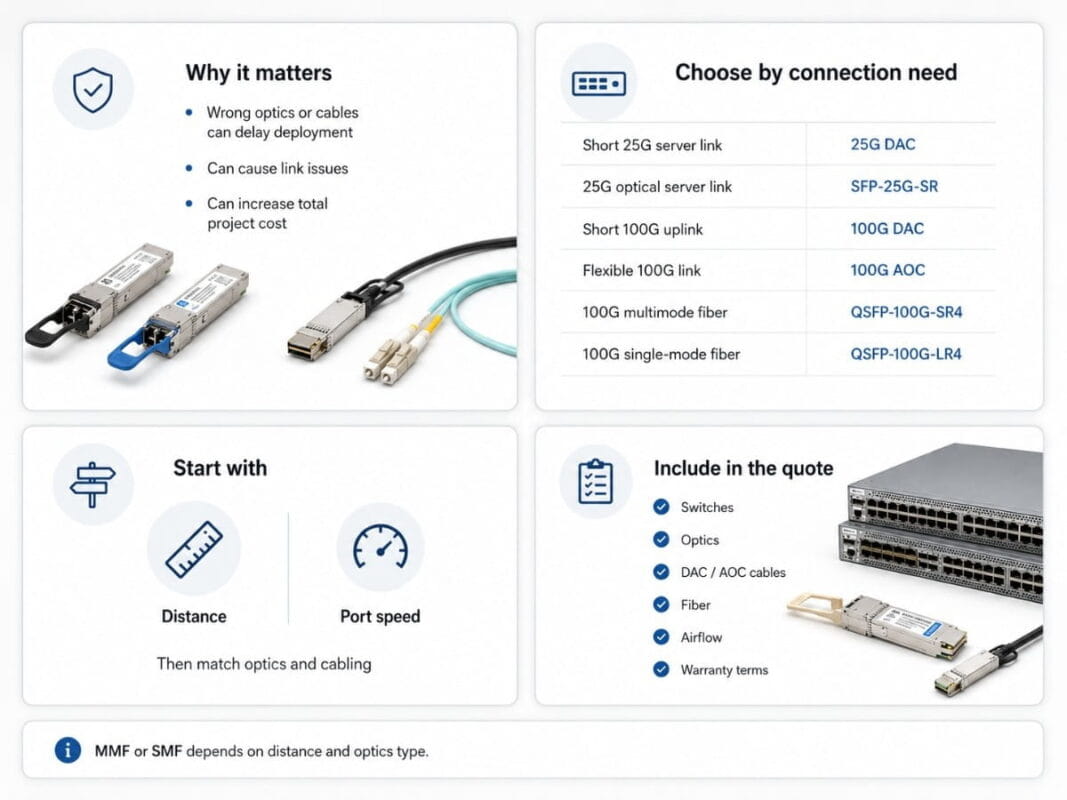
Optics and cables can make or break a refurbished Arista deployment. The switch may fit the design, but the wrong transceiver or cable can create delays, link problems, or unexpected cost.
For Arista 7050 and 7060 leaf-spine designs, buyers often need:
- SFP-25G-SR for 25G multimode server access
- 25G SFP28 DAC cables for short server links
- QSFP-100G-SR4 for short-reach 100G multimode uplinks
- QSFP-100G-LR4 for longer 100G single-mode links
- 100G QSFP28 DAC cables for short rack connections
- 100G AOC cables where active optical cabling fits better
- MMF or SMF fiber based on distance and optics type
The design should start with distance and port speed. Then buyers should choose optics and cabling.
| Connection Need | Common Option | Best Fit |
| Short 25G server link | 25G DAC | Same rack or short in-row links |
| 25G optical server link | SFP-25G-SR | Multimode fiber access links |
| Short 100G uplink | 100G DAC | Short leaf-to-spine or rack links |
| Flexible 100G link | 100G AOC | Short-to-mid reach where active cable helps |
| 100G multimode fiber | QSFP-100G-SR4 | Short data center fiber runs |
| 100G single-mode fiber | QSFP-100G-LR4 | Longer data center or inter-room runs |
Buyers should not treat optics as an afterthought. A complete quote should include switches, optics, DAC/AOC cables, fiber, airflow, and warranty terms.
This matters even more for AI and GPU environments. Network cost can grow quickly when teams add more uplinks, more optics, and more east-west capacity. Buyers planning these builds should include AI cost planning early.
What Outcome Should Buyers Expect From the Right Strategy?
The right strategy should lead to a cleaner decision. Buyers should know which platform fits the workload, how much capacity they need, which optics and cables belong in the quote, and where refurbished equipment can reduce cost without adding risk.
A strong decision should answer five questions:
| Decision Area | What Buyers Should Know |
| Platform fit | Whether Arista, Cisco, or both match the environment |
| Architecture fit | Whether the design needs 25G leaf, 100G spine, routing, or aggregation |
| Operations fit | Whether EOS, CloudVision, NX-OS, ACI, or Nexus tools match the team |
| Sourcing fit | Whether new, refurbished, or mixed sourcing makes sense |
| Lifecycle fit | Whether old hardware can be reused, resold, traded in, or recycled |
Arista gained ground because it gave cloud-style buyers a strong, software-driven alternative to Cisco. Cisco remains strong where its ecosystem and operating model match the enterprise.
For many buyers, the best path is a practical comparison. Buying Refurbished Arista Switches can support cost control, faster sourcing, and scalable 25G / 100G designs when the hardware matches the plan.
Need Help Comparing Arista and Cisco for a Data Center Refresh?
Catalyst Data Solutions helps buyers compare Arista and Cisco options based on workload, budget, port count, airflow, optics, lead time, and refurbished availability.
A refresh project often needs more than one switch quote. Buyers may need a full bundle that includes leaf switches, spine switches, optics, DAC/AOC cables, fiber, and buyback options for retired hardware.
Connect with Catalyst for refurbished Arista availability, bundle pricing, compatibility checks, and options to sell or trade in decommissioned switches.
FAQs
Why did Arista gain ground against Cisco in cloud data centers?
Arista gained ground because many cloud and high-scale buyers wanted consistent software, simple operations, automation, telemetry, and high-performance leaf-spine switching. Arista’s EOS and CloudVision approach matched those needs well.
Is Arista better than Cisco Nexus 9000?
Arista is not always better than Cisco. Arista often fits cloud-style Ethernet fabrics and teams that value EOS consistency. Cisco Nexus 9000 often fits Cisco-heavy enterprise data centers, ACI deployments, and organizations that want broader Cisco ecosystem alignment.
Are refurbished Arista switches a good option?
Refurbished Arista switches can be a good option when buyers verify the exact model, airflow, optics compatibility, power supplies, fans, software needs, testing, and warranty. They can help reduce cost and improve sourcing flexibility.
Which Arista switches should buyers compare for 25G / 100G refreshes?
Buyers should often compare Arista 7050 and 7060 models for 25G server access and 100G uplink designs. Arista 7280 models fit routing, aggregation, and larger-scale network roles.
What optics and cables matter in Arista leaf-spine designs?
Common options include SFP-25G-SR, QSFP-100G-SR4, QSFP-100G-LR4, 25G DAC, 100G DAC, 100G AOC, MMF fiber, and SMF fiber. The right choice depends on distance, port speed, switch model, and rack layout.
When should a buyer stay with Cisco Nexus?
A buyer should often stay with Cisco Nexus when the team already uses Cisco ACI, Cisco operations tools, Cisco support processes, or enterprise standards that make Cisco the lower-risk option.
How can Catalyst help with a data center switch refresh?
Catalyst can help compare Arista and Cisco options, source new or refurbished switches, validate optics and cabling, build 25G / 100G bundles, and evaluate buyback or trade-in options for retired hardware.