
Data center buyers face a hard mix of pressure right now. Budgets need to stretch further, refresh cycles keep moving, and many teams still deal with long lead times, supply gaps, and rising network demand from AI, storage, virtualization, and cloud-style workloads.
That is why the Arista vs Cisco Nexus decision is not just a brand debate. It is a design, operations, sourcing, and lifecycle decision. The right choice depends on how your network runs today, what your team can support, and how quickly you need to source reliable hardware.
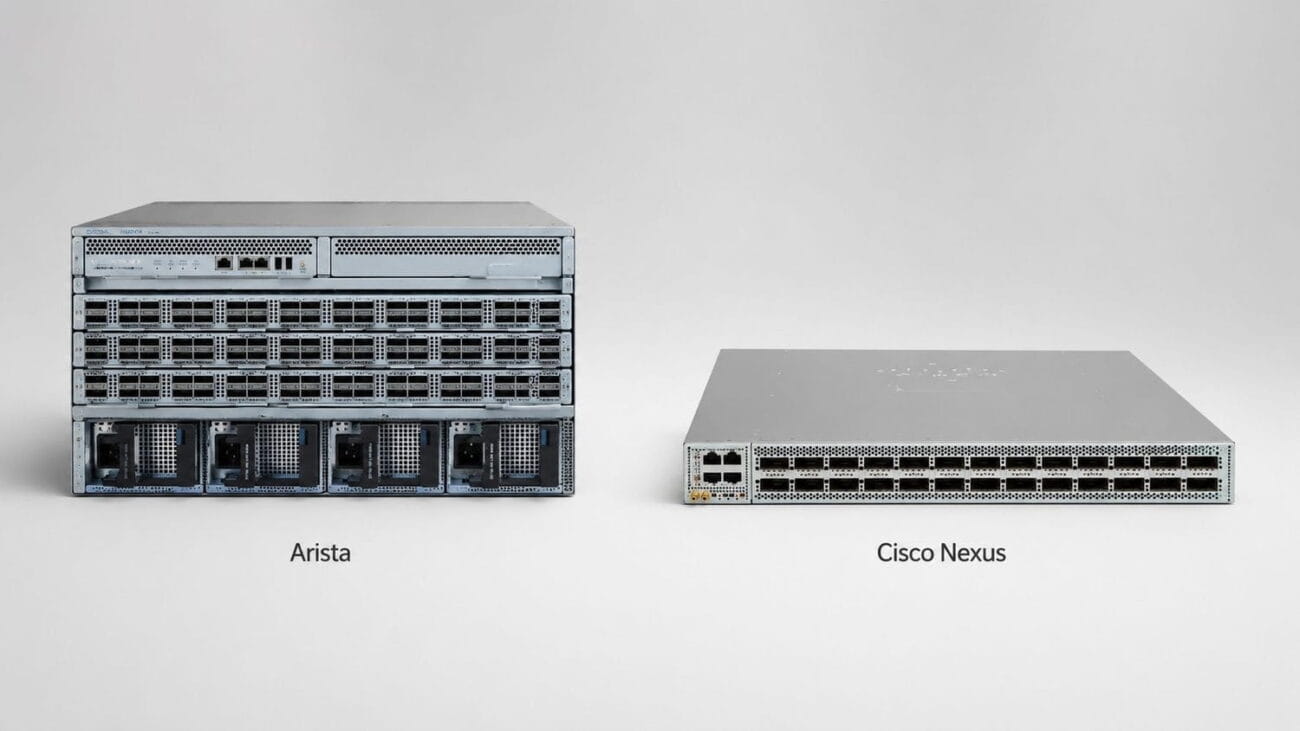
Arista often fits organizations that want cloud-style networking, simple operations, strong leaf-spine design, and cost-effective refurbished fabric options. Cisco Nexus remains strong for teams already built around Cisco architecture, ACI, NX-OS, and the broader Cisco enterprise ecosystem.
This guide compares both platforms through a practical buyer lens so you can choose based on environment, not loyalty.
Should You Choose Arista or Cisco Nexus?
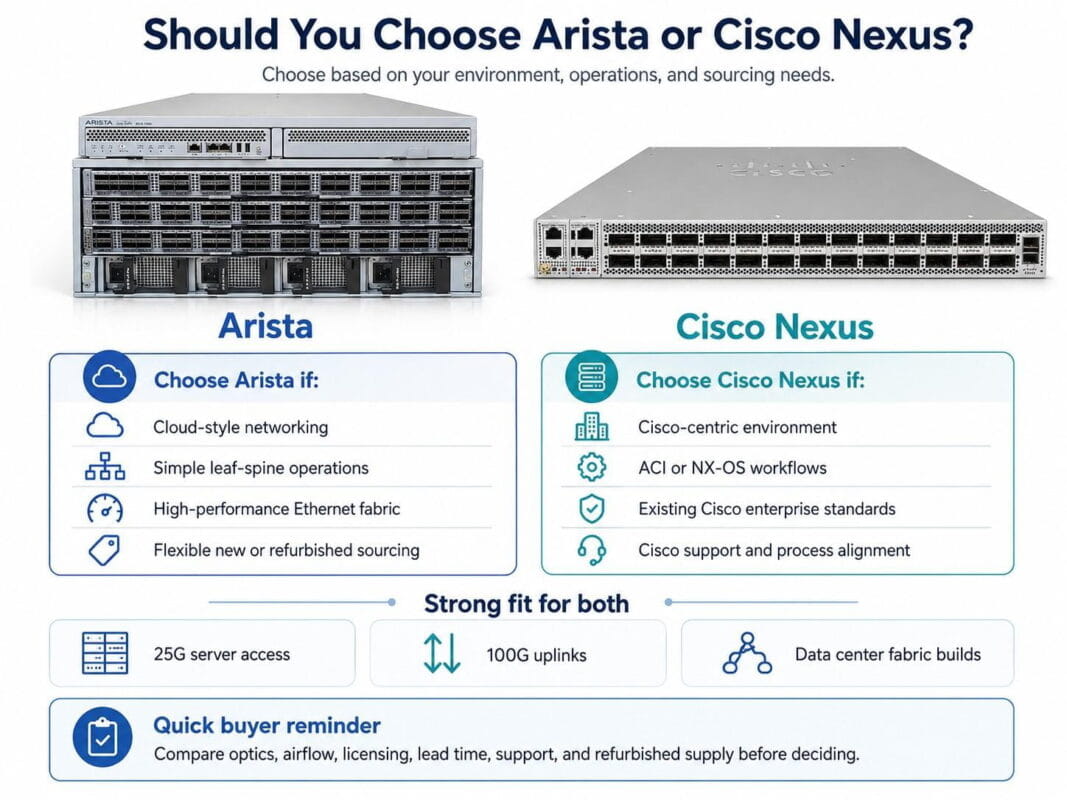
Choose Arista when your data center favors high-performance Ethernet, consistent software operations, scalable leaf-spine architecture, and flexible sourcing across new or refurbished inventory.
Choose Cisco Nexus when your environment already depends on Cisco tools, Cisco ACI, NX-OS workflows, Cisco support processes, or broader Cisco enterprise standards.
Many buyers compare both because they need better performance without overbuying. A practical network cost control plan should compare platform fit, optics, airflow, licensing, lead time, support, and refurbished supply before a purchase decision.
| Buyer Question | Arista Fit | Cisco Nexus Fit |
| Do you want a cloud-style leaf-spine fabric? | Strong fit | Strong fit, especially with Cisco design standards |
| Do you already use Cisco ACI? | Possible, but less natural | Strong fit |
| Do you need 25G server access and 100G uplinks? | Strong fit | Strong fit |
| Do you want simple, consistent switch operations? | Strong fit | Good fit for Cisco-trained teams |
| Do you need refurbished options? | Strong fit | Strong fit, depending on model and support needs |
| Do you want vendor-neutral sourcing? | Strong fit | Strong fit |
What Problem Are Buyers Trying to Solve?
Most buyers are not replacing data center switches because they want a new logo in the rack. They are solving business and technical problems.
Common triggers include:
- 10G server access no longer meets workload needs.
- AI and storage traffic need better east-west performance.
- Hardware refresh budgets face more pressure.
- OEM lead times slow down projects.
- Teams need reliable refurbished hardware to reduce cost.
- Data centers need 25G access and 100G uplinks without a full redesign.
- Retired switches create e-waste and buyback questions.
A buyer may start with a simple question: “Should we buy Arista or Cisco Nexus?” But the real question is broader. “Which platform helps us meet the performance target, source hardware faster, control cost, and operate the network with less risk?”
That is why a refurbished network strategy matters for many refresh projects. It can help teams source proven data center hardware while managing budget and lifecycle goals.
It also supports circular IT practices when retired equipment can be resold, reused, or responsibly processed through a circular economy IT model.
Where Does Arista Fit Best in Data Center Switching?
Arista fits best in data centers that prioritize cloud-style networking, high-throughput Ethernet, consistent operations, and scalable leaf-spine architecture. It works well for organizations that want a clean switching model across leaf, spine, aggregation, and AI/HPC fabric roles.
The Arista 7050SX3 and Arista 7050SX3-F are strong examples for 25G leaf switching. Arista lists the 7050SX3-48YC8 with 48 25G SFP ports and 8 100G QSFP ports, which makes it a practical fit for dense server access with high-speed uplinks.
The Arista 7050CX3 fits a different role. Arista lists the 7050CX3-32S / 7050CX3-32C with 32 100G QSFP interfaces, so buyers often evaluate it for spine, collapsed spine, high-density interconnect, and performance-heavy environments.
The Arista 7060SX2-F and Arista 7060SX2-R offer another 25G/100G option. Arista positions the 7060SX2-48YC6 for 25GbE support and large-scale cloud, traditional, and virtualized data centers.
Arista often fits best when buyers need:
- 25G access at the top of rack
- 100G uplinks or spine capacity
- High-performance Ethernet fabric
- Leaf-spine scale
- AI/HPC infrastructure support
- Simple operations across similar switch families
- Strong refurbished availability for cost-controlled builds
Arista does not need to be “better than Cisco” to be the right choice. It only needs to match the workload, network model, sourcing goal, and operating team.
Where Does Cisco Nexus Fit Best?
Cisco Nexus fits best where the data center already depends on Cisco architecture, Cisco operations, Cisco ACI, or Cisco enterprise standards. Many organizations have years of Cisco process, training, monitoring, support, and compliance built into their network.
The Cisco Nexus N9K-C93180YC-FX is a common 25G/100G data center leaf switch. Cisco describes the Nexus 93180YC-FX as a model with 48 x 1/10/25-Gbps fiber ports and 6 x 40/100-Gbps QSFP28 ports.
The Cisco Nexus N9K-C93180YC-FX3 continues that 25G/100G design pattern. Cisco states that the 93180YC-FX3 has 48 downlink ports that support 1/10/25-Gbps Ethernet and 6 uplinks that support 40/100-Gbps Ethernet.
Cisco Nexus often fits best when buyers need:
- ACI alignment
- NX-OS familiarity
- Cisco-standard procurement
- Cisco support paths
- Existing Cisco monitoring and automation processes
- Data center standards tied to broader Cisco enterprise architecture
- Storage, compute, and network teams already trained on Nexus
Nexus is not only for legacy environments. It remains a strong data center platform. The key question is whether your team gains more value from staying inside the Cisco model or from evaluating an Arista option during a refresh.
How Do 25G and 100G Fabrics Shape the Arista vs Cisco Nexus Decision?
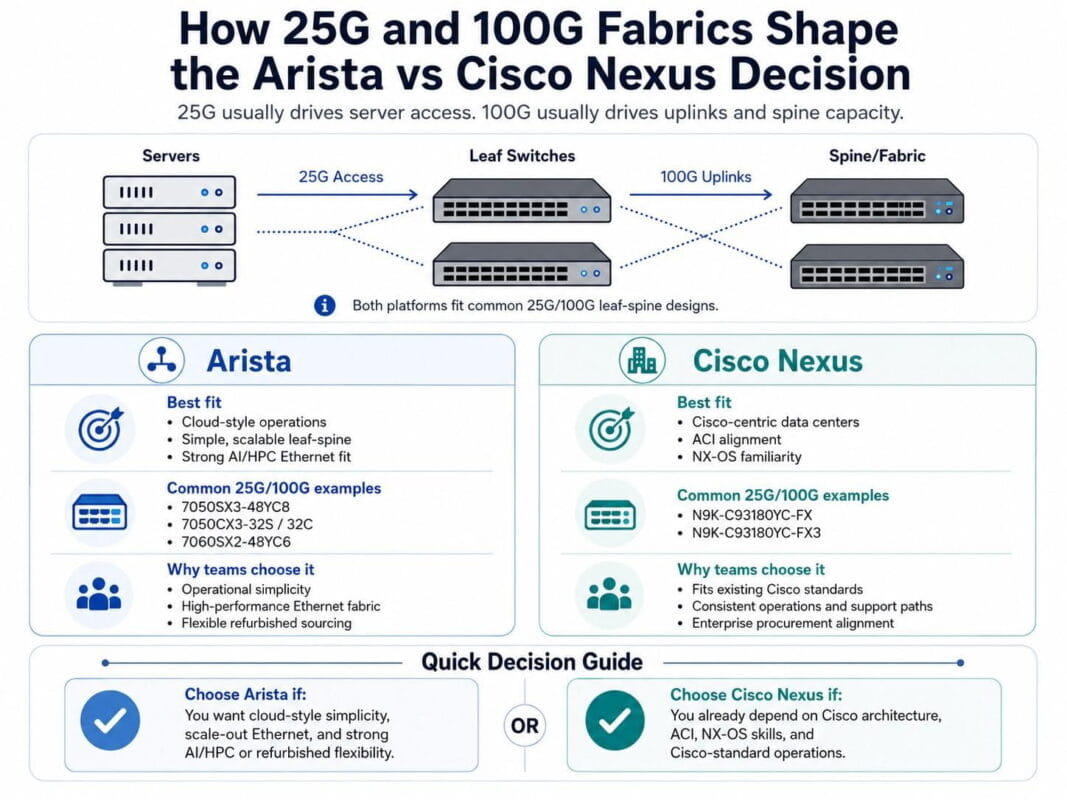
The Arista vs Cisco Nexus decision often becomes clearer when buyers map the design around port speed, traffic flow, and distance.
25G Server Access
Many data centers move from 10G to 25G because it offers more bandwidth per server port without a huge jump in design complexity. This matters for virtualization hosts, storage nodes, GPU servers, and dense compute racks.
A 25G leaf switch usually connects directly to servers. In this role, both Arista and Cisco Nexus provide strong options. The Arista 7050SX3, Arista 7060SX2, Cisco Nexus N9K-C93180YC-FX, and Cisco Nexus N9K-C93180YC-FX3 all fit common 25G server access needs.
For short-reach fiber, SFP-25G-SR can support 25G server connections over multimode fiber. Buyers should always validate switch compatibility, fiber type, distance, and optic coding before ordering.
100G Uplinks and Spine
100G matters when leaf switches need to move large amounts of traffic northbound, east-west, or between racks. AI, storage replication, private cloud, and high-density virtualization can all push uplink demand.
Arista buyers may pair a 25G leaf such as the 7050SX3 or 7060SX2 with a 100G spine such as the 7050CX3. Cisco buyers may use Nexus 93180YC-FX or FX3 as leaf switches with 100G uplinks into a Nexus spine layer.
For short data center links, QSFP-100G-SR4 optics often fit multimode fiber designs. For longer single-mode links, QSFP-100G-LR4 optics may fit better.
Optics, DAC/AOC, and Fiber Planning
Switch selection and optics selection should happen together. A buyer can choose the right switch and still slow down deployment with the wrong transceiver, cable, airflow, or distance plan.
DAC, AOC, and fiber choices depend on distance, rack layout, port type, and budget. DAC can fit short in-rack or nearby rack links. AOC can simplify some short-to-mid-distance optical needs. Fiber with SR4 or LR4 optics works better when reach, patching, and structured cabling matter.
| Fabric Component | Common Role | Arista Example | Cisco Nexus Example |
| 25G leaf switch | Server access | 7050SX3 or 7060SX2 | N9K-C93180YC-FX / FX3 |
| 100G switch | Spine or uplink layer | 7050CX3 | Nexus spine platform |
| 25G optic | Server fiber links | SFP-25G-SR | Cisco-compatible 25G optic |
| 100G optic | Leaf-spine uplinks | QSFP-100G-SR4 / LR4 | Cisco-compatible 100G optic |
| DAC/AOC/fiber | Distance-based cabling | Add during bundle planning | Add during bundle planning |
How Should Buyers Compare Automation and Operations?
Automation matters, but it should not become a buzzword. The real question is how your team will configure, monitor, change, and troubleshoot the network after deployment.
Arista often appeals to teams that want consistent operations across cloud-style data center fabrics. Its EOS-based model, leaf-spine design focus, and automation-friendly approach make it attractive for teams that value repeatable configuration and simple operations. Arista describes EOS as a modular switch operating system built around a state-sharing architecture, which supports this operations story.
Cisco Nexus often appeals to teams that already use Cisco tooling, Cisco ACI, NX-OS, and Cisco network standards. Cisco states that Nexus 9000 switches can run in NX-OS mode or support Cisco ACI for automated, policy-based infrastructure management.
A practical comparison should ask:
- Which operating model does the team already know?
- Does the team use ACI today?
- Will the data center use EVPN/VXLAN, traditional L2/L3, or another design?
- Who will manage the network after cutover?
- Which platform fits your monitoring and change-control process?
- Which platform gives you better availability in the required timeline?
For AI environments, automation also supports repeatable growth. A rack-by-rack buildout can become difficult when optics, cabling, and switch configurations change from one phase to the next. Strong planning helps reduce the type of AI network challenges that appear when compute grows faster than the network.
How Important Is Refurbished Market Availability?
Refurbished availability can strongly affect the Arista vs Cisco Nexus decision. Many enterprises need reliable data center hardware faster than standard procurement can deliver. Others need to cut cost without reducing performance.
Arista and Cisco Nexus both have active secondary-market demand. Buyers often evaluate refurbished units for expansion racks, lab networks, staging environments, budget-sensitive refreshes, and replacement inventory.
The Cisco Nexus 93180YC-FX deserves special planning because Cisco lists the model with an end-of-sale date of July 31, 2024, and an end-of-support date of July 31, 2029. That does not make the switch unusable. It means buyers should check support status, software needs, sparing plans, and lifecycle risk before purchase.
Refurbished Arista switches can also support strong value when buyers need 25G/100G performance at a lower cost. The same checks still apply:
- Verify airflow direction.
- Check power supplies and fans.
- Confirm optics support.
- Validate port speed requirements.
- Review software and licensing needs.
- Ask about testing and warranty.
- Confirm lead time and available quantity.
- Plan buyback for retired equipment.
This is where cost optimization becomes practical. Buyers can combine new optics, refurbished switches, and tested cabling to control spend while still meeting data center performance goals. That approach can also support AI data center cost planning when GPU, server, and network budgets compete for the same capital.
How Do You Choose Based on Environment, Not Brand Loyalty?
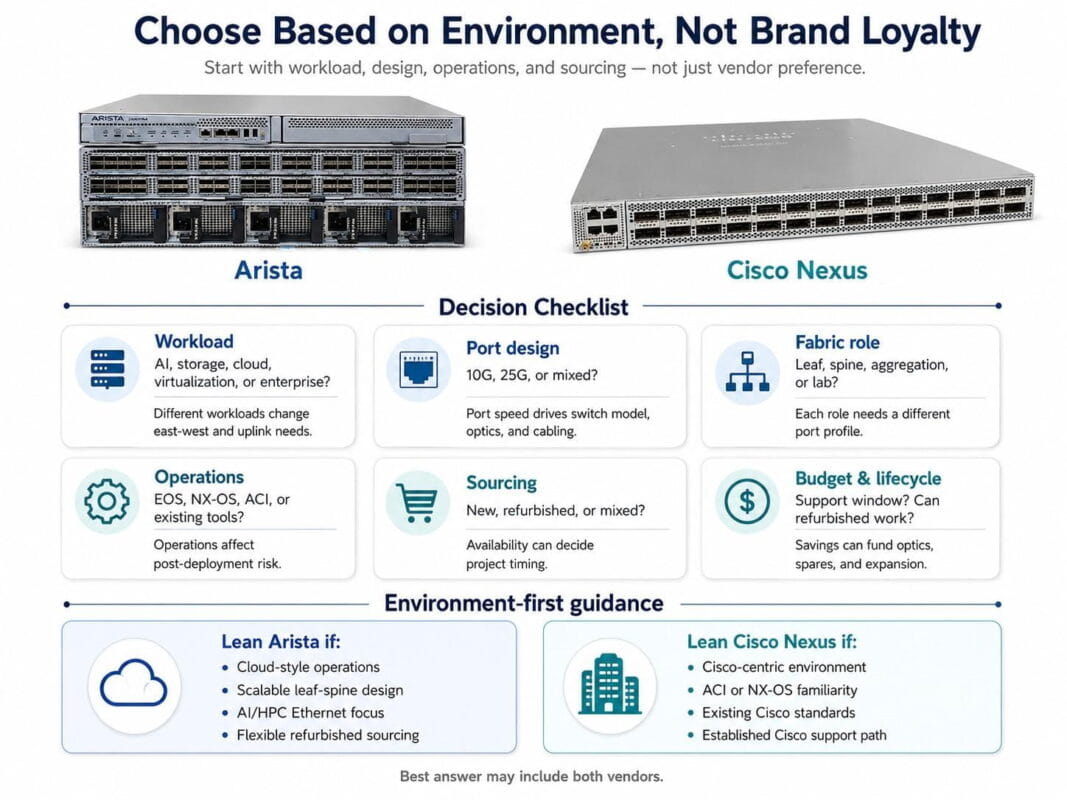
The best decision comes from the environment. Brand preference should not lead the process.
Start with workload, then design, then operations, then sourcing. A switch that looks better on paper may not fit if your team cannot support it, your optics plan does not match, or your lead time misses the project window.
| Decision Area | Ask This Question | Why It Matters |
| Workload | Are you supporting AI, storage, cloud, virtualization, or general enterprise traffic? | Different workloads create different east-west and uplink needs. |
| Port design | Do servers need 10G, 25G, or mixed speeds? | Port speed affects switch model, optics, and cabling. |
| Fabric role | Is the switch a leaf, spine, aggregation, or lab unit? | Leaf and spine roles need different port profiles. |
| Operations | Does your team prefer EOS, NX-OS, ACI, or existing tooling? | Operations affect risk after deployment. |
| Sourcing | Do you need new, refurbished, or mixed inventory? | Availability can decide project timing. |
| Lifecycle | What support window do you need? | Hardware age and software support affect risk. |
| Budget | Can refurbished hardware meet the requirement? | Cost savings can fund optics, spares, or future expansion. |
For many buyers, the answer may include both vendors. A Cisco-heavy enterprise may keep Nexus in core production environments while using Arista in a specific cloud, lab, AI, or cost-controlled fabric.
Another buyer may standardize on Arista for new leaf-spine builds while keeping Cisco where ACI remains central. The right choice depends on the design, not a fixed vendor rule.
What Should an Arista vs Cisco Data Center Fabric Quote Include?
A useful quote should not only list switches. It should include the switch role, optics, cabling, airflow, support needs, and sourcing options.
| Quote Area | Arista Option | Cisco Nexus Option |
| 25G leaf | 7050SX3 or 7060SX2 | N9K-C93180YC-FX or FX3 |
| 100G spine/uplink | 7050CX3 | Nexus 100G spine option |
| 25G server optics | SFP-25G-SR or 25G DAC | Cisco-compatible 25G optics |
| 100G uplinks | QSFP-100G-SR4 / LR4 or 100G DAC/AOC | Cisco-compatible 100G optics |
| Cabling | DAC/AOC/fiber based on distance | DAC/AOC/fiber based on distance |
| Sourcing | New, refurbished, or mixed | New, refurbished, or mixed |
| Lifecycle | Warranty, testing, compatibility check | Support status and lifecycle check |
This bundle approach helps buyers avoid partial orders. It also reduces the risk of buying switches first and discovering later that optics, airflow, or cable distance do not match the deployment.
Final Recommendation: Match the Platform to the Real Environment
The best Arista vs Cisco Nexus decision starts with the network you need to run, not the brand you already know.
Choose Arista when cloud-style operations, scalable leaf-spine design, 25G/100G Ethernet performance, and flexible refurbished sourcing matter most.
Choose Cisco Nexus when Cisco architecture, ACI, NX-OS skills, and existing enterprise standards reduce risk.
For many buyers, the smartest move is to compare both options side by side. Review port count, fabric role, optics, cabling, lead time, support window, refurbished supply, and lifecycle needs.
That process leads to a stronger design, a cleaner quote, and a better long-term outcome.
Need Help Comparing Arista and Cisco Without Vendor Bias?
Catalyst Data Solutions can help buyers compare Arista and Cisco Nexus options based on workload, port count, software preference, lead time, refurbished availability, and budget.
The goal is not to force one platform. The goal is to help the buyer source the right fabric for the environment.
Frequently Asked Questions
Is Arista better than Cisco Nexus?
Arista is not always better than Cisco Nexus. Arista often fits cloud-style data centers, high-performance Ethernet fabrics, and teams that want simple leaf-spine operations.
Cisco Nexus often fits Cisco-heavy enterprises, ACI deployments, and teams already built around Cisco operations.
Which platform is better for 25G and 100G data center fabrics?
Both platforms can support 25G server access and 100G uplinks. Arista options such as the 7050SX3, 7050CX3, and 7060SX2 fit many 25G/100G designs.
Cisco Nexus options such as the N9K-C93180YC-FX and N9K-C93180YC-FX3 also fit common 25G leaf and 100G uplink designs.
Which is better for AI and HPC networking?
Arista often receives strong consideration for AI and HPC networks because it fits cloud-style leaf-spine designs and high-throughput Ethernet fabrics.
Cisco Nexus can also fit AI and HPC environments, especially where Cisco architecture, operations, or ACI already guide the data center.
Should I buy new or refurbished switches?
Buy new when you need the latest lifecycle, vendor support alignment, or a standard procurement path.
Consider refurbished when you need faster sourcing, lower cost, expansion capacity, spares, or a budget-controlled refresh. Always validate testing, warranty, airflow, optics, and software needs.
What optics should I plan for?
Use 25G optics such as SFP-25G-SR for short-reach server access over multimode fiber when the design supports it.
Use 100G optics such as QSFP-100G-SR4 for short-reach links and QSFP-100G-LR4 for longer single-mode links. Validate compatibility before purchasing.