
Many enterprise networks are under pressure. More users, more wireless devices, more cloud apps, and more security tools all create heavier traffic across the network.
At the same time, IT teams face rising hardware costs, long lead times, and budget limits. A core switch decision now affects performance, sourcing, refresh planning, and long-term cost.
This guide explains whether the Cisco Catalyst C9500-48Y4C-A is the right fit for your core or aggregation layer. It also explains what to bundle with it, when to choose new or refurbished, and how to avoid common buying mistakes.
Cisco Catalyst C9500-48Y4C-A Review: Key Specs and Buyer Fit
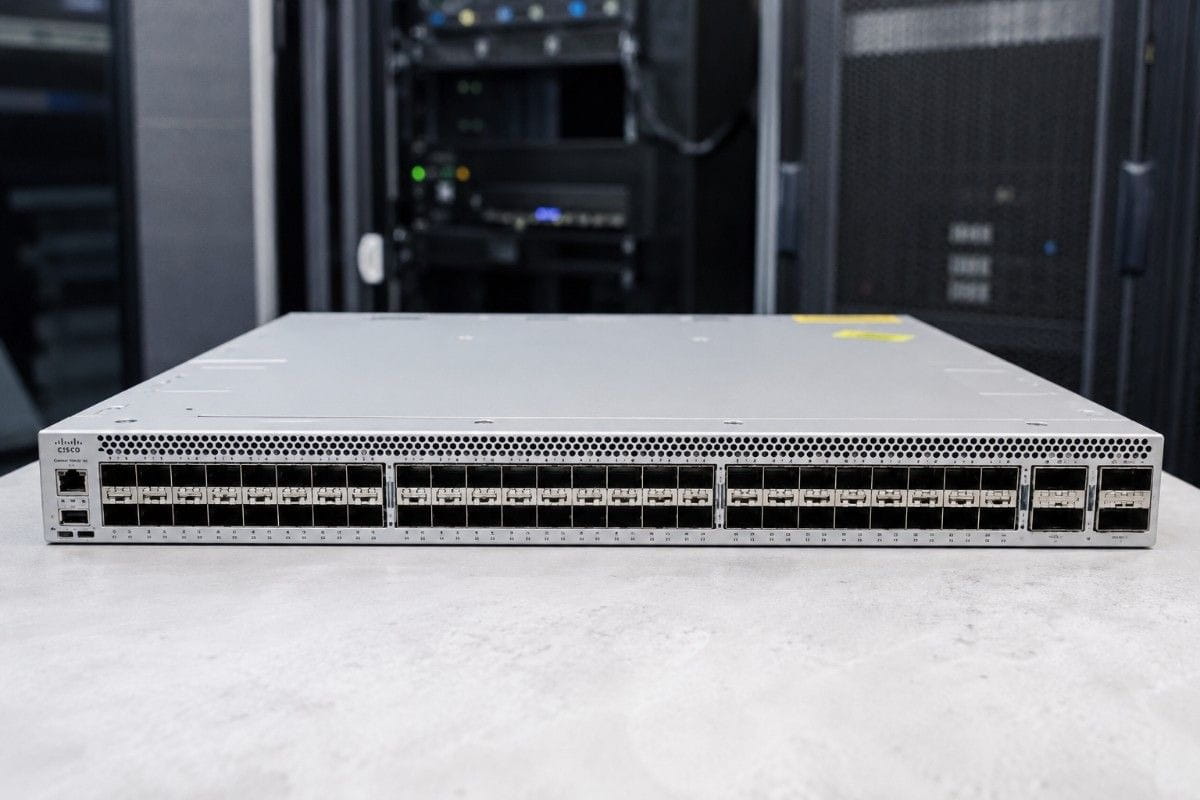
The Cisco Catalyst C9500-48Y4C-A is a high-performance fixed switch for enterprise core and aggregation use. Cisco describes the Catalyst 9500 Series as its lead fixed enterprise core and aggregation switching platform.
The C9500-48Y4C-A is built for buyers who need more than basic access switching. It belongs higher in the network, where multiple access switches, security tools, routers, and uplinks come together.
It supports 48 x 1/10/25G SFP28 ports and 4 x 40/100G QSFP28 uplink ports, giving enterprises a compact option for high-bandwidth campus and data center-adjacent networks. Cisco’s Catalyst 9500 architecture material also lists high-performance Catalyst 9500 switching and forwarding capacity at 3.2 Tbps / 1 Bpps.
| Review Area | What It Means for Buyers |
| Best network role | Enterprise core, aggregation, or collapsed core |
| Main port design | 48 x 1/10/25G SFP28 ports |
| Uplink design | 4 x 40/100G QSFP28 uplink ports |
| Switching performance | Up to 3.2 Tbps switching capacity |
| Forwarding rate | Up to 1 Bpps forwarding rate |
| Common pairings | Catalyst 9300, Catalyst 9200L, 25G optics, fiber, DAC |
| Best buyer fit | Enterprises moving beyond older 10G backbone designs |
| Main buying risk | Wrong optics, wrong access pairing, poor sourcing, or missed lead time |
This switch makes sense when the network needs a stronger middle layer. It can collect traffic from access switches, support high-speed uplinks, and help simplify core design.
The main value is not only speed. The value comes from matching speed, port density, optics, access switches, and sourcing into one working plan.
Why Do Enterprise Networks Need Stronger Core and Aggregation Switching?
Enterprise networks used to have simpler traffic patterns. Users connected to local apps, internet traffic moved through a few links, and wireless demand was lower.
That has changed. Today, users depend on cloud platforms, video meetings, secure remote access, wireless-first workspaces, and real-time applications. These tools push more traffic through the network core.
This creates several problems for IT and procurement teams:
- Core links reach capacity faster.
- Access switches need faster uplinks.
- Wireless refresh projects increase PoE and bandwidth demand.
- Firewalls and routers need stronger internal connections.
- Long lead times can delay refresh work.
- Budget pressure forces teams to compare new and refurbished options.
A stronger core or aggregation layer helps reduce these risks. It gives the access layer a better path upstream and gives the business more room to grow.
This is also where cost planning matters. Many teams want to reduce network costs without cutting performance or creating future bottlenecks. The right C9500 bundle can support that goal when it matches the real network design.
Is C9500-48Y4C-A Better for Core or Aggregation?
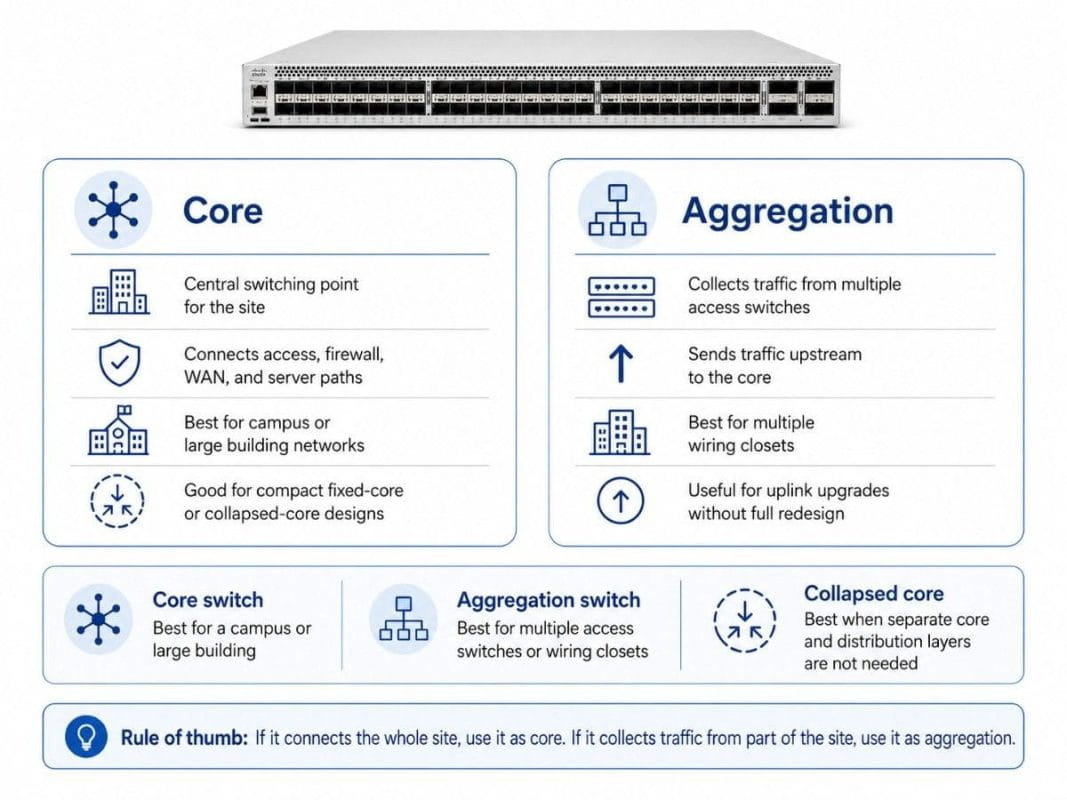
The C9500-48Y4C-A can work as either a core switch or an aggregation switch. The best role depends on the size of the site, the access switch count, and how traffic moves through the network.
When to Use C9500-48Y4C-A as a Core Switch
Use the C9500-48Y4C-A as a core switch when it connects the main parts of the network.
In this role, it may connect access switch stacks, firewalls, routers, server networks, wireless systems, and WAN edge devices. It acts as the central traffic point for the campus or building.
This design works well for mid-sized and large enterprises that want a compact fixed-core switch. It can also support collapsed-core designs, where one layer handles both core and distribution duties.
When to Use C9500-48Y4C-A as an Aggregation Switch
Use the C9500-48Y4C-A as an aggregation switch when it collects traffic from several access switches before sending that traffic upstream.
This is common in larger campuses with several wiring closets. Access switches may connect users, phones, cameras, printers, and wireless access points. The C9500-48Y4C-A then gives those access switches a faster path toward the network core.
Aggregation use is also helpful when a company wants to upgrade access uplinks without redesigning the whole network at once.
| Deployment Role | Best For | What It Solves |
| Core switch | A campus or large building that needs a central switching point | Connects access, firewall, WAN, and server paths |
| Aggregation switch | Multiple access switches or wiring closets | Collects access traffic and sends it upstream |
| Collapsed core | Sites that do not need separate core and distribution layers | Reduces hardware layers and simplifies design |
| High-speed campus refresh | Networks moving from 10G toward 25G/100G | Improves bandwidth and future growth |
| Data center edge | Campus networks that connect into server or storage areas | Supports fast handoff between campus and data center zones |
For most buyers, the choice comes down to scope. If the switch connects the whole site, use it as core. If it collects access switch traffic from part of the site, use it as aggregation.
How Does 25G and 100G Connectivity Support Campus Growth?
The C9500-48Y4C-A helps enterprises move beyond older 10G-heavy designs. Its 25G ports support faster access or aggregation links, while its 40G/100G ports support high-speed uplinks to key network areas.
This matters because bandwidth demand rarely grows in one place only. A wireless refresh may increase traffic from access switches. A security upgrade may increase firewall traffic. A cloud strategy may increase traffic moving out to the internet or secure edge.
A 25G access or aggregation link gives teams more headroom than 10G. A 100G uplink can also reduce the need for too many parallel links between major network layers.
The SFP-25G-SR-S optics are relevant when buyers need 25G short-reach connections over multimode fiber. Cisco describes its 25GBASE SFP28 portfolio as offering high-density, low-power 25 Gigabit Ethernet connectivity options based on the SFP28 form factor.
Buyers should not treat optics as a small detail. A strong switch plan can fail if the optics, fiber type, port speed, or software support do not match.
Before ordering, confirm:
- Fiber type: multimode or single-mode
- Required distance
- Port speed on both sides
- Switch software support
- Optic compatibility
- Patch panel condition
- Need for fiber or DAC
- Redundant uplink design
This step protects the project timeline. It also helps procurement avoid buying equipment that engineering cannot deploy.
How Does C9500-48Y4C-A Connect with Catalyst 9300 and 9200L?
The C9500-48Y4C-A usually sits above access switches such as the Catalyst 9300 and Catalyst 9200L families.
The access layer connects end devices. These include users, phones, access points, cameras, printers, badge systems, and IoT devices. The C9500 then connects those access blocks to the rest of the enterprise network.
A common design uses Catalyst 9300 switches in larger access areas and Catalyst 9200L switches in smaller or cost-sensitive access areas. This lets buyers balance performance and budget.
A Catalyst access switch can support branch or wiring closet needs when the site does not require the full feature depth of a larger access platform.
Best Access Switch Pairings for C9500
Catalyst 9300 / C9300L access products fit larger access-layer deployments. They make sense when a site needs stacking, stronger uplink planning, high PoE demand, and better growth options.
The C9300 family is often a good match below the C9500-48Y4C-A because it can support more advanced campus access designs. It works well in buildings with many users, many wireless APs, or multiple switch stacks.
Catalyst 9200L access products fit branch offices, smaller sites, and cost-sensitive access refresh projects. They can still connect into the C9500 core or aggregation layer, but they usually serve lighter access needs than C9300 models.
A practical design may use:
- C9500-48Y4C-A for core or aggregation
- C9300 or C9300L for larger access closets
- C9200L for smaller access areas
- 10G or 25G uplinks based on traffic needs
- SFP-25G-SR-S optics where 25G multimode fiber fits
- Fiber or DAC based on distance and rack layout
The main point is simple: the C9500 should not be selected alone. It should match the access switch plan.
If the access layer has many C9300 stacks, the C9500 may need more 25G uplinks. If the access layer uses mostly C9200L switches, the design may rely more on 10G uplinks with room to grow.
Which Cisco C9500-48Y4C-A Bundle Should You Choose?
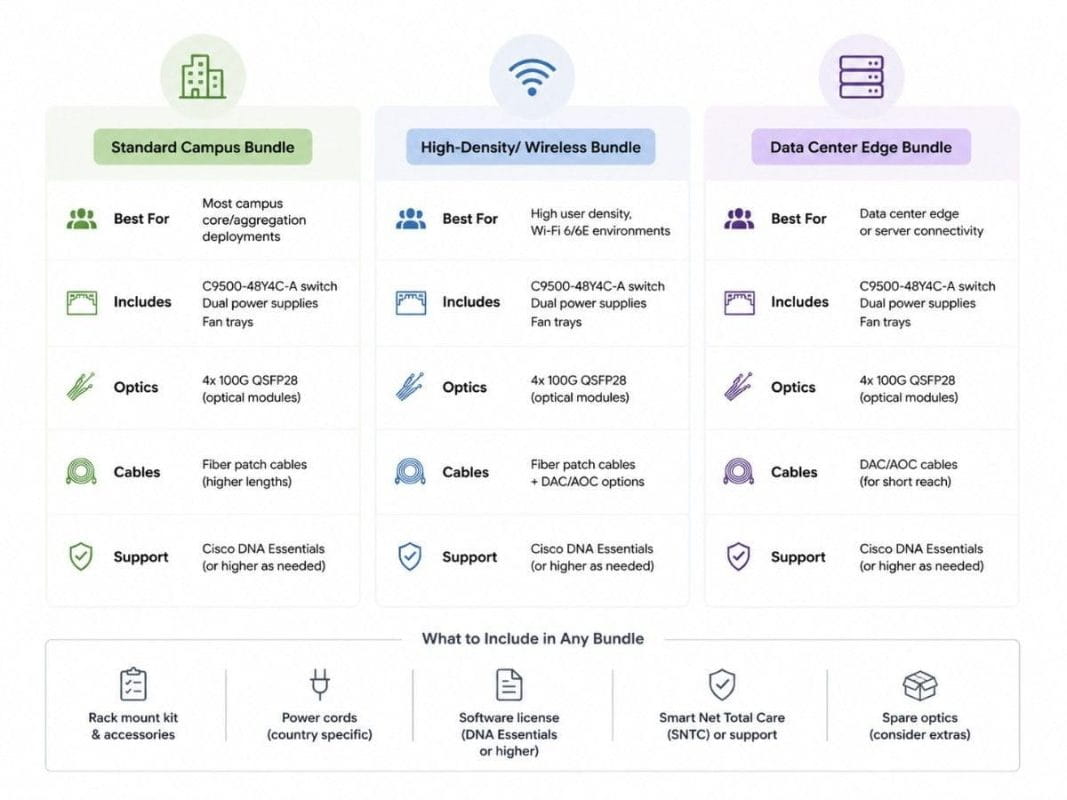
The right bundle depends on the network role, refresh stage, access switch count, and uplink speed.
A buyer replacing only the core may need a smaller bundle. A buyer refreshing the full campus may need C9500 hardware, access switches, optics, cables, and compatibility checks.
| Bundle | Include These Products | Best For | What Catalyst Should Verify |
| Campus Core Bundle | C9500-48Y4C-A, SFP-25G-SR-S, access switches | Core or collapsed-core refresh | Optics, fiber type, access uplinks, license level |
| Core + Access Refresh Bundle | C9500-48Y4C-A, C9300L-48P-4X-E, C9200L models | Multi-site or full access refresh | Model fit, lead time, budget mix, uplink speed |
| High-Speed Uplink Bundle | C9500-48Y4C-A, 25G optics, fiber/DAC | 10G-to-25G or 100G uplink upgrade | Port speed, cable length, multimode/single-mode needs |
| Refurbished Core Expansion Bundle | Refurbished C9500-48Y4C-A, tested optics, cables | Budget-sensitive expansion or replacement | Hardware testing, serials, warranty, accessories |
Bundle A: Campus Core Bundle
This bundle fits buyers who want to strengthen the campus backbone. It should include the C9500-48Y4C-A, SFP-25G-SR-S optics where needed, and compatible access switches.
Bundle B: Core + Access Refresh Bundle
This bundle fits buyers replacing both the core and access layers. It may include C9500-48Y4C-A, C9300L-48P-4X-E, and C9200L models based on site needs.
Bundle C: High-Speed Uplink Bundle
This bundle fits buyers who already have a working network but need faster links. It should include the C9500-48Y4C-A, 25G optics, and the correct fiber or DAC cables.
A bundle approach reduces risk because the parts are checked together. This matters more in enterprise networks, where one wrong optic or missing cable can delay a full cutover.
Should You Buy New or Refurbished Cisco C9500 Core Switching?
New C9500 hardware makes sense when the buyer needs a standard OEM path, a longer planned lifecycle, or a clean refresh across many sites.
Refurbished C9500 hardware makes sense when cost, lead time, or availability is the main pressure. It can also help when a team needs a replacement unit quickly or wants to finish a phased refresh without waiting for new stock.
This is common in supply-constrained markets. Buyers may have budget approval but still face delays from limited inventory or long delivery timelines.
A refurbished C9500-48Y4C-A can be a smart option when it comes from a source that understands enterprise hardware. The unit should be tested, identified correctly, and matched with the right optics and accessories.
Before buying refurbished, check:
- Correct SKU
- License level
- Serial and sourcing history
- Port condition
- Power supplies and fans
- Optics compatibility
- Software and support needs
- Warranty or replacement terms
- Lead time and shipping date
Refurbished buying also supports better asset use. It can reduce waste when equipment still has value and meets the project requirement.
The best choice is not always new or refurbished. The best choice is the option that fits the project risk, budget, timeline, and network role.
What Should You Check Before Buying Cisco C9500-48Y4C-A?

Before buying the C9500-48Y4C-A, confirm how the switch will work in the real network.
Start with the role. Decide whether it will act as core, aggregation, or collapsed core. Then match ports, optics, access switches, and cabling to that role.
Important questions include:
- How many access switches will connect to it?
- Will those uplinks run at 10G or 25G?
- Do you need 40G or 100G uplinks?
- Will the design use multimode fiber, single-mode fiber, or DAC?
- Do you need redundancy between switches?
- Are the access switches C9300, C9300L, C9200L, or mixed?
- Are the optics available with the switch?
- Is the project better served by new, refurbished, or mixed sourcing?
- What lead time can the project accept?
Buyers should also review the security and segmentation plan. A strong core switch can support better traffic design, but the network still needs policy, monitoring, and access control.
For teams planning stronger segmentation, a zero trust design should connect the core switch decision with identity, routing, and security enforcement.
Some buyers may also compare Cisco with other campus options. A neutral review can include Arista campus solutions when the environment calls for a broader platform comparison.
The goal is not to force one vendor answer. The goal is to choose hardware that fits the design and can be sourced on time.
Need Help Quoting a Cisco C9500 Core Bundle?
Catalyst Data Solutions can help buyers quote the C9500-48Y4C-A with compatible optics, access switches, cabling, and new or refurbished availability.
This is useful when a team has a design goal but still needs help turning it into an orderable bill of materials. It also helps when lead times, budget limits, or hard-to-find hardware make procurement harder.
A buyer may also use core refresh planning as part of broader IT optimization planning. That can help control spend while still improving the network.
Request a quote for a Cisco campus core and access bundle with C9500-48Y4C-A, SFP-25G-SR-S optics, compatible access switches, cabling, and new or refurbished availability.
FAQs About Cisco Catalyst C9500-48Y4C-A
Is the Cisco Catalyst C9500-48Y4C-A good for enterprise core switching?
Yes. The C9500-48Y4C-A fits enterprise core and collapsed-core designs that need high-speed fiber ports and 40G/100G uplinks. It works best when older 10G backbone links no longer give enough room for growth.
Can the C9500-48Y4C-A be used as an aggregation switch?
Yes. It can collect uplinks from Catalyst 9300, C9300L, and C9200L access switches. This is useful in campuses with several wiring closets or access switch stacks.
What should the C9500-48Y4C-A be bundled with?
Common bundle items include SFP-25G-SR-S optics, fiber or DAC cables, C9300 access switches, C9200L access switches, and any required accessories. The exact bundle should match port speed, distance, and access-layer design.
When should I choose 25G uplinks instead of 10G uplinks?
Choose 25G uplinks when the access layer supports heavy wireless, camera, user, or application traffic. A 25G design gives more headroom and can reduce bottlenecks between access and core layers.
Is refurbished C9500-48Y4C-A hardware worth buying?
It can be worth buying when budget, lead time, or replacement needs matter. The buyer should verify testing, licensing, serial history, port condition, optics compatibility, and warranty terms before purchase.
How does C9500-48Y4C-A connect with Catalyst 9200L switches?
Catalyst 9200L switches can connect into the C9500 core or aggregation layer for branch, office, and cost-sensitive access deployments. They often fit smaller access areas where a full C9300 design is not required.
Can Catalyst Data Solutions help verify compatibility?
Yes. Catalyst can help check switch models, optics, cabling, access switch pairings, license needs, and new or refurbished availability before quoting the bundle.