
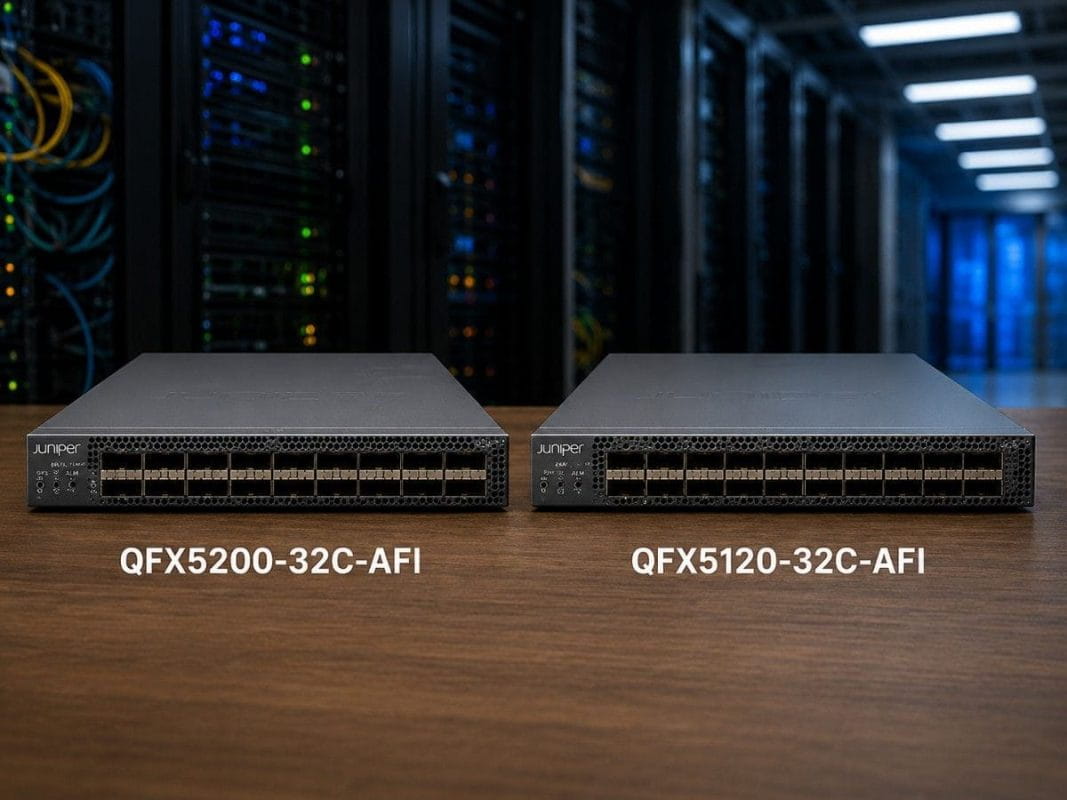
The Juniper QFX5200 vs QFX5120 Data Center Switch decision usually comes down to architecture fit, port planning, sourcing options, and refresh timing. Both platforms can support high-speed data center networks, but buyers should not treat them as the same switch.
The QFX5200-32C-AFI fits well in dense 100G fabric roles where teams need strong spine, aggregation, or high-density fabric capacity. The QFX5120-32C-AFI fits well in leaf-spine and fabric designs where buyers want 100G ports, 25G breakout options, EVPN-VXLAN support, and flexible data center growth.
Many enterprise buyers face the same problem: network traffic keeps growing, but budgets, lead times, and hardware availability do not always match project timelines. A clean comparison helps teams decide whether to buy new, source refurbished, expand an existing Juniper fabric, or compare Juniper against Cisco Nexus and Arista options.
For buyers working on data center infrastructure, the right choice depends less on brand preference and more on server speed, spine capacity, optics, cabling, airflow, and lifecycle needs.
Why Are Buyers Comparing QFX5200-32C-AFI and QFX5120-32C-AFI Now?
Data center teams are under pressure to support faster workloads without overbuying. Virtualization, private cloud, storage traffic, AI workloads, and backup traffic can push older 10G and 40G designs past their limits.
At the same time, new hardware can carry long lead times or higher upfront cost. Refurbished Juniper switches can help when buyers need fast deployment, spare units, cost control, or a staged refresh.
The main buyer question is simple:
Should the network use QFX5200-32C-AFI, QFX5120-32C-AFI, or a combination of both?
The answer depends on where the switch sits in the fabric:
- Spine layer
- Leaf layer
- Collapsed leaf-spine
- Data center aggregation
- 25G server access
- 100G uplink or fabric interconnect
- Lab, DR, or expansion network
How Does QFX5200-32C-AFI Fit Into a Data Center Architecture?
QFX5200-32C-AFI quick fit
The QFX5200-32C is a compact 1U data center switch. Juniper lists the QFX5200-32C with 32 QSFP+ or QSFP28 ports, 6.4 Tbps aggregate throughput, and 3.2 Bpps forwarding performance. Each QSFP28 port can support 1x100G, 2x50G, or 4x25G using breakout cables. QSFP+ ports can support 1x40G or 4x10G using breakout cables.
That port design makes the QFX5200-32C-AFI useful where buyers need dense 100G connectivity. It can serve as a spine switch in smaller fabrics, an aggregation switch, or a high-capacity fabric switch for 25G server environments.
Juniper also positions the QFX5200 family around low latency, wire-speed packet performance, Junos features, automation, and data center deployment flexibility. The official datasheet lists support for automation features, BGP add-path, MPLS, L3 VPN, and Fibre Channel over Ethernet.
Best-fit use cases include:
- 100G spine layer
- 25G server access using breakout cables
- Data center aggregation
- High-density fabric expansion
- Cloud, virtualization, and storage-heavy environments
- Secondary-market expansion for existing Juniper fabrics
For teams working through network modernization, the QFX5200-32C-AFI can be a strong option when capacity matters more than buying the newest generation.
How Does QFX5120-32C-AFI Fit Into a Data Center Architecture?
QFX5120-32C-AFI quick fit
The QFX5120-32C is a 1U 100G data center leaf-and-spine and campus distribution switch. Juniper lists the QFX5120-32C with 32 100G QSFP28 or 40G QSFP+ ports, a 2.2 GHz quad-core Intel CPU, 16 GB memory, 64 GB SSD storage, and up to 3.2/6.4 Tbps L2 and L3 performance.
The QFX5120-32C also supports breakout options. Juniper states that ports 0–30 can break 100G QSFP28 ports into four 25G SFP28 ports, while 40G QSFP+ ports can break into four 10G SFP+ ports. This can raise total 25G density to 124 ports and total 10G density to 126 ports, with specific limits on port 31.
The QFX5120 also brings strong fabric features. Juniper lists support for VXLAN as an L2 or L3 gateway, EVPN-VXLAN, BGP add-path, L3 VPN, MPLS, Python, and zero-touch provisioning.
Best-fit use cases include:
- Leaf-spine fabric builds
- 25G server access with 100G uplinks
- Collapsed spine in smaller data centers
- Data center edge or distribution
- EVPN-VXLAN overlay designs
- Staged refresh projects using 25G and 100G
For buyers comparing current availability, a QFX5120 refurbished option can help when the project needs faster sourcing than a standard new-hardware timeline.
QFX5200-32C-AFI vs QFX5120-32C-AFI: What Are the Main Differences?
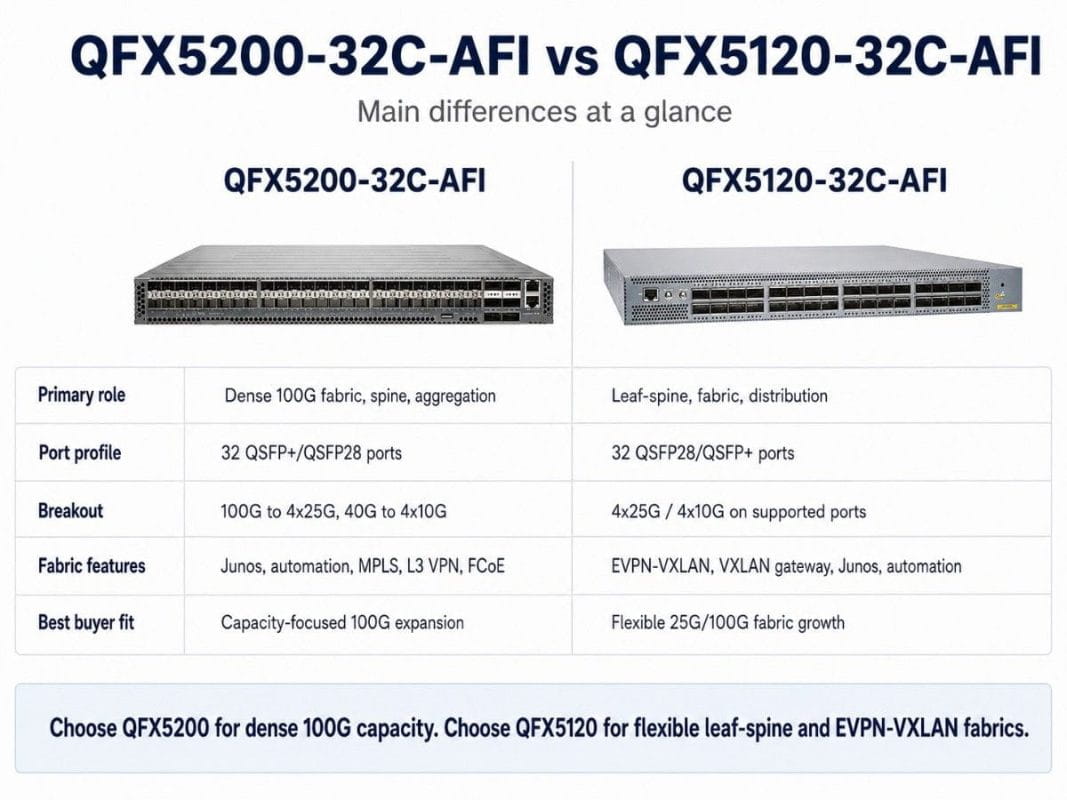
The two switches overlap in 100G density, but they often solve different problems. QFX5200-32C-AFI is often considered for dense 100G fabric and aggregation needs. QFX5120-32C-AFI is often considered for leaf-spine fabrics that need strong 25G breakout, EVPN-VXLAN support, and flexible deployment.
| Category | QFX5200-32C-AFI | QFX5120-32C-AFI | Buyer Takeaway |
| Primary role | 100G access, aggregation, lean spine | 100G leaf-spine, fabric, distribution | QFX5200 fits dense fabric roles; QFX5120 fits flexible fabric roles |
| Form factor | 1U | 1U | Both work well in rack-dense data centers |
| Port profile | 32 QSFP+/QSFP28 ports | 32 QSFP28/QSFP+ ports | Both support high-density 40G/100G designs |
| Breakout value | 100G to 4x25G, 40G to 4x10G | 100G to 4x25G on supported ports, 40G to 4x10G | QFX5120 needs port-level breakout planning |
| Fabric features | Junos, automation, MPLS, L3 VPN, FCoE | EVPN-VXLAN, VXLAN gateway, Junos, automation | QFX5120 is strong for EVPN-VXLAN fabrics |
| Best buyer fit | Dense 100G fabric, spine, aggregation | Leaf/fabric, 25G access, collapsed spine | Choose based on fabric role, not only port count |
The main keyword for this decision is not just speed. The real issue is fit. A buyer should map each switch to server access speed, uplink count, routing design, and the planned fabric model.
Which 100G Use Cases Fit QFX5200 and QFX5120?
100G data center switching is no longer only for large cloud providers. Many enterprises now need 100G for storage clusters, virtualization hosts, AI servers, backup systems, and spine-to-leaf connectivity.
| 100G Use Case | Better Fit | Why It Fits |
| Small data center spine | QFX5200-32C-AFI or QFX5120-32C-AFI | Both can provide 32 x 100G-class ports for compact spine designs |
| 25G server access with breakout | QFX5120-32C-AFI | Strong fit when many servers need 25G and uplinks need 100G |
| Dense 100G aggregation | QFX5200-32C-AFI | Good fit when the design needs more direct 100G aggregation capacity |
| EVPN-VXLAN fabric | QFX5120-32C-AFI | Juniper lists EVPN-VXLAN and VXLAN gateway support for QFX5120 |
| Storage or virtualization fabric | Either model | Final choice depends on latency, oversubscription, and port mix |
| Expansion of existing QFX5200 fabric | QFX5200-32C-AFI | Keeps design and spares strategy aligned |
| Mixed 25G/100G refresh | QFX5120-32C-AFI | Strong option when buyers need fabric flexibility |
For optics planning, buyers should confirm distance, fiber type, transceiver support, and port speed before purchase. A 100G fabric may need QSFP28 optics, DAC cables, breakout cables, or long-reach transceivers. For longer 100G fiber runs, 100G LR4 optics can become part of the bill of materials.
How Should Buyers Design Leaf-Spine Networks With Juniper QFX?
A leaf-spine design connects every leaf switch to every spine switch. This creates predictable paths and reduces the limits of older three-tier designs. It also helps teams scale east-west traffic between servers, storage, and services.
In a simple Juniper QFX fabric:
- Leaf switches connect to servers.
- Spine switches connect leaf switches together.
- 25G server ports often break out from 100G ports.
- 100G ports often handle spine-to-leaf links.
- EVPN-VXLAN can support overlay networks.
- Routing design should match the team’s operational skill set.
The QFX5120-32C-AFI can work well as a leaf or collapsed fabric switch where 25G breakout and EVPN-VXLAN matter. The QFX5200-32C-AFI can work well as a compact spine or aggregation switch where dense 100G matters.
A common planning mistake is buying the switch before validating the full bill of materials. The switch alone does not complete the fabric. Buyers also need optics, DAC cables, breakout cables, rails, power, airflow match, software needs, and spares.
What Juniper QFX Bundles Should Buyers Consider?
Recommended Juniper QFX bundles
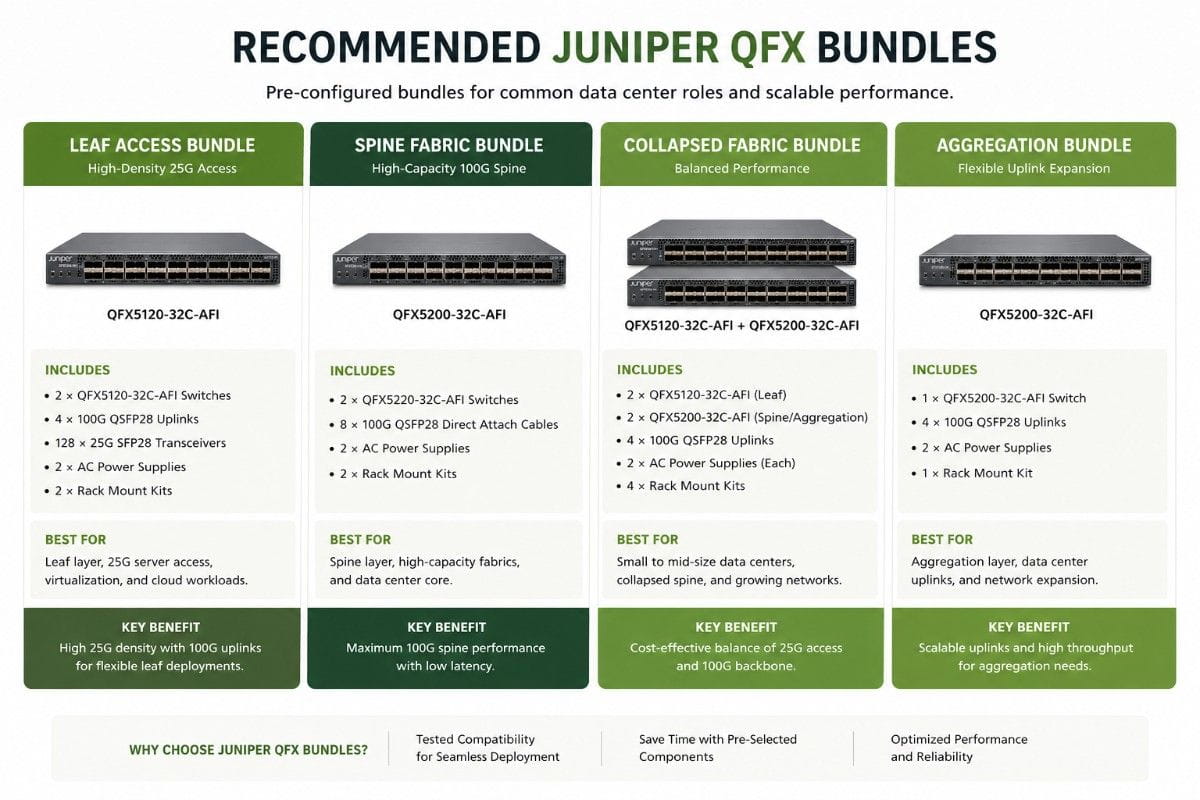
A strong bundle reduces deployment risk. It also helps procurement compare new and refurbished options in one quote.
| Bundle | Hardware | Best Fit | What to Validate |
| Bundle A: 100G Spine Bundle | QFX5200-32C-AFI, 100G optics, DAC cables | Spine, aggregation, dense 100G fabric | Optic type, cable distance, airflow, power, software needs |
| Bundle B: Leaf / Fabric Bundle | QFX5120-32C-AFI, 25G/100G connectivity | 25G server access, EVPN-VXLAN fabric, collapsed spine | Breakout rules, port map, optics, transceiver support |
| Bundle C: Juniper Data Center Fabric Bundle | QFX5200 + QFX5120 combination, optics, cabling | Mixed spine and leaf design | Oversubscription, uplink count, rack layout, spares |
Catalyst can help buyers quote the switch and the supporting parts together. This matters because a switch-only quote may look cheaper but still delay deployment if optics or cabling are missing.
Where Does Juniper Fit Against Cisco Nexus and Arista?
Juniper QFX, Cisco Nexus, and Arista all have strong roles in modern data centers. The right choice depends on installed base, fabric model, operations skill, lead time, licensing, and sourcing options.
Cisco Nexus often fits buyers standardized on NX-OS or ACI. Arista often fits buyers standardized on EOS and large-scale cloud-style operations. Juniper QFX often fits buyers who value Junos consistency, EVPN-VXLAN design, automation options, and strong 25G/100G fabric choices.
The Cisco statistics provided in the brief are useful only as Cisco context. Cisco states that the Nexus 93180YC-FX supports 3.6 Tbps bandwidth, 1.2 Bpps, 48 x 1/10/25G downlink ports, and 6 x 40/100G uplink ports. Cisco also states that the Nexus 93180YC-FX3 supports 3.6 Tbps, 1.2 Bpps, 48 x 1/10/25G downlinks, and 6 x 40/100G uplinks.
That means raw Cisco FX vs FX3 throughput and front-panel port density can look similar. But this article’s Juniper decision should focus on QFX architecture fit, not Cisco model parity.
For teams evaluating different vendors, Arista campus solutions may also enter the discussion when the network spans campus and data center requirements.
Should Buyers Choose New or Refurbished Juniper QFX Switches?
New hardware can make sense when a buyer needs the latest lifecycle status, standard OEM channel purchase, or a long support runway. Refurbished hardware can make sense when cost, availability, spares, or refresh timing matter more.
A refurbished QFX5200-32C-AFI or QFX5120-32C-AFI may fit when:
- The buyer needs faster sourcing.
- The data center already runs the same QFX model.
- The project needs a spare or replacement switch.
- Budget limits delay a full refresh.
- The buyer wants to stretch useful hardware life.
- The team needs a lab, DR, or expansion unit.
Refurbished sourcing should never mean guesswork. Buyers should verify hardware condition, airflow, power type, optics compatibility, software needs, and return policy before purchase.
This is where a partner matters. Catalyst works with buyers who need practical options across OEM, channel, distribution, and secondary-market supply. That flexibility helps teams reduce risk in supply-constrained markets without forcing a single path.
Cost control also matters across the full project. A strong sourcing plan can support lower network costs without cutting the wrong parts of the design
What Compatibility Checks Matter Before Buying QFX5200 or QFX5120?
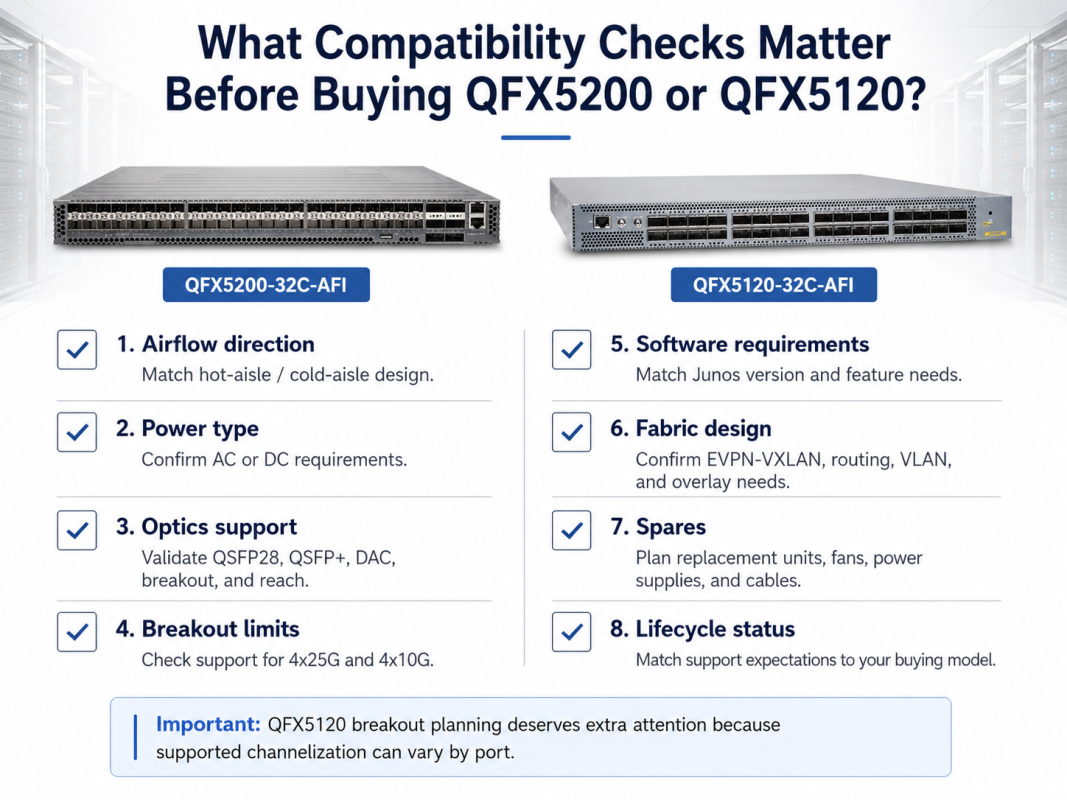
Compatibility checks should happen before the purchase order. The most common problems are not switch performance issues. They are planning gaps.
Key checks include:
- Airflow direction: Match hot aisle and cold aisle design.
- Power type: Confirm AC or DC requirements.
- Optics support: Validate QSFP28, QSFP+, DAC, breakout, and reach.
- Breakout limits: Confirm which ports support 4x25G or 4x10G.
- Software requirements: Match Junos version and feature needs.
- Fabric design: Confirm EVPN-VXLAN, routing, VLAN, and overlay needs.
- Spares: Plan replacement units, fans, power supplies, and cables.
- Lifecycle status: Match support expectations to the buying model.
The QFX5120-32C deserves special attention for breakout planning because Juniper documents port-specific channelization limits. Buyers should not assume every port supports every breakout mode.
Need Help Building the Right Juniper Data Center Fabric?
A strong Juniper QFX plan includes more than choosing QFX5200-32C-AFI or QFX5120-32C-AFI. It includes switch role, port speed, optics, cabling, power, airflow, lead time, and new versus refurbished sourcing.
Catalyst can help buyers compare Juniper QFX models, verify compatibility, and quote the full bundle across switches, optics, DAC cables, breakout cables, and supporting accessories. This is useful when timelines are tight, budgets are fixed, or the hardware market creates sourcing delays.
Request a Juniper data center bundle quote with compatible optics and cabling.
FAQs About Juniper QFX5200 vs QFX5120 Data Center Switches
1. What is the main difference between QFX5200-32C-AFI and QFX5120-32C-AFI?
QFX5200-32C-AFI is often a strong fit for dense 100G fabric, spine, or aggregation roles. QFX5120-32C-AFI is often a better fit for flexible leaf-spine fabrics, 25G breakout, and EVPN-VXLAN designs.
2. Is QFX5200-32C-AFI still worth buying refurbished?
Yes, it can be worth buying refurbished when the buyer needs dense 100G capacity, a replacement unit, or an expansion switch for an existing QFX5200 environment. The buyer should verify condition, airflow, power, optics, and software needs before purchase.
3. Is QFX5120-32C-AFI a good switch for 25G server access?
Yes. The QFX5120-32C can support 100G-to-25G breakout on supported ports, which makes it useful for 25G server connectivity with 100G uplinks. Buyers should confirm the port map before finalizing the design.
4. Can QFX5200 and QFX5120 work together in one fabric?
Yes, they can be planned together in a Juniper data center fabric. A common approach is to use one model for spine or aggregation and the other for leaf or fabric access, depending on port needs and software design.
5. When should I choose new instead of refurbished Juniper QFX hardware?
Choose new when lifecycle support, OEM channel purchase, or long-term standardization matters most. Choose refurbished when speed, cost, spares, or matching an existing environment matters more.
6. What should a Juniper QFX switch be bundled with?
A complete bundle should include the switch, 100G optics or DAC cables, breakout cables if needed, power supplies, fans, rails, and any required spare parts. Buyers should also check fiber type and distance.
7. Can Catalyst help verify Juniper QFX compatibility?
Yes. Catalyst can help check model fit, airflow, optics, cabling, power, availability, and new or refurbished sourcing options before the buyer commits to a purchase.