
Data center refresh projects rarely start with a simple switch replacement. They often begin when costs rise, lead times stretch, workloads grow, and older Cisco-based networks become harder to scale. Teams need more east-west traffic support, 25G server access, 100G uplinks, and AI-ready performance without adding more budget pressure.
That decision gets complicated fast. Cisco may still fit Cisco-heavy enterprises, ACI-driven networks, and teams built around Cisco operations. But during a refresh cycle, many buyers ask whether replacing Cisco Switches with Arista should be part of the comparison.
For many enterprises, replacing Cisco Switches with Arista creates a practical path toward stronger performance, better sourcing flexibility, and a more cost-conscious refresh plan. The right strategy also accounts for optics, DAC and AOC cables, MMF or SMF fiber, and the buyback value of retired Cisco equipment.
Why does a data center refresh make vendor comparison necessary?
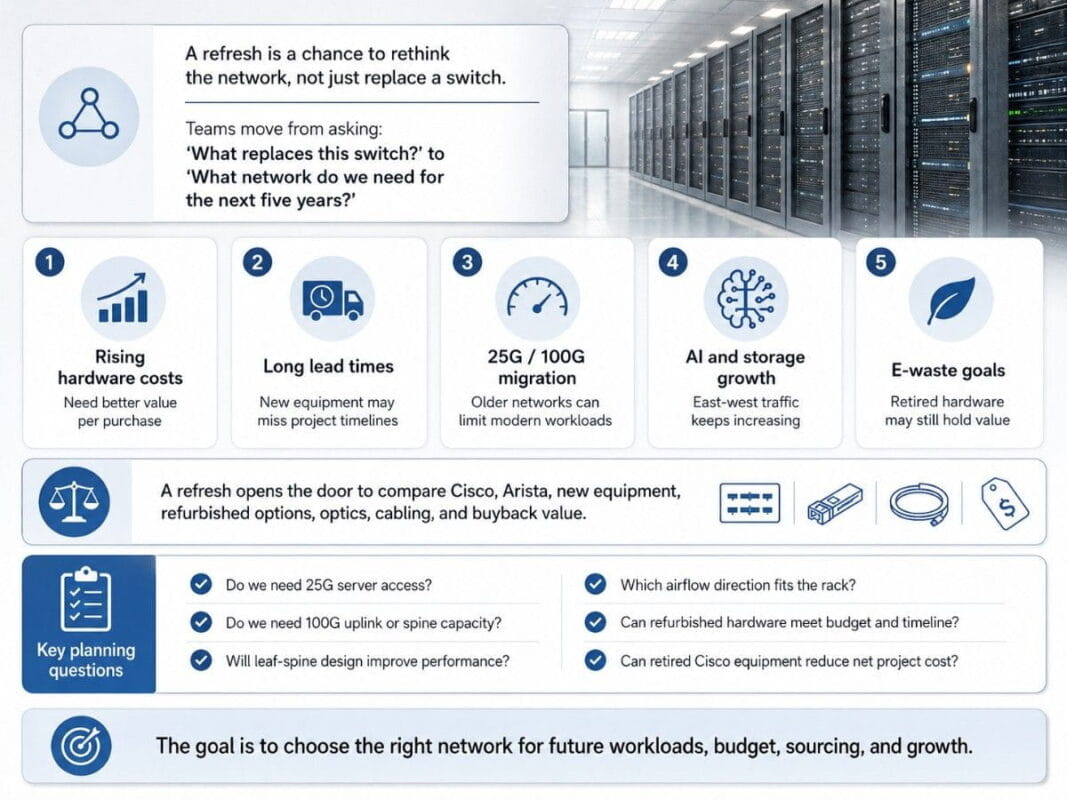
A data center refresh gives buyers a rare chance to rethink the network. Many teams keep the same vendor for years because the design works, the staff knows the tools, and procurement has a familiar path.
A refresh changes the question. Instead of asking, “What replaces this switch?” teams ask, “What network do we need for the next five years?”
That question opens the door to compare Cisco Nexus, Cisco Catalyst, Arista, new equipment, refurbished equipment, optics, cabling, and buyback options. It also helps teams avoid buying hardware that only solves yesterday’s problem.
A business that once used 10G access may now need 25G server links. A storage or virtualization environment may need more 100G uplinks. An AI or HPC cluster may need better east-west traffic handling across the fabric.
A practical refurbished network guide can help buyers understand testing, warranty, sourcing, and risk before choosing a refresh path.
| Refresh pressure | Why it matters | Buyer question |
| Rising hardware costs | Teams need more value from each purchase | Can we lower cost without hurting performance? |
| Long lead times | New equipment may not fit the project schedule | What can ship when we need it? |
| 25G / 100G migration | Older networks may limit modern workloads | Should we move to leaf-spine design? |
| AI and storage growth | East-west traffic keeps increasing | Can the fabric handle higher traffic volume? |
| E-waste goals | Retired hardware may still hold value | Can we sell or trade in old Cisco equipment? |
Refresh planning should answer clear questions:
- Do we need 25G server access?
- Do we need 100G spine or uplink capacity?
- Will a leaf-spine design improve performance?
- Which airflow direction fits the rack?
- Can refurbished hardware meet the budget and timeline?
- Can retired Cisco equipment reduce the net project cost?
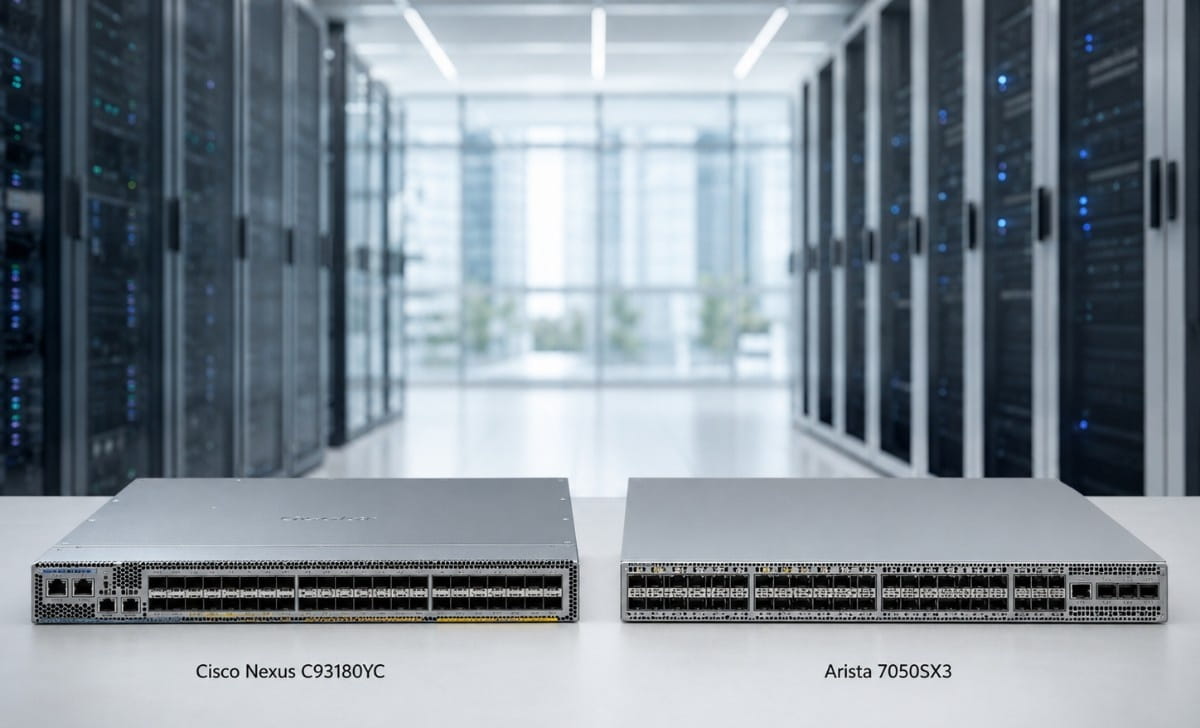
Many teams compare the Arista 7050SX3 switch with Cisco Nexus options when they plan 25G access and 100G uplinks. This comparison works best when buyers look at the full deployment, not just the switch price.
Why does Cisco still remain strong in enterprise environments?
Cisco remains a strong choice for many enterprises. A large number of organizations already use Cisco switching, routing, security, wireless, management, and support workflows.
That installed base matters. Network teams often know Cisco tools well. Procurement may already have Cisco supplier relationships. Internal standards may require Cisco in certain parts of the business.
Cisco can make strong sense when the organization depends on Cisco ACI, has Cisco-trained staff, or wants a consistent architecture across campus, core, and data center networks. In these cases, Cisco may reduce operational change during a refresh.
The Cisco Nexus C93180YC often appears in the same 25G and 100G data center discussion as Arista leaf switches. Buyers may compare the Cisco Nexus N9K-C93180YC-FX / FX3 with Arista 7050SX3 and 7060SX2 models when they need dense server access and 100G uplinks.
The Cisco Catalyst C9500 can also remain useful when refresh planning includes campus, aggregation, or enterprise core requirements.
Cisco may fit best when:
- The business already runs a Cisco-heavy environment
- The network team uses Cisco tools and support processes
- The architecture depends on Cisco ACI
- The project includes campus, core, and data center needs
- The buyer wants vendor continuity over platform change
A fair refresh plan should not frame Cisco as weak. Cisco remains strong in many enterprise environments. The better question is whether Cisco remains the best fit for the next workload, budget, and sourcing cycle.
Why are buyers evaluating Arista for cloud-style data center fabrics?
Buyers evaluate Arista when they want high-performance Ethernet switching, simplified operations, and scalable leaf-spine design. Arista often fits environments with heavy east-west traffic, automation needs, and fast-growing data center workloads.
Arista does not fit every network. It often fits buyers who want a cleaner data center fabric and strong 25G / 100G options without adding unnecessary platform complexity.
Arista is attractive for:
- Cloud-style data centers
- AI and HPC infrastructure
- Virtualization-heavy environments
- Storage networks
- 25G server access designs
- 100G spine and uplink designs
- Refurbished data center refresh projects
Cost also matters. Many buyers study network cost strategies before choosing new hardware, refurbished hardware, or a blended sourcing model.
Arista can support a clear refresh pattern. Buyers can use 25G leaf switches for server access and 100G switches for spine or uplink capacity. This makes it easier to size the network and quote the right optics, DAC cables, AOC cables, and fiber.
That structure also helps procurement. Instead of buying parts one by one, the team can request a full switch, optics, and cable bundle that matches the rack layout and workload.
Which Arista switches fit a 25G leaf and 100G spine migration?
A Cisco-to-Arista refresh often focuses on two key layers: leaf and spine. The leaf layer connects servers. The spine layer connects leaf switches and moves traffic across the fabric.
This model supports scale. It also gives buyers a cleaner way to plan port speed, optics, cables, rack airflow, and future growth.
25G leaf switch options
The Arista DCS-7050SX3-48YC8 fits many 25G server access designs. It can serve as a leaf switch in a modern data center fabric where the buyer needs 25G downlinks and 100G uplinks.
The Arista DCS-7060SX2-48YC6-F and DCS-7060SX2-48YC6-R also support 25G server access with 100G uplinks. These models give buyers airflow choices, which matters in real data center racks.
A buyer may choose the 7060SX2 front airflow model or the 7060SX2 rear airflow model based on cooling direction and rack design.
100G spine switch options
The Arista DCS-7050CX3-32S-F fits high-density 100G switching needs. Buyers can use it for spine, collapsed spine, or high-performance interconnect roles.
The Arista DCS-7060CX-32S-F also fits 100G-heavy environments. It can support fabric capacity for cloud, storage, AI, HPC, and virtualization workloads.
For higher-density 100G planning, the Arista 7050CX3 platform and Arista 7060CX spine give buyers practical options for fabric growth.
| Network role | Arista option | Cisco option | Main consideration |
| 25G leaf | DCS-7050SX3-48YC8 | Nexus N9K-C93180YC-FX / FX3 | Server access and 100G uplinks |
| 25G / 100G flexible leaf | DCS-7060SX2-48YC6-F / R | Nexus N9K-C93180YC-FX / FX3 | Airflow, rack fit, and fabric design |
| 100G spine | DCS-7050CX3-32S-F | Cisco Nexus options | Spine capacity and high-density links |
| 100G-heavy fabric | DCS-7060CX-32S-F | Cisco Nexus options | Cloud, storage, AI, and HPC traffic |
| Enterprise aggregation | Depends on design | Catalyst C9500-48Y4C-A | Campus, core, and Cisco standardization |
What optics and cables should buyers plan with Arista switches?
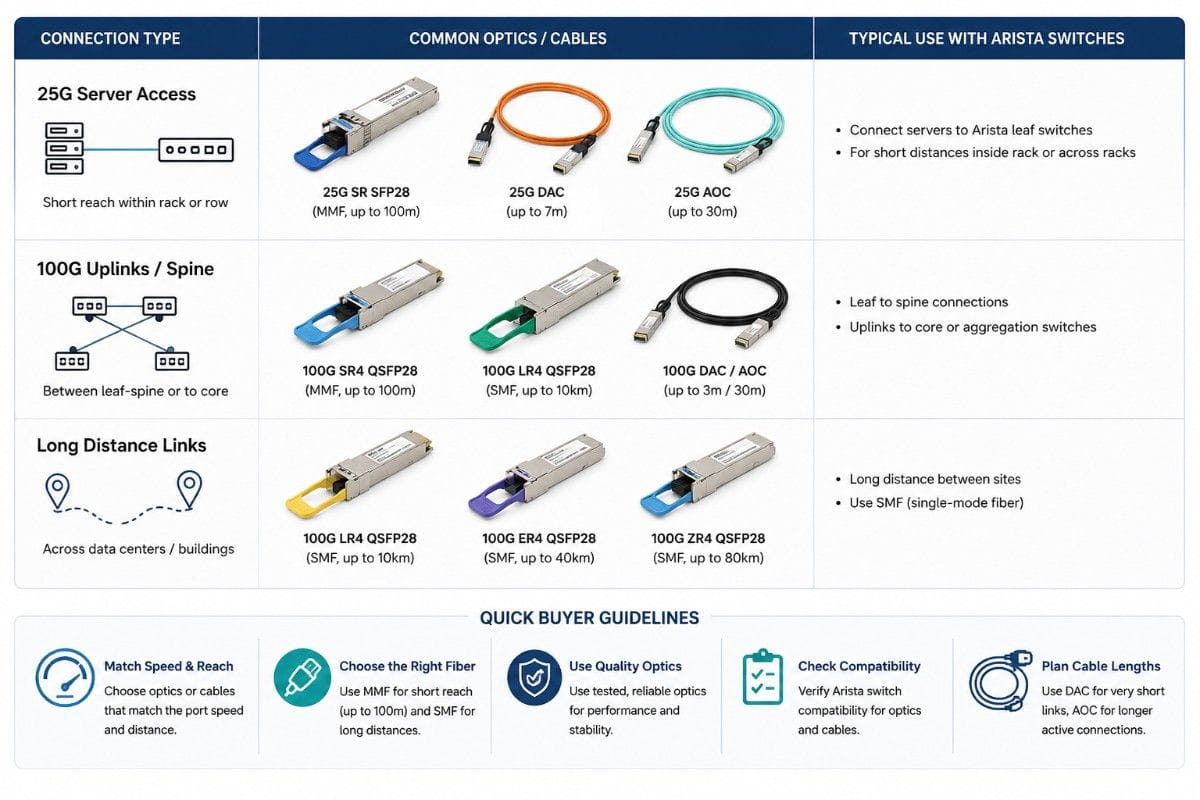
A refresh project needs more than switches. Optics, DAC cables, AOC cables, MMF fiber, and SMF fiber can affect cost, lead time, and deployment success.
For 25G server access, buyers often compare the Arista 25G SR transceiver with 25G DAC cables. The right choice depends on distance, rack layout, and fiber preference.
For 100G uplinks, buyers often compare the Arista 100G SR4 transceiver, the Arista 100G LR4 transceiver, 100G DAC cables, and 100G AOC cables.
MMF fiber often fits short data center links. SMF fiber supports longer distances. Buyers should confirm reach, connector type, fiber plant, and switch compatibility before finalizing the quote.
| Connectivity need | Common option | Best fit | Planning note |
| 25G server access | Arista SFP-25G-SR | Short MMF links | Useful when fiber is preferred |
| 25G short runs | 25G DAC cables | In-rack or short rack links | Often cost-effective |
| 100G short uplinks | Arista QSFP-100G-SR4 | MMF data center links | Common for short fabric uplinks |
| 100G longer uplinks | Arista QSFP-100G-LR4 | SMF links | Better for longer runs |
| 100G short cable runs | 100G DAC cables | Short rack connections | Simple and cost-focused |
| 100G active cable links | 100G AOC cables | Short-to-mid distance links | Useful when active optical cabling fits |
Buyers should not treat optics as an afterthought. A switch plan and a cable plan should move together. This helps avoid compatibility gaps, missing transceivers, or wrong fiber choices during deployment.
When does Buying Refurbished Arista Switches make sense?
Buying Refurbished Arista Switches makes sense when buyers need stronger data center performance, but also need cost control, faster sourcing, or flexible project timing.
Refurbished does not mean random used equipment. Enterprise buyers should expect tested hardware, accurate part numbers, airflow verification, power supply checks, fan checks, warranty options, and clear availability.
Refurbished Arista hardware can fit:
- Data center refresh projects
- Expansion of existing 25G / 100G fabrics
- Lab and development environments
- Secondary sites
- Spare inventory
- AI or HPC expansion projects
- Emergency replacement needs
- Phased Cisco-to-Arista migrations
New hardware may still make sense for long lifecycle production builds. Refurbished hardware may fit better when budget, timing, and availability drive the project.
Some buyers use a blended model. They may use new switches for the most critical production layer and refurbished switches for expansion, labs, spares, or secondary clusters.
This matters for AI and high-performance networks. The network must support servers, GPUs, and storage, but the budget may already face pressure from compute and power needs. Teams planning AI infrastructure should account for switching, optics, and cabling early because AI network challenges can affect the full system.
| Buying path | Best fit | Main value | Watch point |
| New Arista | Long lifecycle production builds | Latest lifecycle path | Higher cost or lead time |
| Refurbished Arista | Refresh, expansion, labs, spares | Lower cost and faster sourcing | Verify testing and compatibility |
| New Cisco | Cisco-standard environments | Strong continuity | May not fit every budget |
| Refurbished Cisco | Like-for-like replacement | Keeps existing design stable | May not modernize the fabric |
| Mixed sourcing | Phased migrations | Balances cost, risk, and timing | Requires careful planning |
How can retired Cisco equipment support the refresh budget?
A refresh project should not end with retired switches sitting unused in storage. Older Cisco Nexus and Cisco Catalyst hardware may still hold resale or trade-in value.
Organizations can use that value to offset the cost of new or refurbished Arista equipment. This can reduce the net project cost and support sustainability goals.
A Cisco-to-Arista refresh may include:
- Audit of retired Cisco Nexus switches
- Audit of retired Cisco Catalyst switches
- Part number and serial number review
- Condition checks
- Configuration and accessory review
- Buyback or trade-in quote
- Logistics planning
- Recycling for equipment with no resale value
This approach also supports circular IT practices. A practical circular IT model helps enterprises recover value from usable hardware instead of treating every retired asset as waste.
Buyback planning should start early. If the team waits until the end of the refresh, retired equipment may sit for months. Early planning gives procurement a clearer view of the real project cost.
What should a Cisco-to-Arista data center refresh bundle include?
A Cisco-to-Arista refresh bundle should include every part needed to connect servers and uplinks. A switch-only quote can miss important deployment costs.
A practical bundle may include:
- Leaf switch: Arista DCS-7050SX3-48YC8 or DCS-7060SX2-48YC6-F / R
- Spine switch: Arista DCS-7050CX3-32S-F or DCS-7060CX-32S-F
- Server connectivity: Arista SFP-25G-SR or 25G DAC cables
- Uplinks: Arista QSFP-100G-SR4, QSFP-100G-LR4, 100G DAC, or 100G AOC
- Fiber: MMF or SMF based on distance
- Buyback option: retired Cisco Nexus or Cisco Catalyst equipment
- Optional comparison quote: Cisco Nexus vs Arista side by side
| Bundle area | Recommended items | Why it matters |
| Leaf layer | DCS-7050SX3-48YC8 or DCS-7060SX2-48YC6 | Supports 25G server access and 100G uplinks |
| Spine layer | DCS-7050CX3-32S-F or DCS-7060CX-32S-F | Supports 100G fabric capacity |
| Server links | SFP-25G-SR or 25G DAC | Matches rack distance and cabling preference |
| Uplinks | QSFP-100G-SR4 / LR4 or 100G DAC/AOC | Supports fabric connectivity |
| Fiber | MMF or SMF | Matches reach and fiber plant |
| Recovery value | Cisco Nexus / Catalyst buyback | Helps offset refresh cost |
This bundle-based view helps buyers avoid missing parts. It also helps procurement compare Cisco and Arista options more fairly.
A switch-only quote may look cheaper at first. A full bundle quote gives a better view of real deployment cost.
How can buyers compare Cisco and Arista without vendor bias?

A fair comparison starts with the environment, not the logo. The right platform depends on workload, operations, budget, sourcing timeline, and lifecycle goals.
Buyers should compare Cisco and Arista across:
- Current architecture
- Future workload growth
- 25G and 100G port needs
- Leaf-spine design goals
- Staff experience
- Automation and operations model
- Optics and cable compatibility
- Airflow direction
- Lead time
- New vs refurbished options
- Warranty expectations
- Buyback value for retired equipment
Arista often makes sense when the buyer wants a high-performance Ethernet fabric, cloud-style operations, strong 25G / 100G switching, and flexible sourcing.
Cisco often makes sense when the buyer already runs a Cisco-heavy environment, depends on Cisco architecture, or wants continuity across data center, campus, and enterprise networks.
Some enterprises may use both. They may keep Cisco in parts of the network and use Arista for data center fabric roles. Others may phase in Arista during a refresh while selling retired Cisco hardware to recover value.
Teams planning AI or modern data center upgrades should also consider total infrastructure cost. Switching, optics, and cabling affect servers, GPUs, and storage. A broader AI cost plan can help buyers avoid underbuilding the network after investing in compute.
What outcome should enterprise buyers expect from a better refresh plan?
The best outcome is not simply replacing Cisco with Arista. The best outcome is making a better refresh decision.
For some enterprises, Cisco remains the right path. For others, Arista offers a strong alternative for cloud-style data center switching, 25G leaf access, 100G spine design, and cost-effective refurbished sourcing.
A smart refresh plan should help the buyer:
- Improve network performance
- Control hardware cost
- Reduce sourcing risk
- Plan optics and cabling correctly
- Support AI, storage, and virtualization growth
- Recover value from retired Cisco equipment
- Choose new, refurbished, or blended sourcing with confidence
Buying Refurbished Arista Switches can play a major role in that plan. It gives enterprises another way to modernize data center networks without relying only on new hardware budgets or long replacement cycles.
A vendor-neutral comparison also protects the buyer. It helps teams avoid overbuying, underbuilding, or choosing hardware based only on habit.
The right refresh project should leave the business with a faster, cleaner, and more flexible network. It should also give procurement, IT, and leadership a clear reason for every switch, optic, cable, and sourcing decision.
Need help building a practical Cisco-to-Arista refresh plan?
Catalyst Data Solutions helps buyers compare Cisco and Arista options without forcing a vendor bias. The goal is to match the hardware plan to the workload, budget, timeline, airflow, port speed, optics, and lifecycle need.
Ask Catalyst for refurbished Arista availability, bundle pricing, compatibility checks, and options to sell or trade in decommissioned Cisco switches.
FAQ
Why are enterprises replacing Cisco switches with Arista?
Enterprises consider Arista when they want cloud-style operations, high-performance Ethernet fabrics, simplified network design, and strong 25G / 100G data center switching. This does not mean Cisco is a poor choice. It means some refresh projects create a good time to compare both platforms.
Is Arista better than Cisco for every data center?
No. Arista is not better for every environment. Arista often fits cloud-style data centers, AI/HPC networks, and leaf-spine Ethernet fabrics. Cisco often remains strong in Cisco-standardized enterprises, ACI environments, and broader campus/core ecosystems.
What Arista switch is best for 25G leaf switching?
The Arista DCS-7050SX3-48YC8 and DCS-7060SX2-48YC6-F / R are strong options for 25G server access with 100G uplinks. The right choice depends on port needs, airflow, availability, and fabric design.
What Arista switch is best for 100G spine switching?
The Arista DCS-7050CX3-32S-F and DCS-7060CX-32S-F are useful options for 100G spine, collapsed spine, or high-density interconnect needs. Buyers should compare port count, airflow, power, and availability.
Should enterprises buy new or refurbished Arista switches?
Enterprises should choose based on lifecycle, budget, support needs, and timeline. New switches may fit long-term production builds. Refurbished Arista switches may fit refresh projects, expansion, labs, spares, and cost-controlled deployments.
What should buyers check before buying refurbished Arista switches?
Buyers should check part number, airflow direction, port speeds, power supplies, fans, optics compatibility, testing status, warranty terms, and availability. They should also confirm cable and fiber requirements before deployment.
Can retired Cisco equipment help fund an Arista refresh?
Yes. Retired Cisco Nexus and Catalyst switches may have resale or trade-in value. A buyback plan can help offset the cost of new or refurbished Arista switches, optics, and cabling.
What should a Cisco-to-Arista bundle include?
A complete bundle should include Arista leaf switches, Arista spine switches, 25G server optics or DAC cables, 100G uplink optics or DAC/AOC cables, MMF or SMF fiber, and a buyback option for retired Cisco equipment.
How can Catalyst help with Cisco and Arista comparisons?
Catalyst can help compare Cisco and Arista options based on workload, port count, airflow, budget, lead time, new or refurbished availability, optics compatibility, and buyback value for retired hardware.