
AI and high-performance computing are no longer separate disciplines. Researchers now use machine learning to accelerate simulations, analyze complex datasets, build digital twins, and support discoveries in areas such as climate science, materials research, genomics, and engineering.
That convergence creates new infrastructure demands. A modern scientific AI platform must move data efficiently between CPUs, GPUs, memory, storage, and high-speed networks while maintaining the reliability required for research and production workloads.
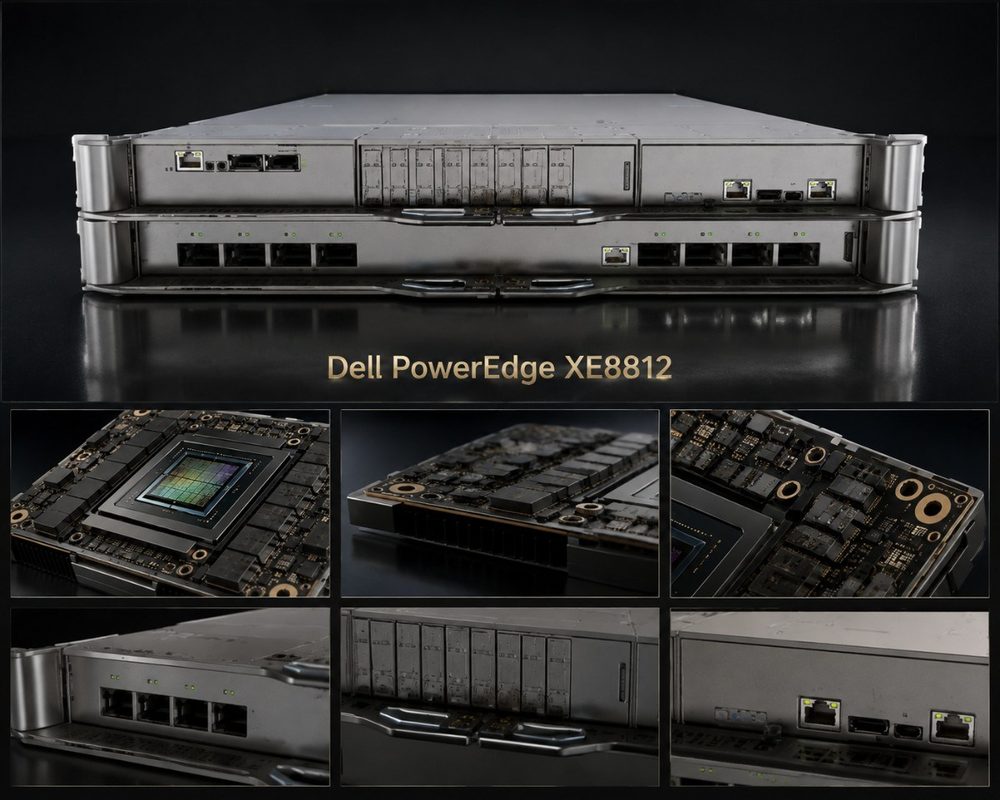
The Dell PowerEdge XE8812 addresses this need with a high-density design built around NVIDIA Vera Rubin NVL4. Dell positions the direct-liquid-cooled server for demanding HPC simulations, AI training, inference, and data-intensive scientific workloads, with PowerRack deployments scaling to 144 Rubin GPUs per rack.
The platform is aimed at research centers, supercomputing environments, engineering organizations, and enterprises that need to combine traditional scientific computing with AI acceleration. Buyers comparing dense NVIDIA systems can also review how DGX and HGX platforms approach GPU computing, networking, and deployment.
What Is the Dell PowerEdge XE8812?
Dell introduced the PowerEdge XE8812 in June 2026 as part of the Dell AI Factory with NVIDIA. Rather than targeting ordinary enterprise server workloads, Dell positions it for demanding HPC, scientific simulation, AI training, inference, and data-intensive computing.
The system uses NVIDIA Vera Rubin NVL4, which places four Rubin GPUs alongside two Vera CPUs in a tightly connected accelerated-computing architecture. Dell plans to integrate XE8812 servers into its PowerRack 9100 environment, using an OCP-based rack design for high-density deployment.
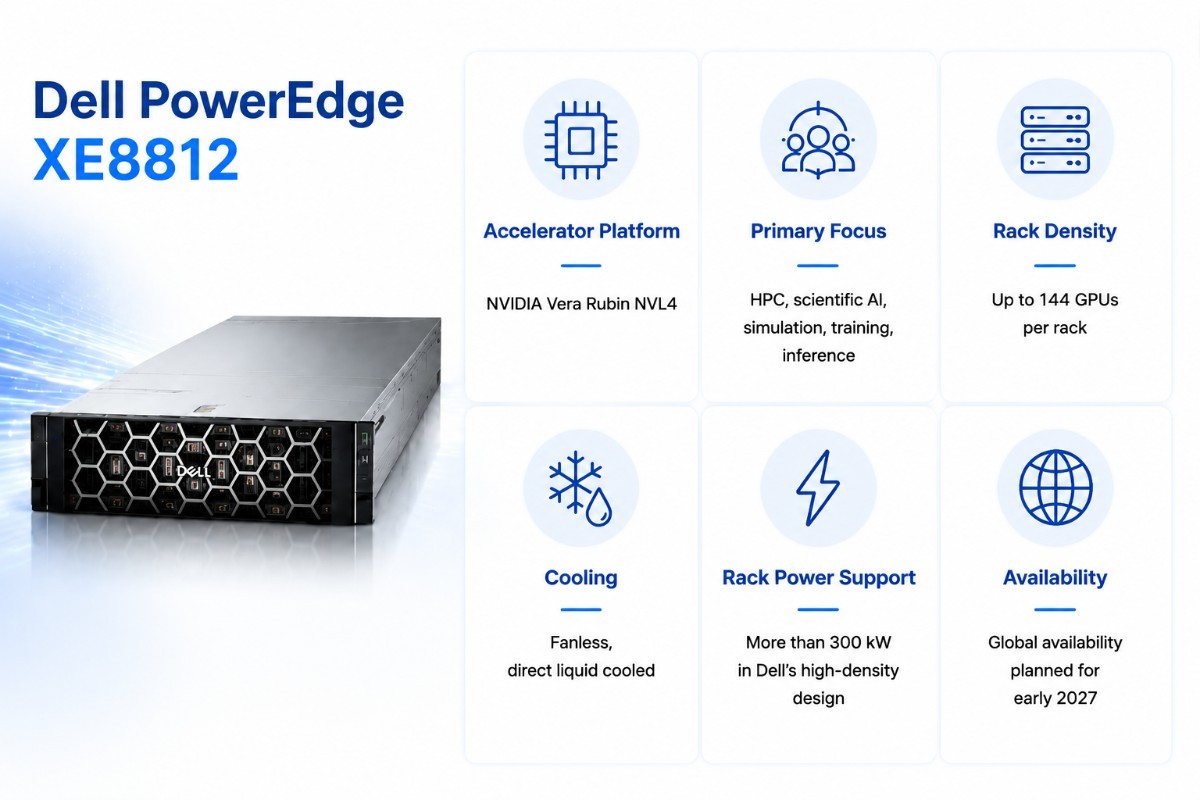
| XE8812 characteristic | Practical meaning |
| Accelerator platform | NVIDIA Vera Rubin NVL4 |
| Primary focus | HPC, scientific AI, simulation, training, inference |
| Rack density | Up to 144 GPUs per rack |
| Cooling | Fanless, direct liquid cooled |
| Rack power support | More than 300 kW in Dell’s high-density design |
| Deployment architecture | Dell PowerRack 9100 / ORv3-style infrastructure |
| Availability | Dell states global availability is planned for early 2027 |
Dell’s June announcement means buyers should currently treat the XE8812 as announced, not generally available. Organizations planning deployments should verify final configurations, validated components, lead times, and orderability as Dell moves toward commercial availability.
The progression from earlier accelerators also shows why buyers need to evaluate complete platforms instead of GPUs alone. Catalyst’s discussion of H100 SXM architecture illustrates how server design, interconnect, power, networking, and cooling already shaped dense GPU deployments before Rubin.
NVIDIA Vera Rubin NVL4 Architecture Explained
NVIDIA Vera Rubin NVL4 combines four Rubin GPUs with two NVIDIA Vera CPUs. NVIDIA connects the GPUs through a second-generation NVLink bridge using sixth-generation NVLink and links the CPU and GPU domains through NVLink-C2C.
How the Vera Rubin NVL4 Architecture Works
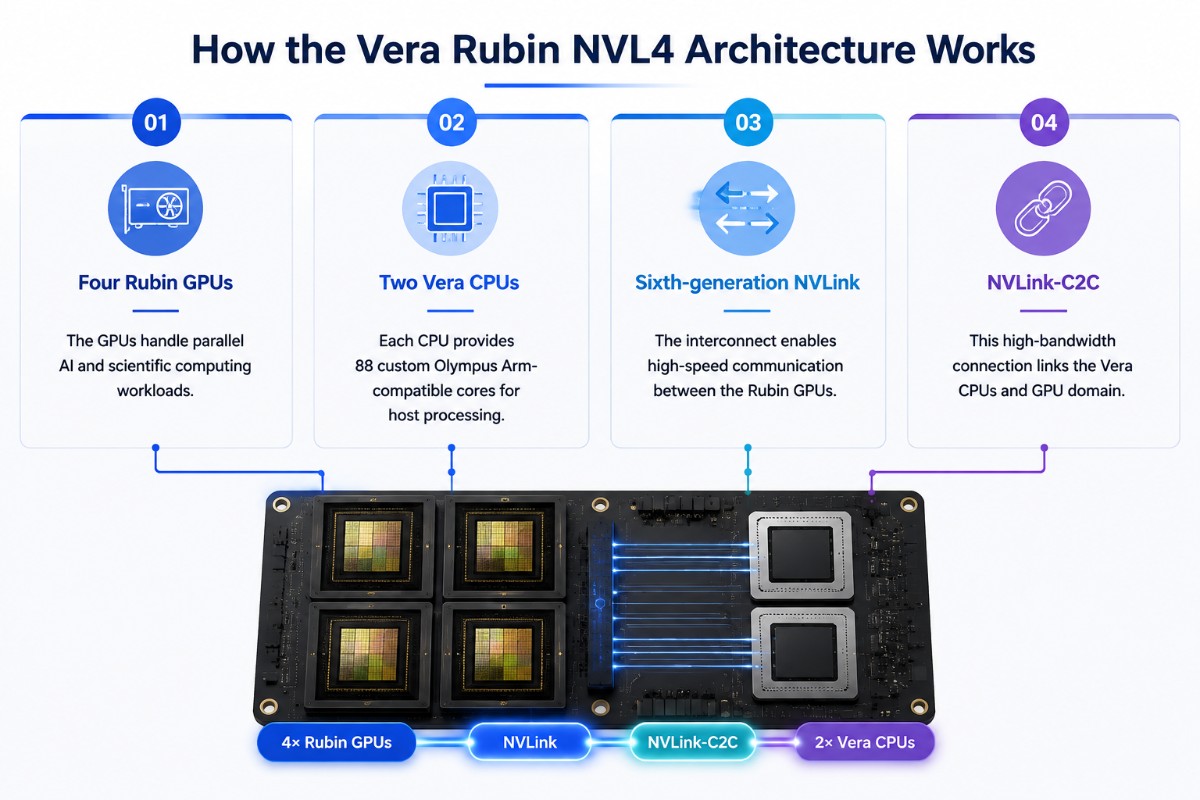
- Four Rubin GPUs: The GPUs handle parallel AI and scientific computing workloads.
- Two Vera CPUs: Each CPU provides 88 custom Olympus Arm-compatible cores for host processing.
- Sixth-generation NVLink: The interconnect enables high-speed communication between the Rubin GPUs.
- NVLink-C2C: This high-bandwidth connection links the Vera CPUs and GPU domain.
Why GPU Interconnect Matters
Scientific computing depends heavily on data movement. A powerful accelerator can deliver limited real-world value when CPUs, GPU memory, storage, or network fabrics cannot supply data quickly enough.
NVLink helps reduce communication delays between GPUs. NVLink-C2C also helps move data efficiently between CPU and GPU resources, which supports workloads that combine traditional HPC processing with AI acceleration.
Reported Vera Rubin NVL4 Performance
NVIDIA reports that NVL4 can deliver:
- Up to 4× higher performance for scientific simulations.
- Up to 6× higher performance for AI-for-Science training.
- Up to 8× higher performance for AI-for-Science inference.
These figures compare NVL4 with Grace Hopper and remain vendor-reported results. Actual performance will vary by application, software stack, dataset, precision, and cluster configuration.
What Buyers Need to Plan
The NVL4 architecture changes how organizations should evaluate an AI or HPC server. Buyers should assess the complete infrastructure, not only the GPU specification.
A deployment plan should include:
- Server and CPU configuration.
- GPU memory and system memory.
- NVLink and cluster networking.
- Storage throughput for datasets and checkpoints.
- Rack power and direct liquid cooling.
- Software, drivers, and application compatibility.
Catalyst’s GPU deployment planning guidance follows this system-level approach. Accelerator selection should happen alongside server, memory, storage, networking, power, and cooling decisions.
How Does the XE8812 Support Scientific AI Workloads?
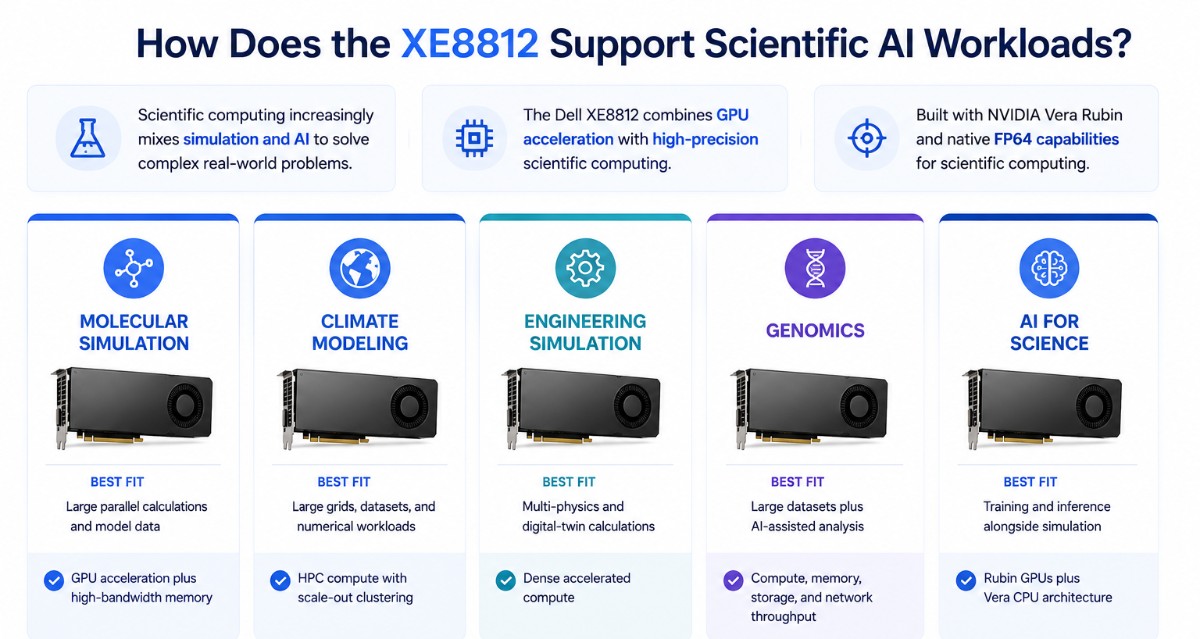
Scientific computing increasingly mixes simulation and AI instead of treating them as separate environments. Researchers may generate data through a physics simulation, train an AI surrogate model on those results, run inference, and feed the output back into another simulation.
The Dell XE8812 fits workloads where both GPU acceleration and high-precision scientific computing matter. NVIDIA specifically positions Vera Rubin for scientific computing with native FP64 capabilities alongside AI acceleration.
| Scientific workload | Why accelerated infrastructure matters | XE8812 relevance |
| Molecular simulation | Large parallel calculations and model data | GPU acceleration plus high-bandwidth memory |
| Climate modeling | Large grids, datasets, and numerical workloads | HPC compute with scale-out clustering |
| Engineering simulation | Multi-physics and digital-twin calculations | Dense accelerated compute |
| Genomics | Large datasets plus AI-assisted analysis | Compute, memory, storage, and network throughput |
| AI for science | Training and inference alongside simulation | Rubin GPUs plus Vera CPU architecture |
Dell specifically cites molecular and multi-physics simulation as target workloads. The U.S. Department of Energy’s upcoming Doudna supercomputer at NERSC will use PowerEdge XE8812 servers with Vera Rubin NVL4 and NVIDIA Quantum-X800 InfiniBand networking.
Dell says Doudna will support more than 12,000 researchers working in areas including climate science, fusion energy, materials science, chemistry, and computational biology. This provides a real deployment reference for how the XE8812 can move from an individual server into scientific AI infrastructure.
Why Are HPC and AI Converging?
Traditional HPC primarily focused on numerical models, simulations, and tightly parallelized scientific applications. Modern scientific environments increasingly add machine learning to accelerate those workflows or analyze results that would be difficult to process manually.
AI can contribute to HPC through surrogate models, digital twins, anomaly detection, generative science, scientific foundation models, and AI-assisted data analysis. NVIDIA describes Vera Rubin as a platform capable of combining traditional numerical solvers, AI training, inference, instrument data, and real-time analytics.
The result changes what a supercomputing AI platform needs. Raw GPU performance still matters, but CPU throughput, memory capacity, storage bandwidth, GPU communication, and network latency increasingly determine how efficiently the full scientific workflow runs.
Inside the Dell XE8812 AI Factory Design
The XE8812 illustrates the move from standalone GPU servers toward integrated AI data center architecture. Dell’s PowerRack design coordinates compute, rack power, cooling, management, and deployment rather than asking operators to assemble each layer independently.
Dell describes the XE8812 as fanless and direct liquid cooled. At rack scale, Dell plans configurations with up to 144 GPUs, support for more than 300 kW, and direct liquid cooling for both CPUs and GPUs.
The infrastructure stack matters as much as the server:
| Layer | XE8812 deployment consideration | Why buyers should verify it |
| Compute | Vera CPUs + Rubin GPUs | Determines workload and software fit |
| GPU interconnect | NVLink / NVLink-C2C architecture | Moves data across the accelerated domain |
| Scale-out network | InfiniBand or validated Ethernet architecture | Connects servers across the cluster |
| Storage | High-throughput shared and local storage | Feeds datasets and handles checkpoints/results |
| Facility | Rack power, liquid cooling, CDU and distribution | Sustains high-density operation |
Network design becomes especially important when simulations or training jobs span many nodes. Catalyst’s guide to AI networking bottlenecks explains why congestion, topology, optics, and bandwidth can affect expensive accelerators even when the servers themselves are correctly sized.
Dell also includes iDRAC, Dell Integrated Rack Controller, and OpenManage Enterprise in its management approach. Real-time telemetry and automated leak detection help operators manage a liquid-cooled infrastructure environment rather than treating cooling as a separate facilities problem.
What Should Be Bought With a Dell XE8812?
A Dell PowerEdge XE8812 deployment should not stop with the server. Buyers need a validated configuration spanning the rack, networking, storage, cabling, cooling, power, and management layers.
A practical configuration may include a Dell PowerRack environment with XE8812 compute, a low-latency scale-out fabric, high-throughput storage for datasets and checkpoints, and redundant facility-side liquid cooling. The exact bill of materials should follow Dell and NVIDIA validation rather than assumptions based only on port type or connector compatibility.
- Network fabric: Size InfiniBand or validated Ethernet around node count, workload communication, and oversubscription.
- Storage: Plan enough throughput for datasets, checkpoints, simulation output, and AI data pipelines.
- Optics and cables: Match speed, reach, connector type, switch ports, and selected network topology.
- Cooling: Confirm CDUs, manifolds, facility water requirements, redundancy, and heat-rejection capacity.
- Power: Validate rack distribution against Dell’s 300 kW-plus high-density architecture.
High-density hardware requires facility planning before installation. Catalyst’s guidance on high-density cooling strategies covers the thermal and infrastructure questions that should accompany a liquid-cooled AI server project.
Dell XE8812 vs Traditional HPC Servers
A traditional HPC server may still rely heavily on CPU performance, with accelerators added only for selected applications. That approach remains appropriate when software depends on CPU-heavy numerical processing or when the workload does not benefit enough from dense GPUs to justify the facility requirements.
The Dell XE8812 HPC server starts from a different assumption: accelerated computing forms a central part of the workload. Its Vera Rubin NVL4 architecture tightly connects CPU and GPU resources for applications that mix simulation, AI, and data processing.
The main differences include:
- Traditional systems may prioritize CPU density; XE8812 prioritizes tightly coupled CPU-GPU acceleration.
- Conventional racks can operate at lower power densities; XE8812 targets very high-density liquid-cooled infrastructure.
- Traditional HPC may use GPUs selectively; XE8812 targets GPU-intensive simulation and scientific AI.
- XE8812 deployments require careful network and storage design when workloads scale across nodes.
That does not make the XE8812 the best HPC AI server for every organization. CPU-centric research codes, modest cluster sizes, existing air-cooled facilities, or constrained power budgets may favor a different platform.
Dell XE8812 vs XE9812: Different Vera Rubin Platforms
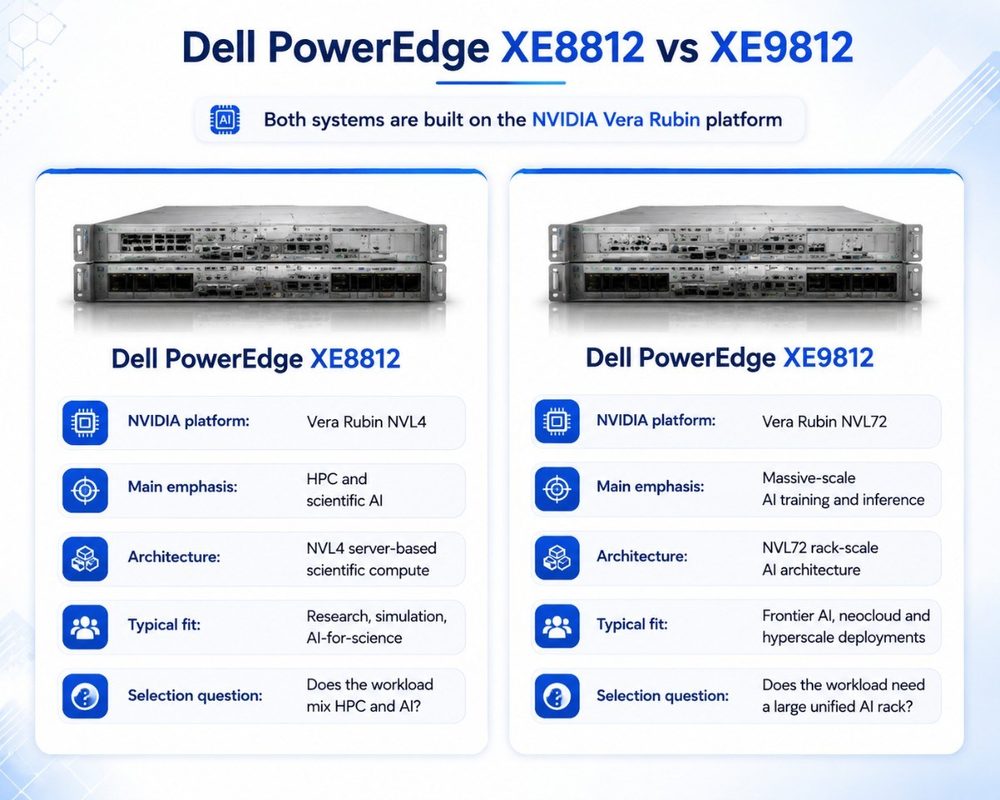
The Dell XE8812 and XE9812 both belong to Dell’s next-generation Vera Rubin portfolio, but Dell designed them around different architectural goals.
| Decision point | Dell PowerEdge XE8812 | Dell PowerEdge XE9812 |
| NVIDIA platform | Vera Rubin NVL4 | Vera Rubin NVL72 |
| Main emphasis | HPC and scientific AI | Massive-scale AI training and inference |
| Architecture | NVL4 server-based scientific compute | NVL72 rack-scale AI architecture |
| Typical fit | Research, simulation, AI-for-science | Frontier AI, neocloud and hyperscale deployments |
| Selection question | Does the workload mix HPC and AI? | Does the workload need a large unified AI rack? |
Dell describes the XE9812 as its flagship liquid-cooled Vera Rubin NVL72 server for massive real-time training and inference. The XE8812 instead focuses strongly on HPC and scientific computing with NVL4.
The larger number is therefore not automatically the better purchase. Organizations should choose based on application topology, model scale, numerical precision, software, network design, power, cooling, and deployment scale.
Buyers who want a non-NVIDIA architecture should also evaluate the AMD Helios architecture. Helios takes a different rack-scale approach built around AMD Instinct MI455X accelerators, EPYC Venice CPUs, Pensando networking, and ROCm.
Why Memory, Networking, and Cooling Matter
Memory
Scientific models can work with enormous matrices, meshes, molecular states, and AI datasets. Keeping more of that working set close to the compute layer can reduce staging and swapping between accelerator memory, system memory, and storage.
Dell says Vera Rubin NVL4 increases both host and GPU memory capacity compared with its previous GB200 NVL4 generation. Dell specifically connects that extra capacity with running larger simulations and models in memory.
Networking
One XE8812 can provide dense compute, but a GPU cluster infrastructure must move data between many servers. Poor network design can leave accelerators waiting during collective communication, distributed simulation, checkpoint operations, or distributed training.
Dell’s Doudna architecture provides a useful reference: Dell and NERSC plan to connect XE8812 systems through NVIDIA Quantum-X800 InfiniBand. Buyers should still verify the validated fabric, NICs, switch topology, optics, and cables for their specific configuration.
Cooling and Power
Liquid cooling does not automatically make an application faster. It allows designers to remove heat efficiently enough to sustain very dense compute while reducing dependence on high-volume server airflow.
That distinction matters for the XE8812 because Dell plans rack designs exceeding 300 kW. Facilities need to evaluate CDUs, manifolds, water loops, power distribution, redundancy, service access, and heat rejection before treating the system as a normal rack-server installation.
Who Is the Dell XE8812 For?
The Dell PowerEdge XE8812 makes the strongest case where scientific computing and AI already overlap.
- National laboratories and supercomputing centers running large simulations.
- Universities and research institutions building scientific AI infrastructure.
- Engineering organizations using multi-physics simulation and AI-assisted design.
- Genomics, climate, energy, chemistry, or materials-science teams with accelerated workloads.
Who Might Not Need It?
Organizations running modest inference, departmental AI, or conventional enterprise workloads may not need this level of density. Smaller GPU servers, DGX/HGX systems, RTX PRO servers, or existing HPC infrastructure may provide a better balance of cost and facility requirements.
A buyer should also avoid committing to XE8812 simply because Rubin represents a newer generation. Software compatibility, rack power, liquid cooling, deployment timeline, and actual application scaling matter more than generation alone.
The Future of Scientific AI Infrastructure
Scientific computing is moving toward platforms that combine simulation, AI, data processing, and accelerated analytics in one environment. NVIDIA describes Vera Rubin as an architecture built specifically around that convergence rather than treating AI and HPC as separate infrastructure domains.
The Dell PowerEdge XE8812 turns that architecture into an OEM server and rack deployment model. Doudna also shows that its intended role extends beyond individual AI servers into leadership-class scientific computing environments.
For buyers, the larger lesson is that the Dell PowerEdge XE8812 should never be evaluated as four Rubin GPUs in a chassis. The real deployment decision includes the Vera CPUs, NVLink architecture, cluster fabric, storage, optics and cabling, direct liquid cooling, rack power, management, software, and facility readiness.
Conclusion
The Dell PowerEdge XE8812 represents a shift from conventional HPC servers toward integrated scientific AI infrastructure. NVIDIA Vera Rubin NVL4 combines Vera CPU host compute, Rubin GPU acceleration, high-bandwidth interconnects, and direct-liquid-cooled deployment for workloads where simulation and AI increasingly operate together.
Its real value, however, depends on the surrounding architecture. Buyers need to size the network, storage, optics, cabling, cooling, power, management, and software stack alongside the server and determine whether NVL4 is the right architecture compared with NVL8, NVL72, or competing platforms.
How Can Catalyst Support a Dell XE8812 HPC Deployment?
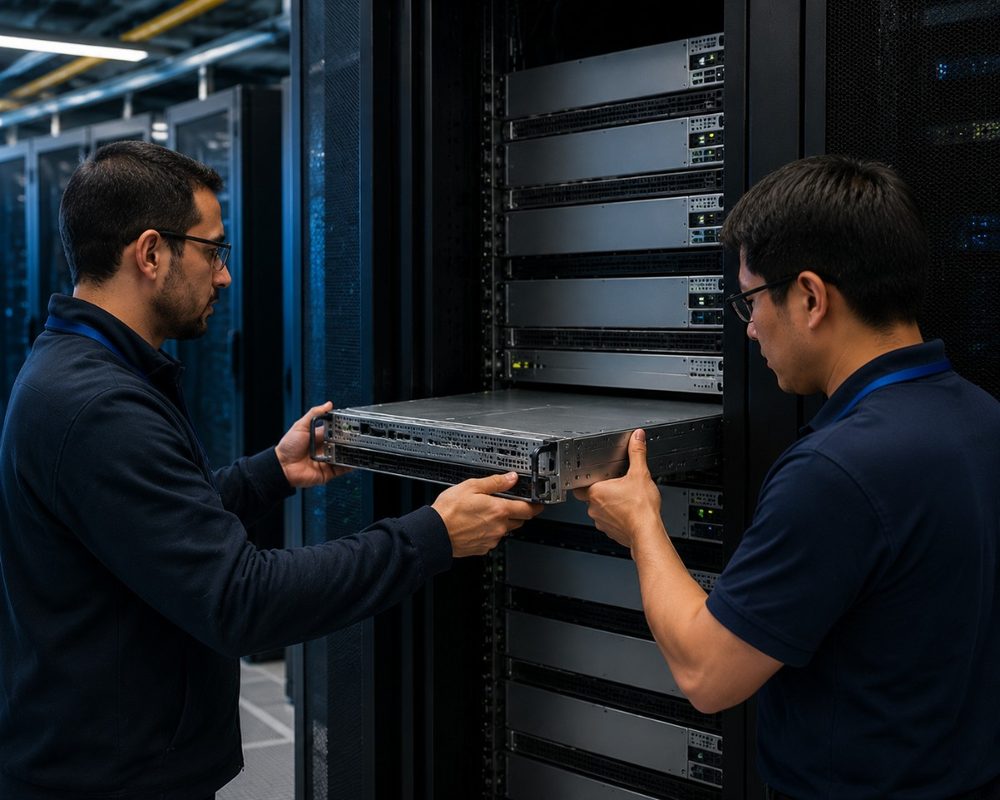
Catalyst Data Solutions Inc works across OEM, channel, and distribution ecosystems to help organizations source AI, HPC, and data center infrastructure. For an XE8812 project, that can include comparing server availability alongside compatible networking, storage, optics, cabling, rack power, and supporting infrastructure.
Because the Dell PowerEdge XE8812 is announced for global availability in early 2027, procurement teams should verify current orderability and lead times rather than treating announced specifications as guaranteed shipping inventory. Catalyst can also compare Dell, NVIDIA, AMD, HPE, and other platforms when workload or facility requirements point toward a different architecture.
Buyers can request current availability when planning a complete configuration. A useful request should include the workload, desired GPU scale, storage requirements, network architecture, rack power, cooling environment, software stack, and deployment timeline.
Dell PowerEdge XE8812 FAQs
When will Dell PowerEdge XE8812 be available?
Dell says the PowerEdge XE8812 will become globally available in early 2027. As of August 2026, Dell has announced the system, but buyers should not describe it as generally available yet.
How many GPUs can the Dell XE8812 support?
The NVIDIA Vera Rubin NVL4 architecture uses four Rubin GPUs with two Vera CPUs. Dell says XE8812-based PowerRack deployments can scale to up to 144 GPUs per rack.
What workloads are best suited for Dell XE8812?
The XE8812 targets HPC, scientific simulation, AI training, inference, and data-intensive scientific workflows. Dell specifically highlights molecular and multi-physics simulations, while announced deployments extend into climate, materials, chemistry, computational biology, and fusion research.
Is Dell XE8812 designed for AI training or HPC simulations?
It supports both. The platform reflects the convergence of AI and HPC, allowing organizations to combine numerical simulation, AI-for-science training, inference, and accelerated data analysis on Vera Rubin infrastructure.
What is the difference between Vera Rubin NVL4 and NVL72?
NVL4 connects four Rubin GPUs with two Vera CPUs and targets dense scientific and accelerated computing. NVL72 integrates 72 Rubin GPUs and 36 Vera CPUs as a much larger rack-scale architecture for frontier AI workloads.
How does liquid cooling improve Dell XE8812 operation?
Direct liquid cooling removes heat from high-power CPUs and GPUs more efficiently than a conventional fan-dependent design at extreme density. It primarily enables sustained high-density operation and facility efficiency rather than guaranteeing faster application performance by itself.
Can Dell PowerEdge XE8812 run large language models?
Yes. Dell positions the XE8812 for AI training and inference as well as HPC, but model size and scaling requirements determine whether NVL4, NVL8, or a larger NVL72 architecture provides the better deployment model.
How does Dell XE8812 compare with NVIDIA DGX Rubin NVL8?
The XE8812 uses Vera Rubin NVL4 and emphasizes HPC and scientific AI, while NVIDIA DGX Rubin NVL8 uses eight Rubin GPUs and targets turnkey training, inference, post-training, and enterprise AI infrastructure. Buyers should compare workload fit, CPU architecture, software, cluster design, facility requirements, and support rather than GPU count alone.
Research Record
Research Date: August 23, 2026
Official Product Source: https://www.dell.com/en-us/dt/corporate/newsroom/announcements/detailpage.press-releases~usa~2026~06~the-dell-ai-factory-with-nvidia-advances-supercomputing-class-infrastructure-powering-the-next-generation-of-hpc-and-ai.htm
Research key points:
1.Dell introduced the PowerEdge XE8812 on June 22, 2026, positioning it as a purpose-built HPC and AI server based on NVIDIA Vera Rubin NVL4. Dell says PowerRack 9100 deployments can scale to up to 144 Rubin GPUs per rack.
2.NVIDIA Vera Rubin NVL4 combines four Rubin GPUs with two Vera CPUs connected through NVLink-C2C, with the GPUs using sixth-generation NVLink. NVIDIA positions NVL4 specifically for scientific simulation, AI-for-Science training, inference, and other accelerated scientific workloads.
3.XE8812 is aimed at real large-scale scientific computing deployments, not only enterprise AI. NVIDIA and Dell identify Vera Rubin systems for workloads such as climate modeling, computational fluid dynamics, molecular and multi-physics simulation, materials science, and other HPC/AI research.