
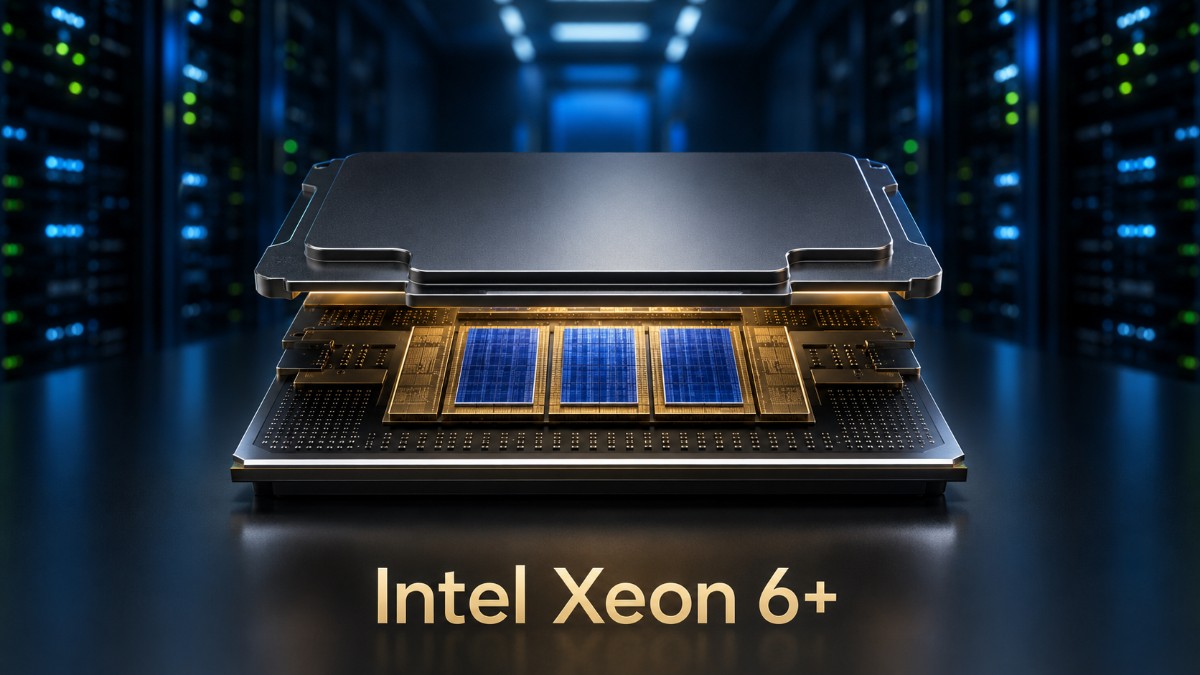
AI infrastructure is shifting from simple model requests toward agentic workflows that retrieve information, call tools, execute code, interact with databases, and coordinate multiple services. Those operations create substantial CPU, memory, storage, and networking activity around every accelerator request.
That makes the host processor increasingly important. Intel Xeon 6+ for agentic AI targets high-density, scale-out environments where concurrency, orchestration, and data movement matter. Buyers should therefore evaluate the CPU as one part of the complete AI system, alongside accelerators, memory, networking, storage, power, and GPU deployment planning.
What Is Intel Xeon 6+ and Why Does It Matter for AI?
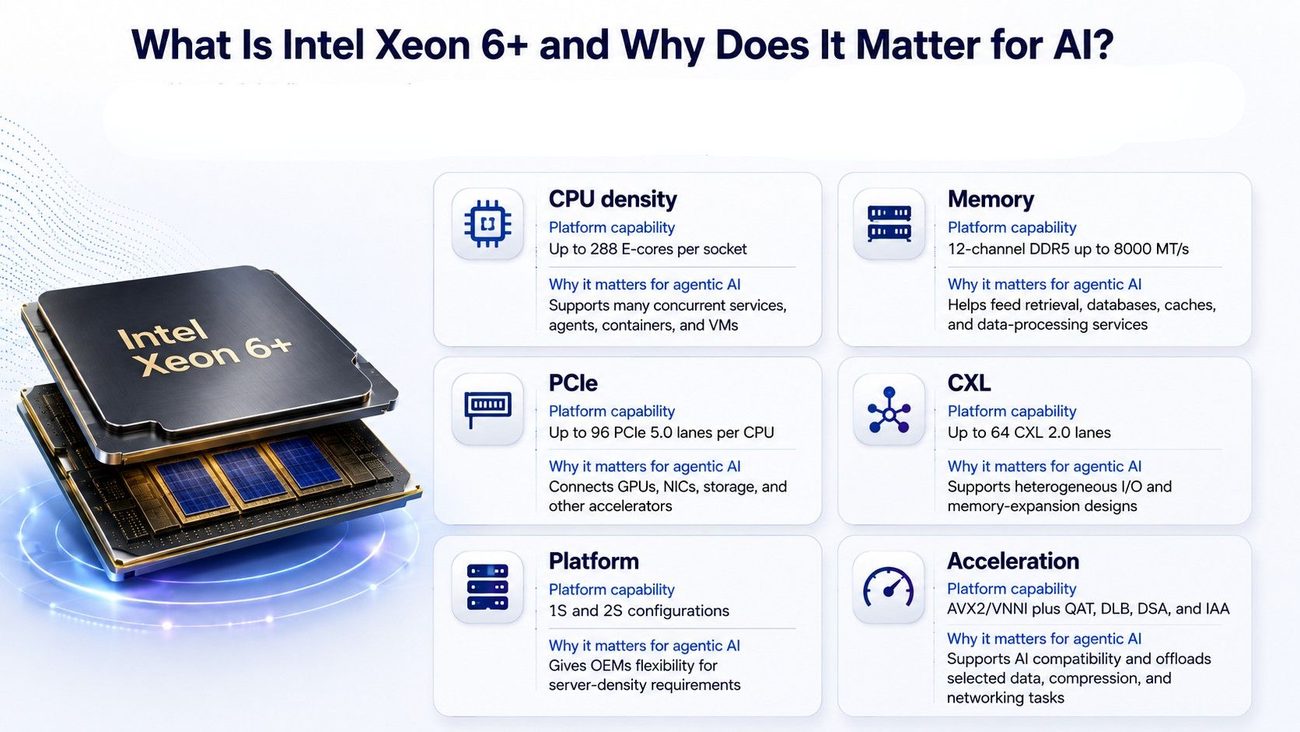
Intel Xeon 6+ is Intel’s next-generation data center CPU platform built on the Intel 18A process. Intel launched the family in Q2 2026 with Efficient-core, or E-core, models designed around high core density, scale-out performance, power efficiency, and highly parallel workloads.
The top Xeon 6+ model reaches 288 E-cores per socket. Intel positions these processors differently from Xeon 6 P-core CPUs: E-cores emphasize task-parallel throughput and density, while P-cores target compute-intensive workloads that need stronger per-core performance and technologies such as Intel AMX.
| Xeon 6+ feature | Platform capability | Why it matters for agentic AI |
| CPU density | Up to 288 E-cores per socket | Supports many concurrent services, agents, containers, and VMs |
| Memory | 12-channel DDR5 up to 8000 MT/s | Helps feed retrieval, databases, caches, and data-processing services |
| PCIe | Up to 96 PCIe 5.0 lanes per CPU | Connects GPUs, NICs, storage, and other accelerators |
| CXL | Up to 64 CXL 2.0 lanes | Supports heterogeneous I/O and memory-expansion designs |
| Platform | 1S and 2S configurations | Gives OEMs flexibility for server-density requirements |
| Acceleration | AVX2/VNNI plus QAT, DLB, DSA, and IAA | Supports AI compatibility and offloads selected data, compression, and networking tasks |
Intel’s Xeon 6+ product presentation confirms the 288-core maximum, 12 DDR5-8000 channels, 96 PCIe 5.0 lanes, and 64 CXL 2.0 lanes. It also lists integrated QuickAssist, Dynamic Load Balancer, Data Streaming Accelerator, and In-Memory Analytics Accelerator engines.
That combination matters because modern AI performance depends on more than processor arithmetic. Many deployments encounter AI networking bottlenecks or memory and storage constraints before they run out of theoretical accelerator performance.
Why Agentic AI Changes the Role of the CPU
Traditional AI diagrams often show a simple relationship: the CPU manages the server while the GPU performs model computation. Agentic AI creates a more complicated workflow.
An AI agent may retrieve documents, query a database, invoke an API, execute code, update state, call an inference model, evaluate the result, and repeat. Much of that work happens outside the GPU.
| Agent workflow stage | CPU responsibility | Main infrastructure dependency |
| Planning and orchestration | Workflow logic, scheduling, service coordination | CPU cores and memory |
| Retrieval | Search, ranking, database access, preprocessing | Memory, storage, network |
| Tool execution | APIs, containers, applications, code | CPU density and virtualization |
| Model invocation | Request preparation and accelerator coordination | PCIe, NICs, GPU fabric |
| State management | Context, logs, security, application state | Memory and storage |
Intel describes the CPU as the control plane for agentic AI, emphasizing orchestration, concurrency, and data movement alongside inference. Xeon 6+ extends that idea with an architecture aimed at high-density parallel work.
This division of labor also appears in accelerator-focused HGX system architecture. GPUs perform the primary tensor computation, while host CPUs coordinate applications, data preparation, storage access, network services, monitoring, and other supporting tasks.
CPU Density: Why More Processing Capacity Matters for AI Agents
AI agents create many independent activities rather than one continuous CPU job. A workflow might wait for an API while another agent processes retrieved data, a third writes application state, and several others prepare model requests.
Xeon 6+ addresses that type of parallelism with up to 288 E-cores per socket. Intel specifically positions its E-core architecture for high core density, task-parallel workloads, cloud-native services, and microservices rather than maximum single-thread compute.
Higher CPU density can help organizations:
- Run more concurrent agent services or containers on each server.
- Consolidate orchestration and supporting services onto fewer systems.
- Allocate CPU resources across multi-tenant AI environments.
- Increase service throughput without expanding rack count at the same rate.
Density does not tell a buyer exactly how many agents a server can run. Agent capacity depends on application logic, memory requirements, tool activity, databases, security services, network latency, and where model inference actually occurs.
Intel demonstrates the density potential with a liquid-cooled rack reference containing 36,864 E-cores in 32U of compute space. Intel lists approximately 100 kW of rack power for that specific reference architecture, so buyers should treat it as a design example rather than a standard Xeon 6+ requirement.
Memory Matters: Why AI Agents Need More Than Compute
Agentic systems constantly create, retrieve, transform, and move data. Vector databases, retrieval pipelines, application state, caches, APIs, databases, and preprocessing services can place significant pressure on memory before a GPU receives an inference request.
Xeon 6+ provides 12 DDR5 memory channels with support up to 8000 MT/s in Intel’s current platform material. Intel’s rack reference also lists 768 GB/s of memory bandwidth per socket, although real throughput depends on the server, DIMM population, workload, and memory configuration.
Memory capacity and memory bandwidth solve different problems. Capacity determines how much active application state, cached information, databases, and working data a server can hold. Bandwidth determines how quickly CPU cores can access and process that information.
CXL adds another design option. Xeon 6+ supports up to 64 CXL 2.0 lanes, allowing system architects to evaluate memory-expansion and heterogeneous device configurations where supported by the server platform.
For agentic AI, this means CPU selection should include a memory plan rather than focusing only on core count.
Why PCIe Connectivity Is Critical for AI Infrastructure
Modern AI servers connect far more than a processor and DRAM. A system may contain GPUs, inference accelerators, high-speed NICs, DPUs, NVMe drives, storage controllers, and CXL devices.
Xeon 6+ supports up to 96 PCIe Gen 5 lanes per processor. Those lanes give OEMs substantial I/O resources for connecting the devices that move data into, out of, and around an AI server.
Existing H100 server configurations illustrate the broader principle: installing powerful accelerators does not automatically produce a balanced server. Host I/O, networking, and storage must support the accelerator topology.
PCIe planning should verify:
- How accelerators connect to the host platform.
- How many high-speed NICs or DPUs the server needs.
- How much NVMe storage requires direct PCIe connectivity.
- Whether CXL devices share platform I/O resources.
The CPU’s maximum PCIe lane count does not mean every OEM server exposes every lane through accessible slots. Buyers should verify the actual PCIe topology, slot layout, risers, bifurcation support, and accelerator validation in official server documentation.
How Does Xeon 6+ Fit Into a Complete Agentic AI System?
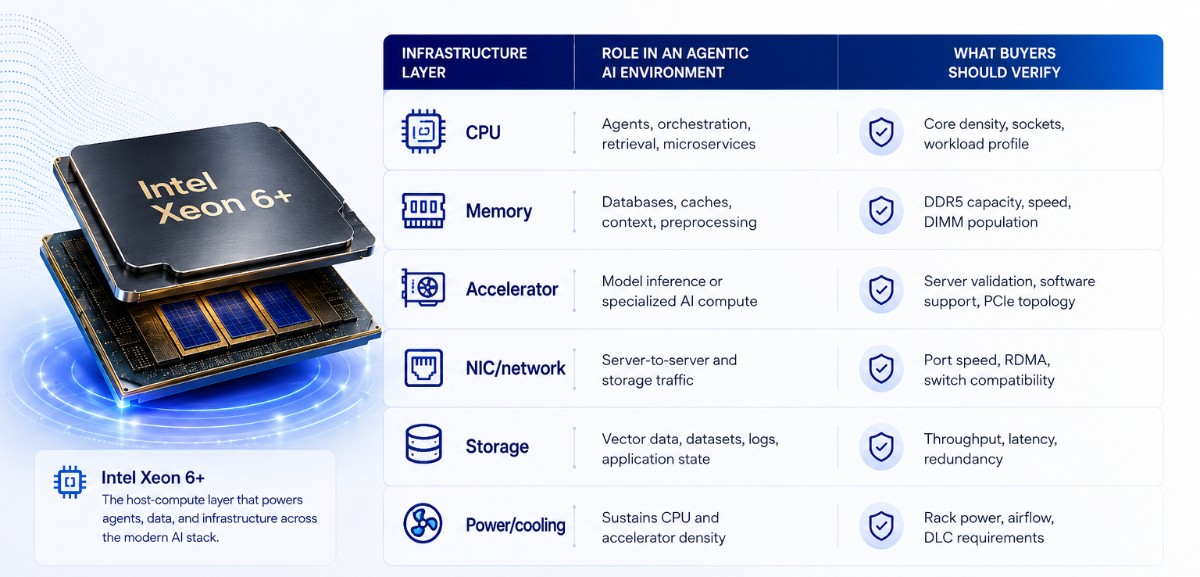
Xeon 6+ should not be evaluated as an isolated processor. It forms the host-compute layer of an infrastructure stack in which GPUs or other accelerators perform model computation while networking, storage, memory, and facility systems keep the workflow operating.
| Infrastructure layer | Role in an agentic AI environment | What buyers should verify |
| CPU | Agents, orchestration, retrieval, microservices | Core density, sockets, workload profile |
| Memory | Databases, caches, context, preprocessing | DDR5 capacity, speed, DIMM population |
| Accelerator | Model inference or specialized AI compute | Server validation, software support, PCIe topology |
| NIC/network | Server-to-server and storage traffic | Port speed, RDMA, switch compatibility |
| Storage | Vector data, datasets, logs, application state | Throughput, latency, redundancy |
| Power/cooling | Sustains CPU and accelerator density | Rack power, airflow, DLC requirements |
Networking deserves particular attention. Intel launched the Ethernet E835 alongside Xeon 6+, with configurations reaching 200GbE and support for RDMA technologies including RoCEv2 and iWARP. Intel positions the combination around reducing networking bottlenecks in distributed AI, cloud, and data center environments.
Power and thermal design also change as CPU and accelerator density increases. Depending on server configuration, an environment may use air cooling, enhanced air cooling, or direct liquid cooling, making AI rack cooling strategies part of infrastructure planning rather than an afterthought.
What Infrastructure Should Be Paired With Intel Xeon 6+?
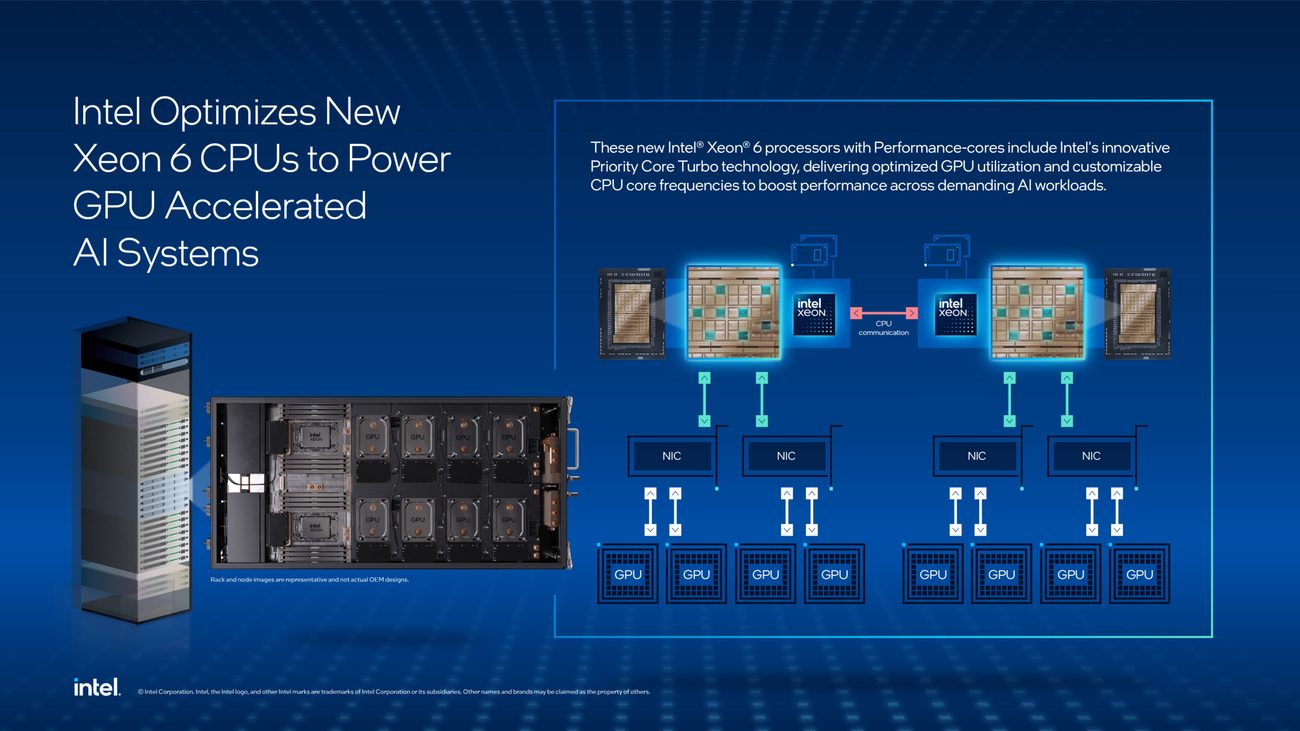
A Xeon 6+ deployment usually involves much more than purchasing processors. The correct configuration depends on whether the system runs CPU-centric agents, accelerator-backed inference, cloud services, databases, or a combination of workloads.
Typical supporting infrastructure includes:
- An OEM-validated 1S or 2S Xeon 6+ server.
- DDR5 memory sized and populated for the workload.
- Appropriate GPUs, NICs, NVMe devices, or other PCIe accelerators.
- Compatible switches, optics, cabling, storage, power, and cooling.
Intel says Xeon 6+ platforms are being configured across an ecosystem that includes Dell Technologies, HPE, Lenovo, Supermicro, ASUS, and GIGABYTE. Intel describes the infrastructure as available now, but exact server configurations, regional availability, and lead times still vary by OEM and channel.
That distinction matters when planning procurement: a processor may be launched and available while a specific server configuration still has different qualification or delivery timelines.
Where Does Intel Xeon 6+ Fit for AI Inference?
Xeon 6+ can participate in inference, but its primary architectural strength is density-oriented E-core computing, not replacing every GPU or Intel P-core inference platform.
Intel Xeon 6+ E-cores support AVX2 with VNNI and fast conversion for BF16 and FP16. Intel reserves AVX-512 and Intel AMX for Xeon 6 P-core processors, which makes P-core systems more relevant when CPU inference depends heavily on matrix or vector acceleration.
For agentic AI, Xeon 6+ is particularly interesting when inference sits inside a larger CPU-heavy workflow involving retrieval, APIs, microservices, containers, databases, security, and orchestration.
Smaller or optimized models may also run on CPUs, but model size, quantization, latency, throughput, and software support should guide that decision. Large parallel models will often continue to use GPUs or dedicated AI accelerators.
Intel Xeon 6+ vs AMD EPYC and NVIDIA Grace CPU
There is no universal best CPU for AI servers. Intel Xeon 6+, AMD EPYC, and NVIDIA Grace use different architectural approaches, and the right choice depends on the complete workload rather than a single specification.
| Area | Intel Xeon 6+ | AMD EPYC 9005 | NVIDIA Grace CPU Superchip |
| Architecture | x86 E-core | x86 Zen 5 / Zen 5c | Arm Neoverse V2 |
| Core strategy | Up to 288 E-cores/socket | Up to 192 cores/socket | 144 cores/module |
| Memory approach | 12-channel DDR5 | 12-channel DDR5 | Up to 960 GB LPDDR5X |
| Main strength | Density and scale-out throughput | Broad x86 compute and I/O flexibility | High memory bandwidth and NVIDIA integration |
| Strong evaluation point | Agent and microservice density | Workload flexibility and per-platform I/O | Accelerator-centric Arm environments |
AMD’s current EPYC 9005 portfolio reaches up to 192 cores and supports 12-channel DDR5, while individual I/O capabilities vary by SKU and platform. NVIDIA’s Grace CPU Superchip combines 144 Arm Neoverse V2 cores with up to 960 GB of LPDDR5X memory.
For organizations already standardized on x86 software and seeking high task-parallel density, Xeon 6+ presents a clear option. AMD EPYC provides another x86 path with a different balance of core architecture, I/O, and workload performance.
Grace follows a more tightly integrated NVIDIA approach. Buyers considering broader alternatives should also evaluate how a rack-scale AMD architecture changes the CPU, accelerator, networking, and software stack together.
The correct conclusion depends on workload, software ecosystem, accelerator strategy, power, cooling, budget, existing infrastructure, deployment timeline, and hardware availability.
Who Is Intel Xeon 6+ For?
Xeon 6+ is most relevant where an AI environment creates substantial parallel CPU-side work around model inference.
- Neocloud and service providers hosting many concurrent services or agents.
- Enterprises building x86-based private agentic AI infrastructure.
- Cloud and telecom operators prioritizing workload density and efficiency.
- AI platforms pairing dense host compute with separate accelerators.
The strongest use case is not simply “AI.” It is infrastructure where orchestration, microservices, databases, networking, and data movement need to scale alongside the model-serving layer.
Who Might Not Need Intel Xeon 6+?
Not every enterprise needs a 288-core E-core processor. Smaller AI deployments may achieve better economics with a lower-core server, particularly when orchestration demand remains modest.
Workloads that prioritize maximum per-core performance, Intel AMX, or AVX-512 should also compare Xeon 6 P-core systems. Intel itself positions P-cores for compute-intensive AI and HPC, while Xeon 6+ E-cores emphasize high-density task-parallel workloads.
GPU-dominated systems need another evaluation. In those environments, accelerator topology, GPU memory, scale-up interconnects, scale-out networking, and storage throughput may influence performance more than maximum CPU core density, as newer accelerator system design increasingly demonstrates.
The Future of CPUs in Agentic AI Infrastructure
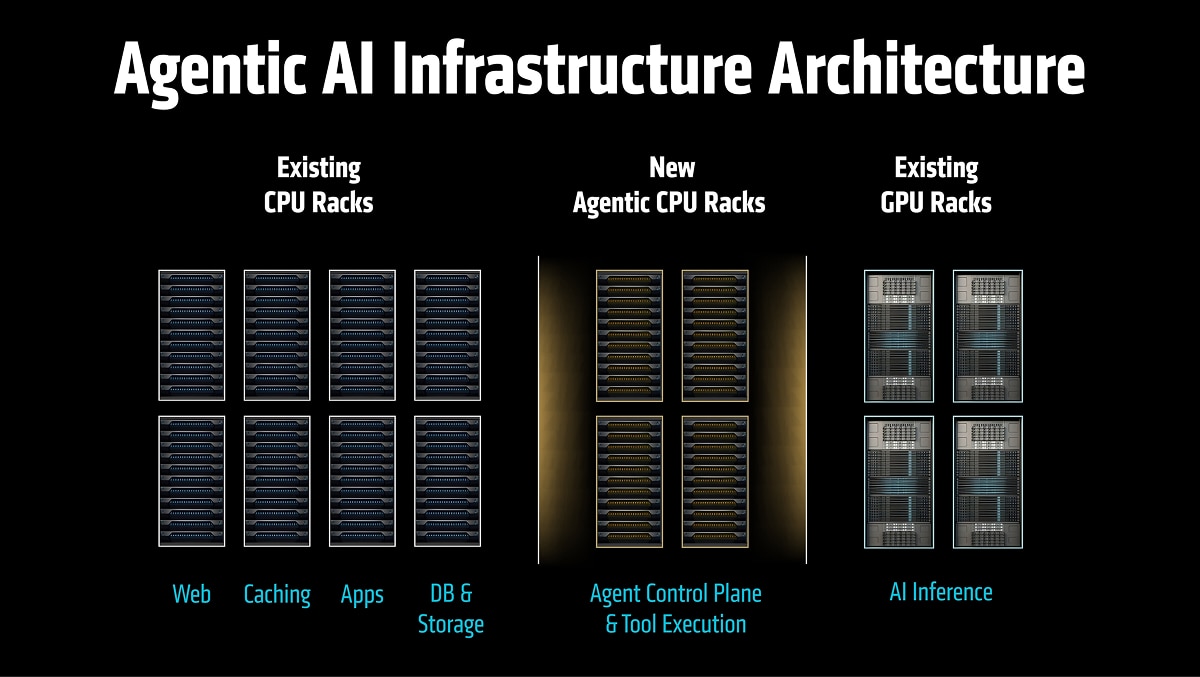
GPUs will remain critical for demanding model training and inference, but agentic AI expands the amount of useful work that happens around the model. Retrieval systems, APIs, workflow engines, databases, application logic, networking, and security all need CPU resources.
That shift favors more balanced infrastructure. CPUs increasingly function as orchestration and data-movement engines while specialized accelerators handle highly parallel AI computation.
Xeon 6+ represents Intel’s density-focused approach to that model. Similar system thinking appears in modern rack-scale AI platforms, where compute, networking, storage, cooling, and power operate as one architecture instead of independent purchases.
Conclusion
Intel Xeon 6+ for agentic AI is primarily about density, concurrency, memory throughput, and data movement. With up to 288 E-cores, 12-channel DDR5, PCIe 5.0, and CXL 2.0, the platform gives data center architects substantial host-compute resources for the services surrounding AI inference.
The processor is only one layer of the deployment. Buyers should evaluate memory capacity, accelerator topology, NICs, switching, storage, software, power, cooling, and validated OEM systems together.
That complete-system approach determines whether additional CPU density produces useful agent capacity or simply moves the infrastructure bottleneck somewhere else.
How Can Catalyst Support a Xeon 6+ Agentic AI Build?

Catalyst Data Solutions Inc works across leading OEM, channel, and distribution ecosystems to help organizations source AI, HPC, and data center infrastructure. A Xeon 6+ project may involve servers, DDR5 memory, accelerators, NICs, switches, storage, optics, cabling, rack infrastructure, power, and cooling.
Organizations can request a configuration quote based on workload, agent concurrency, memory requirements, accelerator plans, networking, storage, power, cooling, and deployment scale.
FAQs
1. What makes Intel Xeon 6+ different from Intel Xeon 6?
Intel Xeon 6+ extends the Xeon 6 family with Intel 18A-based E-core processors focused on very high density and scale-out workloads. Current Xeon 6+ models reach up to 288 E-cores per socket, while Xeon 6 also includes P-core processors designed for stronger per-core compute and AI acceleration.
2. Is Intel Xeon 6+ available now?
Yes. Intel launched Xeon 6+ in Q2 2026, and its product catalog lists 6960E+, 6970E+, 6980E+, and 6990E+ models. Specific OEM server configurations, regional availability, and lead times can still vary.
3. Can Intel Xeon 6+ run AI models without GPUs?
Yes, for appropriate workloads. Xeon 6+ E-cores include AVX2/VNNI support for AI-related operations, but CPU-only inference should be evaluated against model size, quantization, latency, and throughput requirements. Compute-intensive CPU inference may favor Xeon 6 P-core systems with Intel AMX.
4. Is Intel Xeon 6+ suitable for large language model inference?
It can support the infrastructure surrounding LLM inference, including orchestration, retrieval, databases, APIs, and concurrent services. Whether the CPU should execute the model itself depends on model size and performance targets; demanding LLM inference will often continue to use GPUs or specialized accelerators.
5. How many AI agents can run on a Xeon 6+ server?
There is no fixed number. Agent density depends on CPU time per workflow, memory consumption, retrieval activity, databases, tool calls, networking, software design, and whether model inference runs locally or on separate accelerators.
6. Why does PCIe 5.0 matter for agentic AI?
PCIe connects the host CPU to GPUs, AI accelerators, NICs, NVMe storage, and other high-speed devices. Xeon 6+ supports up to 96 PCIe 5.0 lanes per processor, but buyers must verify how an OEM server exposes those lanes through its actual slot and device topology.
7. Does agentic AI make CPUs more important?
Yes. Agentic workflows add orchestration, retrieval, database access, code execution, networking, security, and application logic around model inference. Those operations increase CPU, memory, and I/O demand even when GPUs perform the main model computation.
8. Should an enterprise choose Xeon 6+ or a GPU-based AI server?
Many environments need both rather than one or the other. Xeon 6+ can support dense orchestration and CPU-side services, while GPUs handle highly parallel model computation. The correct design depends on workload, model size, concurrency, latency, software, budget, power, cooling, and existing infrastructure.
Research Record
Research Date: August 21, 2026
Official Datasheet:
Research Key Points:
- Intel launched Xeon 6+ in Q2 2026 as an Intel 18A E-core platform focused on high-density, scale-out workloads, including agentic AI orchestration and data movement.
- Intel lists up to 288 E-cores, 12-channel DDR5-8000, 96 PCIe Gen 5 lanes, and up to 64 CXL 2.0 lanes for Xeon 6+.
- Xeon 6+ E-cores support AVX2/VNNI, while Intel AMX and AVX-512 remain P-core capabilities; buyers should distinguish density-oriented agent infrastructure from compute-intensive CPU AI workloads.