

AI models continue to grow in parameter count, context length, and inference complexity. That growth puts pressure on more than raw compute: accelerators also need enough memory capacity, memory bandwidth, interconnect performance, networking, storage throughput, power, and cooling to stay productive.
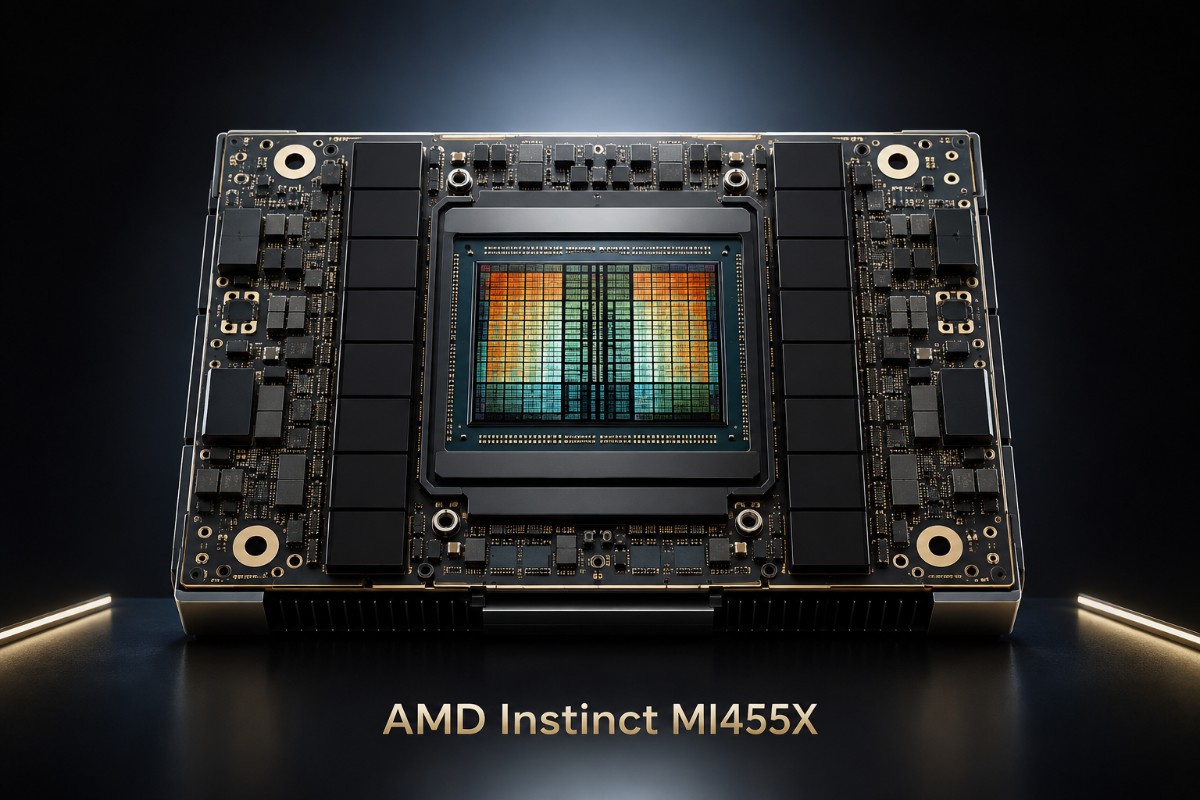
AMD Instinct MI455X is AMD’s CDNA 5-based data center AI accelerator for large-scale training, inference, and fine-tuning. AMD lists 432 GB of HBM4, up to 23.3 TB/s of memory bandwidth, an Enhanced Accelerator Module form factor, and direct liquid cooling. AMD designed the accelerator specifically around its Helios rack-scale AI platform.
The important point is that MI455X is not simply AMD’s newest GPU. Its real role becomes clearer when the accelerator, EPYC host CPUs, scale-up links, AI networking, storage, cooling, and rack infrastructure operate as one system.
What Is AMD Instinct MI455X?
AMD Instinct MI455X is the flagship AI-focused accelerator in AMD’s MI400 family and the first announced product based on 5th Gen AMD CDNA architecture. AMD lists a July 23, 2026 launch date and positions it for frontier AI inference, training, and model fine-tuning.
Unlike a conventional PCIe GPU that buyers can simply add to many existing servers, AMD currently positions MI455X specifically around the AMD Helios rack-scale solution. That distinction matters when planning chassis compatibility, CPU architecture, networking, liquid cooling, and rack power.
The same system-level thinking applies to GPU deployment planning: accelerator specifications only tell part of the deployment story.
AMD Instinct MI455X specifications
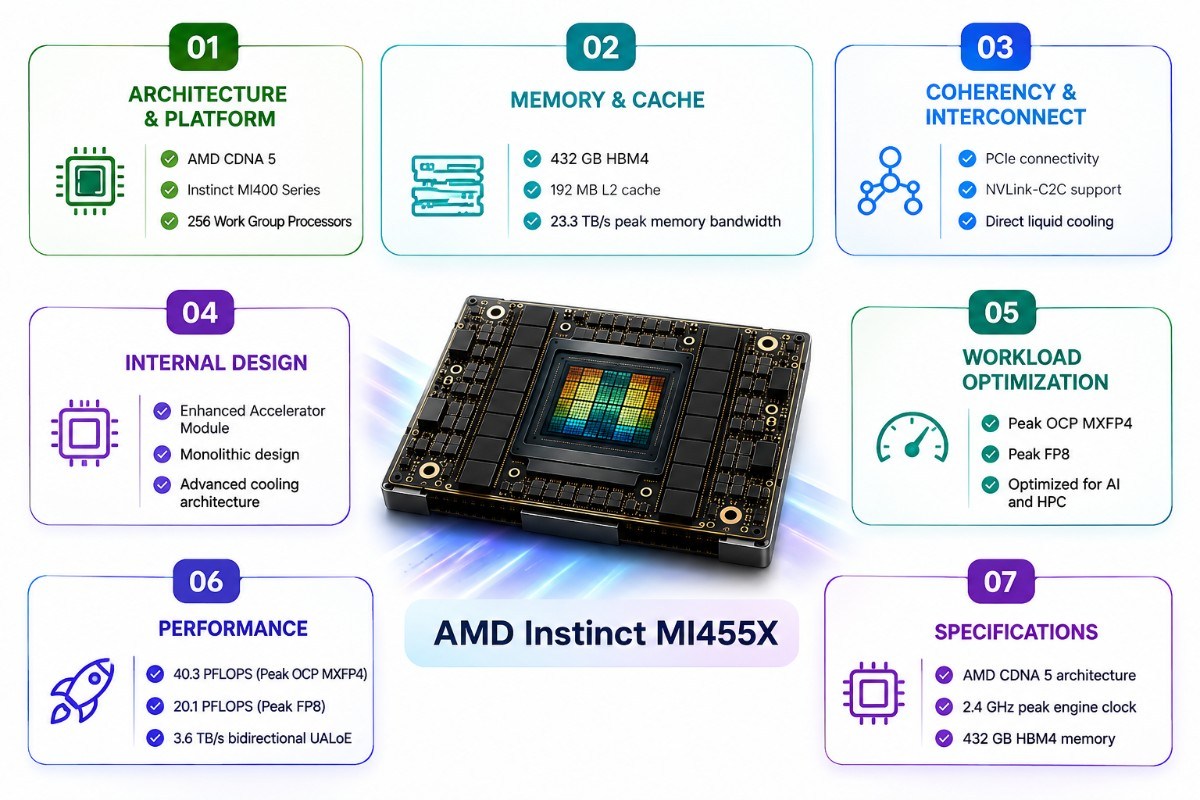
| Specification | AMD Instinct MI455X |
| Architecture | AMD CDNA 5 |
| Product family | Instinct MI400 Series |
| AMD-listed launch date | July 23, 2026 |
| Work Group Processors | 256 |
| Peak engine clock | 2.4 GHz |
| HBM capacity | 432 GB HBM4 |
| Peak memory bandwidth | 23.3 TB/s |
| L2 cache | 192 MB |
| Peak OCP MXFP4 | 40.3 PFLOPS |
| Peak FP8 | 20.1 PFLOPS |
| Form factor | Enhanced Accelerator Module |
| Peak scale-up bandwidth | 3.6 TB/s bidirectional UALoE |
| Cooling | Direct liquid cooling |
| Primary software ecosystem | AMD ROCm |
These figures are peak or published specifications, not application benchmarks. Actual training and inference performance depends on model architecture, precision, batch size, software optimization, cluster topology, and communication efficiency.
How CDNA 5 Powers AMD’s Next AI Accelerator
CDNA is AMD’s compute-focused GPU architecture for data center AI and HPC rather than graphics rendering. AMD uses the architecture in Instinct accelerators to prioritize matrix computation, memory movement, high-bandwidth interconnects, reliability, and data center-scale operation.
CDNA 5 extends that approach through a chiplet architecture that separates compute, memory, cache, and I/O functions across specialized dies. AMD says MI455X includes eight CDNA 5 compute chiplets and 256 Work Group Processors.
That modular design lets AMD optimize different parts of the accelerator for their specific jobs instead of forcing every function onto one monolithic die. AMD also uses 3D hybrid bonding and high-density die-to-die links to improve compute density and communication between the package’s functional blocks.
CDNA 5 introduces several changes aimed directly at modern AI workloads:
- Wave32 execution to reduce synchronization overhead and improve SIMD utilization.
- Expanded MXFP4, MXFP6, and MXFP8 low-precision formats for AI computation.
- Improved matrix and transcendental processing for transformer-era workloads.
- A redesigned memory and cache hierarchy built around 432 GB of HBM4.
AMD says some low-precision operations can deliver up to four times the theoretical throughput of previous-generation Instinct hardware. That remains a theoretical architectural comparison; production model performance still depends heavily on software and system utilization.
The broader industry is moving in the same direction. NVIDIA’s Rubin GPU architecture also combines next-generation compute with HBM4 and high-bandwidth scale-up communication, illustrating why architecture now extends far beyond shader or core counts.
Why HBM4 Memory Is Critical for MI455X
Large AI models continually move weights, activations, attention data, and KV-cache information between memory and compute units. An accelerator can have enormous mathematical throughput but still lose utilization if the memory subsystem cannot deliver data quickly enough.
MI455X combines 432 GB of HBM4 with up to 23.3 TB/s of peak memory bandwidth. HBM places multiple memory stacks close to the accelerator package, providing far wider interfaces than conventional server memory technologies.
The generational change becomes clearer when MI455X is compared with AMD’s previous MI355X.
| Memory characteristic | AMD MI355X | AMD MI455X |
| Architecture | CDNA 4 | CDNA 5 |
| Memory type | HBM3E | HBM4 |
| Memory capacity | 288 GB | 432 GB |
| Peak bandwidth | 8 TB/s | 23.3 TB/s |
| Memory stacks | 12 |
Based on AMD’s published specifications, MI455X provides 50% more memory capacity and roughly 2.9× the peak memory bandwidth of MI355X.
More capacity can keep larger models, longer contexts, and larger KV caches closer to the compute engines. More bandwidth helps move that information quickly enough to support high-throughput training and increasingly memory-sensitive inference.
HBM4 does not remove every bottleneck. Once workloads span many accelerators, scale-up communication, scale-out networking, CPU orchestration, and storage throughput become equally important.
MI455X and the Future of AI Data Centers
AMD designed MI455X as part of a rack-scale architecture rather than as an isolated accelerator. AMD Helios integrates 72 MI455X GPUs with 6th Gen AMD EPYC “Venice” CPUs, Pensando networking, open interconnect technologies, and ROCm software.
This architecture targets AI factories that need hundreds or thousands of accelerators to work together efficiently. At that scale, utilization often depends as much on moving data between processors as on executing matrix operations.
Where MI455X fits in the infrastructure stack
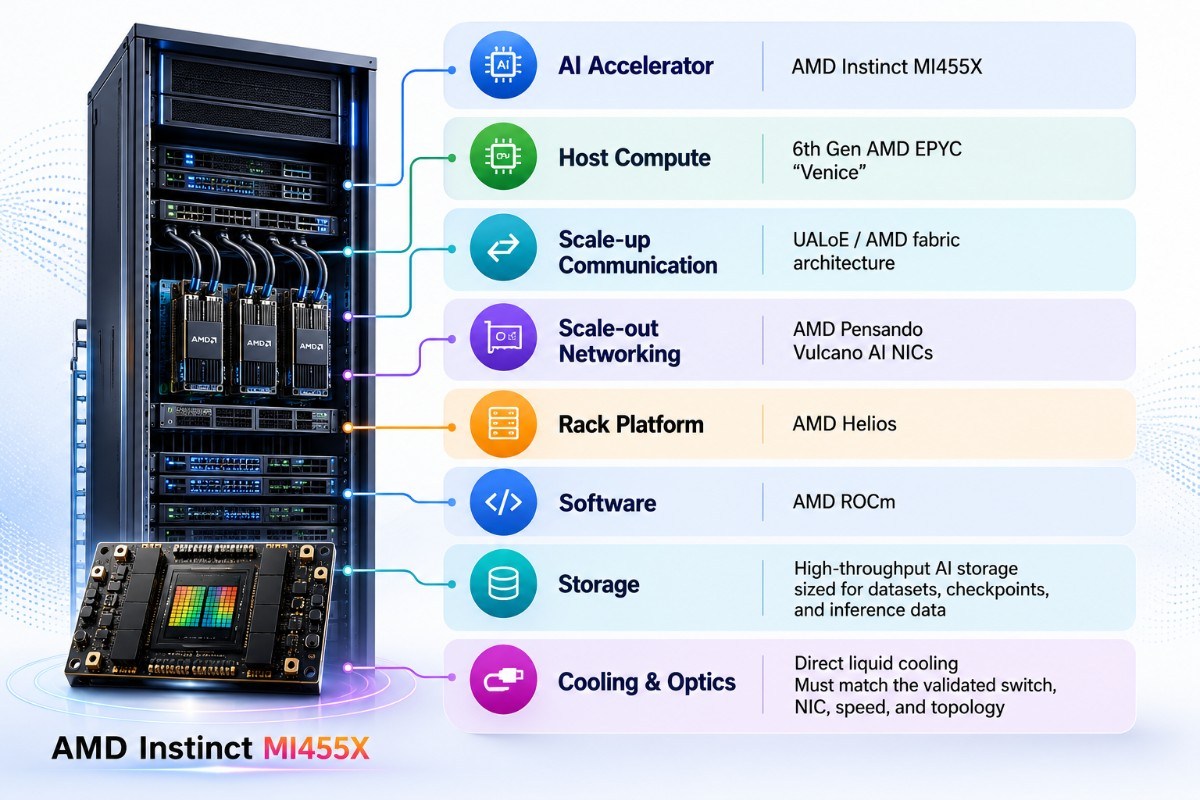
| Infrastructure layer | MI455X / Helios role |
| AI accelerator | AMD Instinct MI455X |
| Host compute | 6th Gen AMD EPYC “Venice” |
| Scale-up communication | UALoE / AMD fabric architecture |
| Scale-out networking | AMD Pensando Vulcano AI NICs |
| Rack platform | AMD Helios |
| Software | AMD ROCm |
| Storage | High-throughput AI storage sized for datasets, checkpoints, and inference data |
| Cooling | Direct liquid cooling |
| Optics/cabling | Must match the validated switch, NIC, speed, and topology |
AMD lists Pensando Vulcano AI NICs with 800 Gbps scale-out capability in its Helios architecture. As clusters become larger, congestion, collective communication, topology, and east-west traffic become major design constraints issues also covered in broader AI networking challenges.
Cooling creates another infrastructure dependency. AMD specifies direct liquid cooling for MI455X, so buyers must account for cold plates, coolant distribution, CDUs, facility heat rejection, redundancy, serviceability, and rack power rather than treating cooling as a server accessory.
Those considerations become increasingly important in high-density AI cooling because adding accelerator density changes both rack design and facility requirements.
What does a buyer actually need with MI455X?
An MI455X deployment may require:
- A validated AMD Helios or supported OEM rack-scale implementation.
- EPYC Venice host compute and sufficient system memory.
- High-bandwidth AI networking with compatible switches, optics, and cabling.
- Storage capable of sustaining datasets, checkpoints, and inference traffic.
- Direct liquid cooling plus the required rack and facility power infrastructure.
inbox dek
AMD MI455X vs NVIDIA AI Accelerators
AMD MI455X and NVIDIA Rubin represent two different full-stack approaches to frontier AI infrastructure. Both combine HBM4 accelerators with purpose-built scale-up communication, high-speed scale-out networking, rack-scale cooling, and dedicated software ecosystems.
The useful comparison therefore extends beyond “which GPU is faster.” Buyers should evaluate architecture, memory, software maturity, networking design, system availability, workload behavior, and operational requirements.
| Factor | AMD Instinct MI455X | NVIDIA Rubin GPU |
| Accelerator architecture | CDNA 5 | Rubin |
| HBM | 432 GB HBM4 | Up to 288 GB HBM4 |
| Peak HBM bandwidth | 23.3 TB/s | Up to 22 TB/s |
| Peak scale-up bandwidth per GPU | 3.6 TB/s | 3.6 TB/s NVLink 6 |
| Rack-scale platform | AMD Helios | Vera Rubin NVL72 |
| Host CPU | EPYC Venice | NVIDIA Vera |
| Software ecosystem | ROCm / HIP | CUDA / CUDA-X |
| Primary positioning | Training, inference, fine-tuning | Training, inference, agentic AI |
AMD and NVIDIA publish different precision formats and performance methodologies, so peak numbers should not be treated as equivalent application benchmarks. AMD’s larger published HBM capacity may benefit memory-heavy workloads, while NVIDIA’s CUDA ecosystem and integrated Vera Rubin platform may influence organizations with established NVIDIA software and infrastructure.
NVIDIA’s Vera Rubin rack architecture provides the closest architectural comparison because both strategies connect the accelerator to CPU, scale-up fabric, networking, and rack infrastructure.
For organizations evaluating smaller NVIDIA configurations, the distinction between rack-scale platforms and conventional DGX and HGX systems also illustrates why deployment scale should influence platform selection.
Software Matters: ROCm and MI455X Adoption
Hardware specifications alone cannot make an accelerator successful. Developers need frameworks, optimized kernels, compilers, profilers, distributed communication libraries, and tools that allow models to use the hardware efficiently.
AMD’s answer is ROCm, its open GPU computing software platform. AMD lists MI455X support for technologies and frameworks including HIP, PyTorch, TensorFlow, JAX, Triton, SGLang, OpenCL, and ROCm-based tooling.
ROCm also provides HIP, a C++ runtime and kernel language designed to make migration from CUDA-based applications more practical. AMD provides HIPIFY tools that translate many CUDA APIs into HIP equivalents.
However, HIP is not a drop-in replacement for CUDA. Existing CUDA applications may require code changes, library validation, profiling, and performance tuning before they run efficiently on AMD hardware.
That software work should be part of procurement planning. An accelerator with attractive hardware specifications may still be the wrong choice if an organization’s production frameworks, custom kernels, monitoring stack, or engineering workflows cannot support it efficiently.
Who Is AMD MI455X For?
MI455X makes the most sense where workloads justify a large rack-scale accelerator environment. AMD specifically positions Helios for frontier training and inference rather than ordinary departmental GPU computing.
| Buyer or workload | MI455X fit |
| Hyperscale AI provider | Strong fit |
| Neocloud GPU provider | Strong fit |
| Frontier-model training | Strong fit |
| High-throughput inference | Strong fit |
| Large LLM / MoE workloads | Strong fit |
| Enterprise private AI | Depends on deployment scale |
| Small inference environment | Often excessive |
| General virtualization | Better served by conventional CPU/GPU platforms |
Not every enterprise needs a 72-accelerator Helios rack. Organizations running smaller models, departmental inference, visualization, or moderate fine-tuning may achieve better utilization and economics with smaller accelerator servers or currently available platforms.
The right decision depends on workload scale, ROCm readiness, networking, storage, power, cooling, deployment timing, and budget not simply whether MI455X has the newest architecture.
Why MI455X Matters for the Next Generation of AI Computing
MI455X shows how quickly AI accelerator design has shifted from individual chips toward complete infrastructure. CDNA 5 adds more low-precision compute capability, while 432 GB of HBM4 and 23.3 TB/s of bandwidth address the growing memory demands of large models and long-context inference.
But those specifications only matter when the rest of the platform keeps up. Helios connects MI455X with EPYC Venice CPUs, rack-scale interconnects, Pensando networking, ROCm software, liquid cooling, and large-scale data center infrastructure.
Future AI performance will depend on the combination of compute, memory, software, networking, storage, power, and cooling not only GPU power.
That makes MI455X strategically important even beyond a simple AMD-versus-NVIDIA comparison. It gives infrastructure buyers another full-stack architecture to evaluate as AI clusters grow from individual servers into rack-, pod-, and data-center-scale systems.
How Can Catalyst Support an AMD MI455X Deployment?
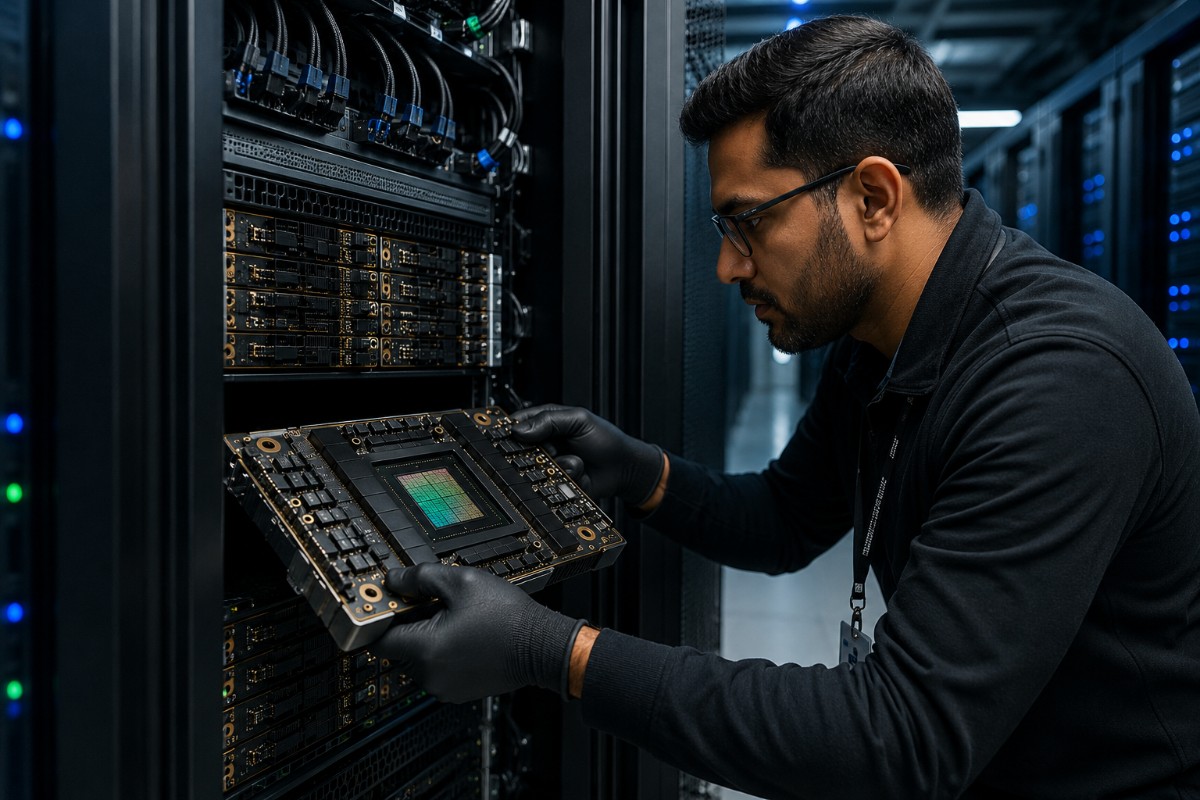
Catalyst Data Solutions works across OEM, channel, and distribution ecosystems to help organizations evaluate AI, HPC, and data center infrastructure without forcing a single-vendor approach.
For an MI455X project, that can include accelerator and platform availability, servers, networking, switches, optics, cabling, storage, rack infrastructure, power, and cooling requirements. Frontier hardware availability changes quickly, so configuration and lead-time validation should happen before procurement.
Buyers can request a configuration quote from catalyst based on workload, scale, budget, existing infrastructure, and deployment timeline.
A complete request should include the expected model or workload, accelerator count, networking topology, storage requirements, rack power, cooling environment, software stack, delivery location, and target deployment date.
AMD Instinct MI455X FAQs
1. When did AMD Instinct MI455X launch?
AMD lists July 23, 2026 as the MI455X launch date. AMD says Helios customer deployments begin during the second half of 2026, so product launch should not be confused with universal OEM availability or immediate delivery.
2. How much HBM4 memory does AMD MI455X include?
AMD Instinct MI455X includes 432 GB of HBM4 memory with up to 23.3 TB/s of peak theoretical memory bandwidth. AMD uses 12 HBM4 stacks in the MI455X package.
3. Is AMD MI455X designed for AI inference or training?
It supports both. AMD positions MI455X and Helios for large-scale AI training, inference, and fine-tuning, including frontier-model workloads.
4. Does AMD MI455X support large language models?
Yes. Its large HBM4 capacity, high memory bandwidth, low-precision AI formats, and rack-scale architecture target large-model training and inference, including workloads with long contexts and substantial KV-cache requirements.
5. What companies are expected to use AMD Instinct MI455X?
Microsoft has announced plans to deploy AMD Helios, while OpenAI expects to bring Helios infrastructure online beginning in the fourth quarter of 2026. Anthropic has also announced plans for MI450-series Helios deployments beginning in 2027.
6. Can MI455X compete with NVIDIA’s AI accelerators?
MI455X competes in the same frontier AI infrastructure market as NVIDIA Rubin, but there is no single specification that determines the better platform. Buyers should compare real workload performance, memory, ROCm versus CUDA requirements, networking, power, cooling, availability, and total deployment cost.
7. Does AMD MI455X support CUDA applications?
MI455X does not run NVIDIA CUDA natively. Developers can port many CUDA applications to AMD’s HIP/ROCm environment, but AMD notes that migration can require manual changes and performance tuning.
8. Will MI455X reduce AI data center power consumption?
AMD promotes Helios around system efficiency, but buyers should not assume a specific energy reduction without workload-level measurements. AMD’s public MI455X specifications currently specify direct liquid cooling but do not provide a public per-GPU board-power figure on the main specification page.
Research and Verification Notes
Research Date: August 19, 2026
Official Datasheet Version:
Research Key Points:
- AMD lists MI455X as launched July 23, 2026 with CDNA 5, 432 GB HBM4, 23.3 TB/s peak memory bandwidth, an EAM form factor, and direct liquid cooling.
- AMD Helios combines 72 MI455X accelerators with EPYC Venice CPUs, Pensando networking, and ROCm software as an integrated rack-scale AI platform.
- Availability should be verified at time of purchase. AMD has announced second-half 2026 Helios customer deployments, but launch, orderability, shipping, and general availability should not be treated as interchangeable terms.