
AI infrastructure is moving beyond individual GPU servers. Large training, reasoning, and agentic AI workloads increasingly depend on rack-scale systems where compute, networking, storage, power, and cooling operate as one coordinated platform.
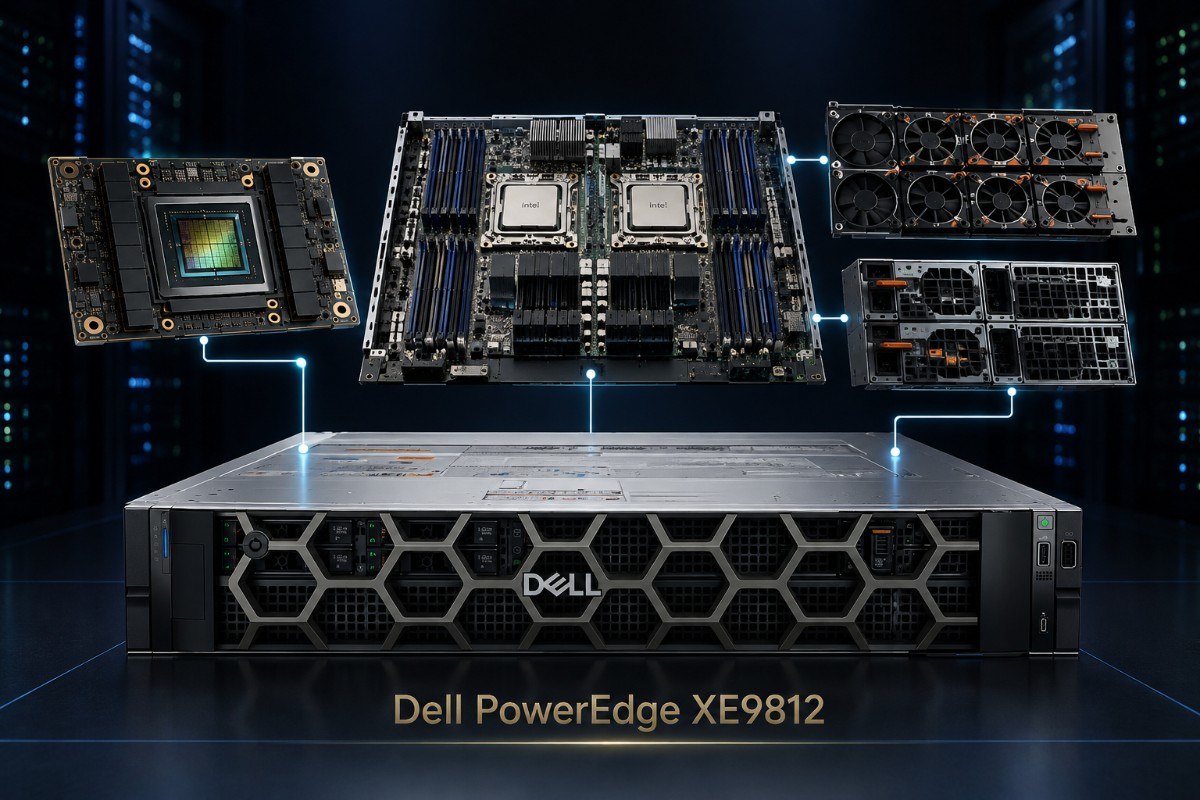
The Dell PowerEdge XE9812 brings NVIDIA Vera Rubin NVL72 into Dell’s AI infrastructure portfolio. Dell positions it as its flagship liquid-cooled platform for massive real-time AI training and inference, rather than a conventional standalone GPU server.
The Dell PowerEdge XE9812 is a 72-GPU rack-scale AI system based on NVIDIA Vera Rubin NVL72. It combines Rubin GPU acceleration with Vera CPUs, NVLink 6 scale-up connectivity, high-speed scale-out networking, infrastructure offload, liquid cooling, and Dell rack integration for large AI factories.
That system-first approach is increasingly important. Teams planning modern GPU deployment architecture must size the network, storage, rack, power, and cooling around the accelerators rather than treating those components as secondary purchases.
What Is Dell PowerEdge XE9812?
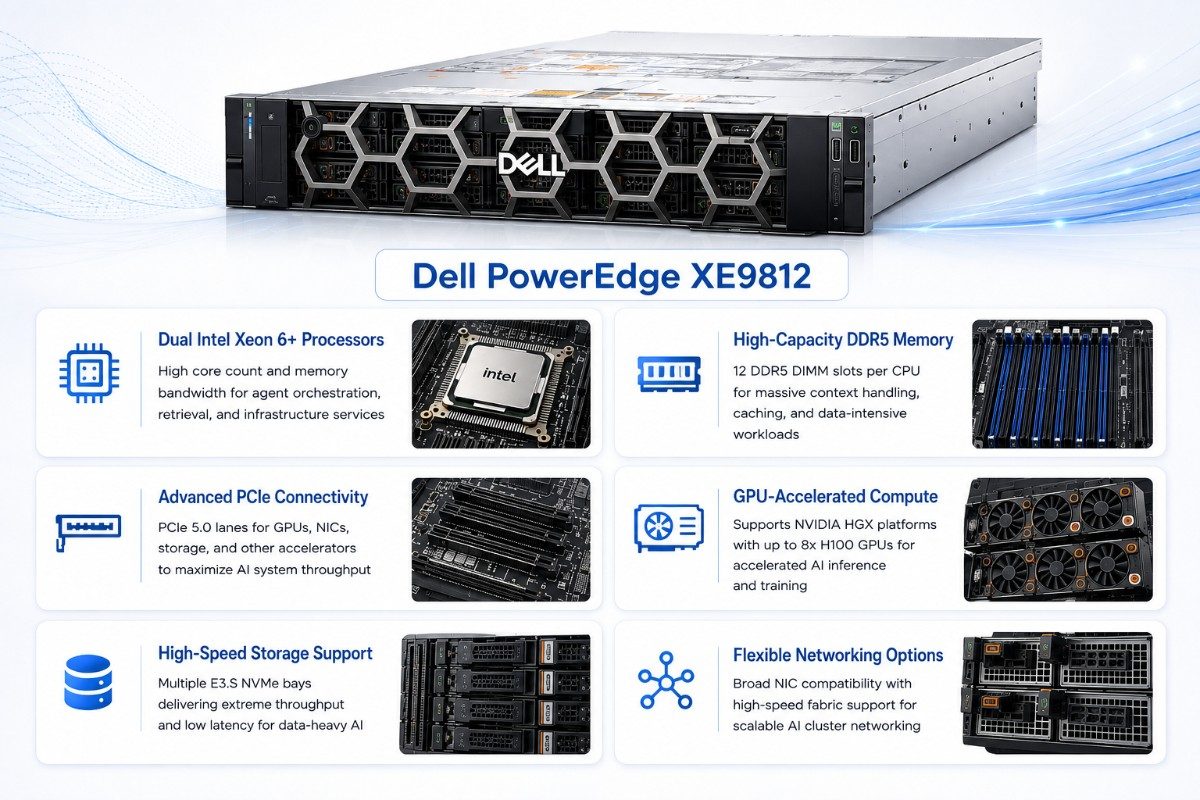
The Dell PowerEdge XE9812 AI server is Dell’s Vera Rubin generation update to the PowerEdge XE9712. Dell describes it as a 72-way GPU-accelerated rack-scale system designed for massive AI training, Mixture-of-Experts models, and large-scale AI reasoning.
This distinction matters. The XE9812 is not simply a chassis containing many discrete GPUs. Its underlying NVIDIA Vera Rubin NVL72 architecture treats an entire rack as a closely connected accelerated computing system.
| XE9812 characteristic | Practical meaning |
| Platform class | Rack-scale AI system |
| Accelerator architecture | NVIDIA Rubin |
| Host compute | NVIDIA Vera CPU |
| GPU scale | 72 Rubin GPUs per NVL72 platform |
| Primary workloads | Large training, reasoning, inference and agentic AI |
Dell also places XE9812 inside Dell PowerRack and the broader Dell AI Factory with NVIDIA. PowerRack integrates compute, networking, storage, power, cooling, and rack management so operators can deploy the architecture as a validated infrastructure unit.
Buyers comparing rack-scale infrastructure with earlier DGX and HGX systems should therefore compare the complete platform boundary, not only GPU specifications.
Inside NVIDIA Vera Rubin NVL72 Architecture
NVIDIA Vera Rubin NVL72 combines 72 Rubin GPUs and 36 Vera CPUs in a rack-scale platform. NVIDIA also integrates NVLink 6 switches, ConnectX-9 SuperNICs, and BlueField-4 DPUs into the architecture.
NVLink 6 provides the scale-up fabric inside the NVL72 system. Spectrum-X Ethernet or Quantum-X800 InfiniBand can then provide scale-out connectivity when an AI factory expands across multiple racks.
Vera Rubin NVL72 platform stack
| Infrastructure layer | Technology | Role |
| Accelerator | 72 NVIDIA Rubin GPUs | Training, inference and AI computation |
| Host compute | 36 NVIDIA Vera CPUs | Data movement, orchestration and CPU processing |
| Scale-up fabric | NVIDIA NVLink 6 | High-bandwidth GPU communication inside the rack |
| Network edge | ConnectX-9 + BlueField-4 | Scale-out connectivity, offload, security and control |
| Scale-out fabric | Spectrum-X / Quantum-X800 | Connects racks into larger AI clusters |
NVIDIA currently lists 20.7 TB of HBM4 GPU memory and up to 1,580 TB/s aggregate GPU memory bandwidth for Vera Rubin NVL72. It also lists 3,600 PFLOPS of dense NVFP4 inference performance, while marking these specifications as preliminary and subject to change.
The key architectural change is simple:
Conventional multi-GPU node → GPUs cooperate within one server
Vera Rubin NVL72 → the rack operates as one large accelerated computing domain
That makes server architecture only one part of the buying decision.
How Dell XE9812 Enables AI Factory Workloads
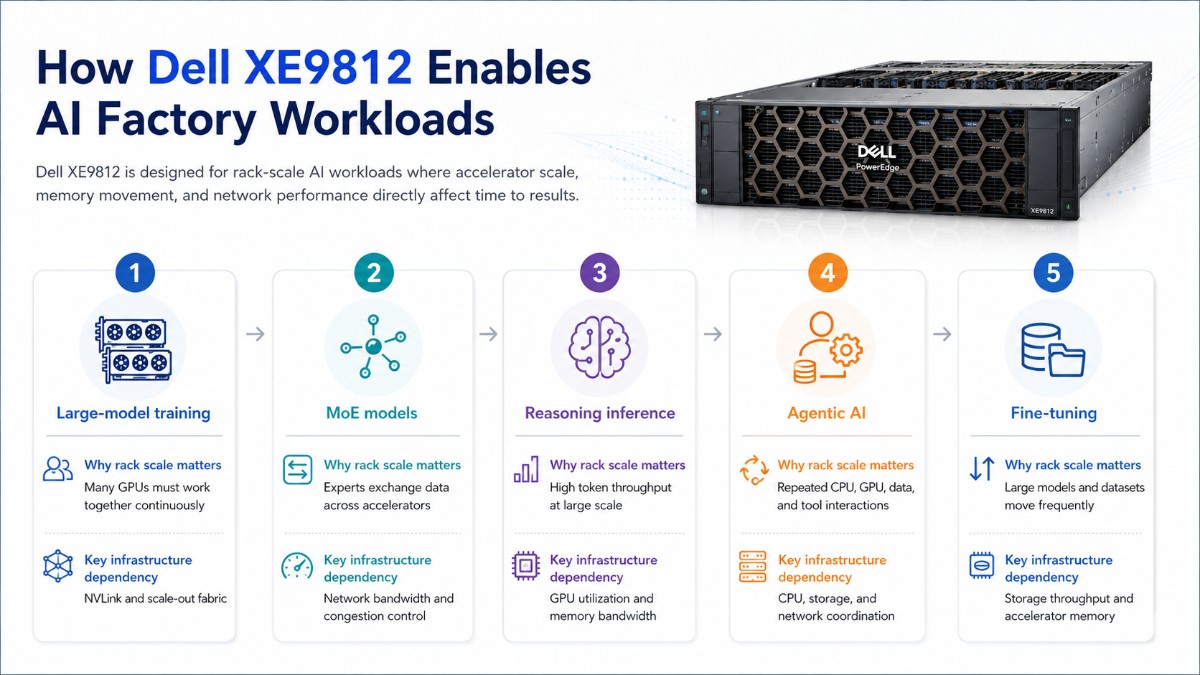
The Dell XE9812 targets workloads where accelerator scale, memory movement, and network performance directly affect time to result. Dell specifically positions the system for large-model training and massive real-time inference.
It can support several AI workload patterns:
| Workload | Why rack scale matters | Key infrastructure dependency |
| Large-model training | Many GPUs must work together continuously | NVLink and scale-out fabric |
| MoE models | Experts exchange data across accelerators | Network bandwidth and congestion control |
| Reasoning inference | High token throughput at large scale | GPU utilization and memory bandwidth |
| Agentic AI | Repeated CPU, GPU, data and tool interactions | CPU, storage and network coordination |
| Fine-tuning | Large models and datasets move frequently | Storage throughput and accelerator memory |
Earlier H100 SXM platforms already showed why dense AI workloads depend on the server, network, storage, power, and cooling around the GPU. XE9812 extends that system-level problem to rack scale.
The Role of NVIDIA Vera CPUs and Rubin GPUs Inside XE9812
The Rubin GPU provides the primary accelerated compute layer. NVIDIA designed it for training, inference, reasoning, and other transformer-era AI workloads, with HBM4 providing the high-bandwidth memory required to keep large models and data close to the accelerator.
The Vera CPU performs a different job. Its role includes orchestration, preprocessing, data movement, memory-intensive work, and keeping accelerators supplied with useful work rather than competing with the GPU for AI computation.
NVIDIA lists 88 Arm-compatible Olympus cores and up to 1.5 TB of LPDDR5X memory for each Vera CPU. NVLink-C2C provides up to 1.8 TB/s of coherent CPU-to-GPU bandwidth in a Vera Rubin Superchip.
That CPU-GPU relationship becomes especially important for agentic AI. Agents may retrieve data, call tools, execute code, modify context, invoke GPU inference, evaluate results, and repeat the workflow many times.
Rubin handles intensive accelerated computation while Vera manages the CPU-heavy work surrounding it. The architecture aims to keep each processing layer busy instead of letting expensive accelerators wait for data or orchestration.
Why Rack-Scale AI Changes Data Center Design
A Dell AI factory server cannot reach its intended utilization if the facility cannot support it. Rack-scale AI shifts design decisions from individual servers to complete electrical, thermal, network, and storage domains.
Four areas require particular attention:
- Cooling: XE9812 belongs to Dell’s liquid-cooled AI portfolio, so facility-side heat removal and coolant distribution must enter deployment planning early.
- Power: operators must plan rack feeds, redundancy, distribution, and future expansion around sustained AI loads.
- Networking: high-bandwidth east-west traffic requires an AI-oriented scale-out fabric rather than ordinary enterprise Ethernet assumptions.
- Storage: training datasets and checkpoints must move fast enough to prevent compute capacity from waiting on I/O.
Network design can become a bottleneck long before a GPU reaches its theoretical limits. Catalyst’s work on AI networking challenges explains why synchronized accelerator traffic puts unusual pressure on congestion control, topology, optics, and link capacity.
Dell supports Vera Rubin environments with PowerSwitch SN6000-series networking based on NVIDIA Spectrum-6, including 1.6TbE and liquid-cooled or co-packaged optics options. Dell also lists NVIDIA Quantum-X800 InfiniBand as part of its high-performance networking portfolio.
Cooling deserves the same system-level planning. High-density data center cooling strategies must account for CDUs, facility water, heat rejection, redundancy, rack density, and retrofit constraints not simply whether a server has liquid-cooled cold plates.
What Should Be Bought With a Dell PowerEdge XE9812?
XE9812 should rarely be evaluated as a single line item. A production deployment requires compatible infrastructure around the compute rack.
| Layer | What buyers should validate | Why it matters |
| Scale-out network | Switches, SuperNICs and fabric topology | Connects XE9812 racks and storage |
| Optics and cabling | Speed, connector, reach and quantity | Completes physical fabric connectivity |
| Storage | Dataset, checkpoint and inference throughput | Keeps accelerators supplied with data |
| Cooling and power | CDU, facility cooling, rack feeds and redundancy | Sustains dense operation |
| Management | Rack monitoring, firmware and operational tooling | Supports production reliability |
The exact bill of materials depends on cluster size and workload. A single-rack inference environment can require a different storage and scale-out design from a multi-rack training cluster.
Compatibility must therefore come from Dell, NVIDIA, and component OEM documentation. Similar port speeds or connector types do not prove that a switch, optic, cable, storage system, or rack design forms a validated configuration.
Dell PowerEdge XE9812 vs Traditional AI Servers
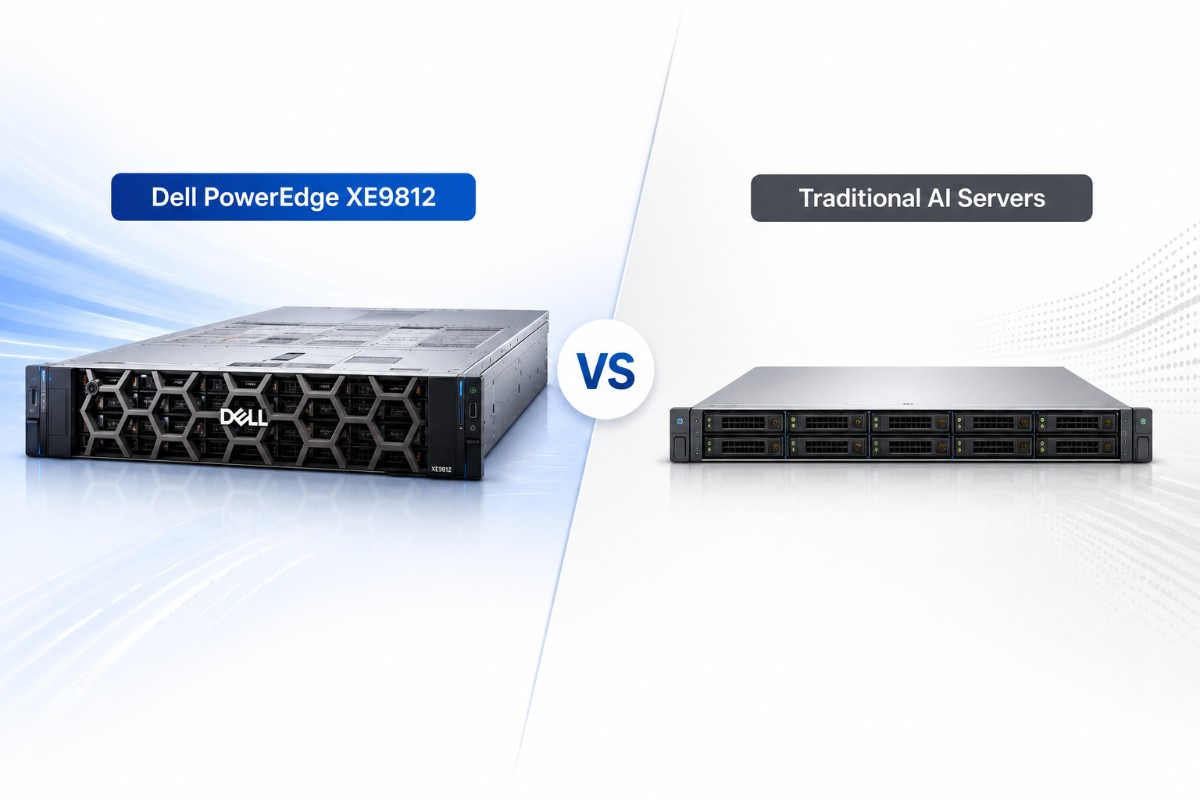
A traditional high-density AI server may contain four or eight accelerators and scale by connecting multiple nodes through an external network. That model remains useful for many enterprise AI, inference, fine-tuning, and HPC workloads.
XE9812 starts at a different level. Its NVIDIA NVL72 architecture creates a 72-GPU rack-scale domain before the deployment scales outward to additional racks.
| Decision point | Traditional GPU server | Dell XE9812 / NVL72 |
| Compute unit | Individual server node | Rack-scale system |
| Typical GPU domain | Commonly 4–8 GPUs | 72 Rubin GPUs |
| Scale-up scope | Inside server | Across NVL72 rack |
| Cooling | Air or liquid, platform dependent | Liquid-cooled architecture |
| Best fit | Enterprise AI and smaller clusters | Large training and inference environments |
That does not make XE9812 automatically better. A smaller HGX Rubin NVL8, DGX-class platform, or conventional GPU server may provide a better operational and financial fit when workloads do not need NVL72-scale compute.
Who Is Dell PowerEdge XE9812 For?
XE9812 makes the strongest case when organizations can keep a rack-scale accelerator busy and already plan for high-density infrastructure.
Likely users include:
- hyperscalers and neocloud GPU service providers;
- enterprises operating very large private AI platforms;
- sovereign AI and national infrastructure programs;
- research or AI organizations training and serving frontier-scale models.
Dell has already shipped PowerRack systems built with PowerEdge XE9812 and Vera Rubin NVL72 to CoreWeave. Dell has also announced XE9812 for other large AI-factory projects, reinforcing its focus on infrastructure operators working at substantial scale.
Who might not need XE9812?
Organizations running smaller RAG systems, departmental inference, development environments, visualization, or moderate fine-tuning may not need a full NVL72 rack.
In those cases, fewer-GPU PowerEdge systems, HGX Rubin NVL8 platforms, RTX PRO servers, or existing-generation GPU infrastructure may offer a better balance of utilization, facility requirements, acquisition cost, and deployment complexity.
Why Enterprises Are Moving Toward AI Factory Platforms
Private AI infrastructure gives enterprises greater control over where models and data run. It also provides predictable capacity for applications that have moved beyond experimentation and into continuous production.
However, owning GPUs alone does not create an AI factory. Enterprises must connect compute with storage, networking, cooling, power, and operational software.
What an Enterprise AI Factory Requires
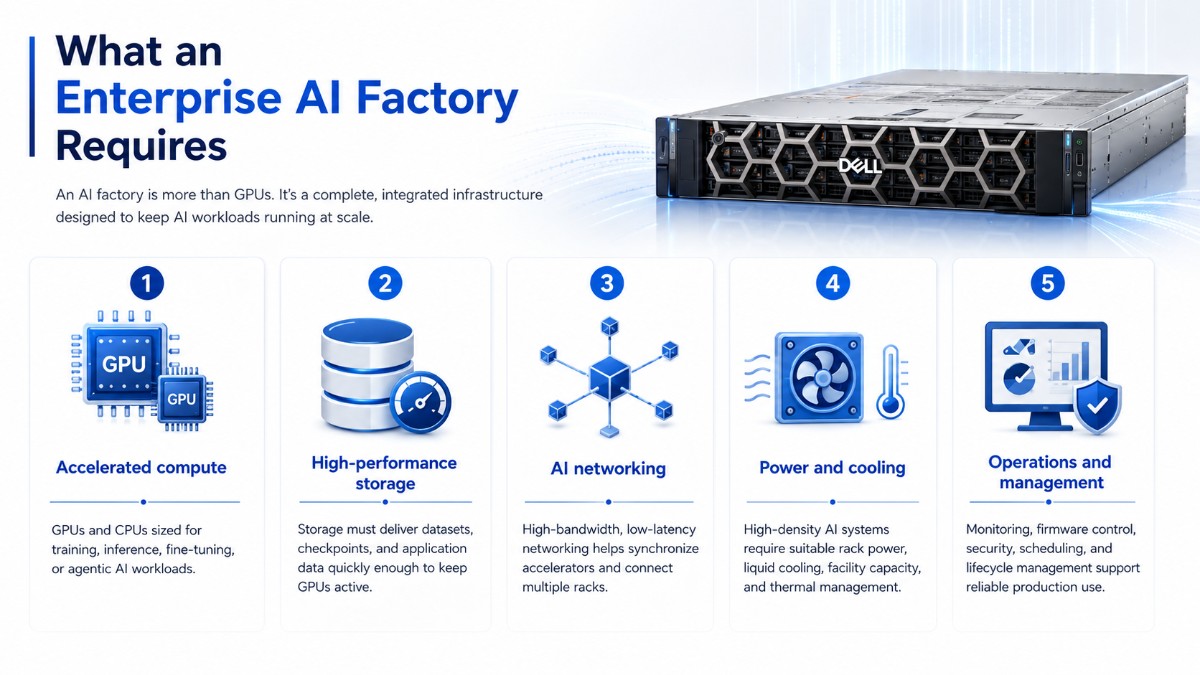
- Accelerated compute
- GPUs and CPUs sized for training, inference, fine-tuning, or agentic AI workloads.
- High-performance storage
- Storage must deliver datasets, checkpoints, and application data quickly enough to keep GPUs active.
- AI networking
- High-bandwidth, low-latency networking helps synchronize accelerators and connect multiple racks.
- Power and cooling
- High-density AI systems require suitable rack power, liquid cooling, facility capacity, and thermal management.
- Operations and management
- Monitoring, firmware control, security, scheduling, and lifecycle management support reliable production use.
Dell addresses these requirements through its broader AI Factory and PowerRack strategy. The company integrates compute, networking, storage, power, cooling, and rack management instead of requiring operators to assemble every layer independently.
What Buyers Should Validate
Before committing to rack-scale infrastructure, organizations should confirm:
- available rack power and cooling capacity;
- network topology, optics, cabling, and redundancy;
- storage performance and expansion requirements;
- software, management, and security compatibility;
- workload utilization, budget, and expected return.
This integrated approach can reduce deployment and integration work. However, buyers should still verify the complete configuration against their workload, facility readiness, deployment timeline, and long-term operating costs.
Dell, NVIDIA and the Next AI Infrastructure Cycle
XE9812 illustrates a larger change in accelerated computing. The competitive unit is shifting from the individual GPU toward a complete system that combines accelerators, host CPUs, scale-up interconnects, scale-out networking, storage, security, power, and cooling.
Dell and NVIDIA represent one path. NVIDIA also offers its own DGX Vera Rubin NVL72 platform, while other OEMs can integrate Vera Rubin architectures into their infrastructure portfolios.
Buyers should also evaluate non-NVIDIA approaches where appropriate. AMD’s Helios rack architecture provides a different rack-scale path built around AMD accelerators, EPYC host compute, Pensando networking, and ROCm.
The right choice depends on workload, software ecosystem, data-center power, cooling, networking, availability, deployment timeline, budget, and existing infrastructurenot simply which platform has the newest accelerator.
How Can Catalyst Support a Dell XE9812 AI Factory Deployment?
Catalyst Data Solutions Inc works across OEM, channel, and distribution ecosystems to help organizations source AI, HPC, networking, storage, optics, cabling, and supporting data-center infrastructure. Because Vera Rubin availability and configuration requirements can change, buyers can request current availability while confirming the XE9812 configuration, workload, rack count, network fabric, storage, cooling, and deployment timeline.
Organizations planning a larger build can also build an infrastructure bundle covering compute, switches, NICs, optics, cables, storage, rack power, and supporting infrastructure. Catalyst can compare Dell, NVIDIA, AMD, HPE, Supermicro, and other options according to workload fit and current availability.
Dell PowerEdge XE9812 FAQs
1. When will Dell PowerEdge XE9812 be available?
Dell announced global XE9812 availability for the second half of 2026. Dell also confirmed in June 2026 that it had already shipped PowerRack systems with XE9812 and Vera Rubin NVL72 to CoreWeave, so shipment has begun for at least selected deployments.
2. What GPUs are inside Dell PowerEdge XE9812?
The XE9812 uses the NVIDIA Vera Rubin NVL72 architecture with 72 NVIDIA Rubin GPUs. The underlying NVL72 platform also includes 36 Vera CPUs, NVLink 6, ConnectX-9 SuperNICs, and BlueField-4 DPUs.
3. How much AI performance can Vera Rubin NVL72 deliver?
NVIDIA currently lists up to 3,600 PFLOPS of dense NVFP4 inference and 2,520 PFLOPS of dense NVFP4 training performance for Vera Rubin NVL72. NVIDIA labels these figures preliminary and subject to change.
4. Is Dell XE9812 designed for training or inference?
It supports both. Dell specifically positions the XE9812 for massive real-time training and inference, including very large models, Mixture-of-Experts workloads, and high-scale AI reasoning.
5. Does Dell XE9812 support large language models?
Yes. Its rack-scale NVIDIA Rubin architecture targets large-model training and inference, including trillion-parameter and Mixture-of-Experts workloads. Actual model capacity and throughput depend on precision, model architecture, software, context length, and cluster configuration.
6. How does cooling work in Dell XE9812 deployments?
Dell describes XE9812 as a liquid-cooled AI platform. Deployment planning must therefore include the server cooling loop plus CDU capacity, facility heat rejection, redundancy, rack power density, and the surrounding thermal infrastructure.
7. Can enterprises deploy Dell XE9812 for private AI?
Yes, when their workload and facilities justify rack-scale infrastructure. Large private AI, regulated environments, sovereign deployments, and high-volume inference can benefit, while smaller enterprise workloads may achieve better utilization with less dense GPU platforms.
8. How does Dell XE9812 compare with NVIDIA DGX Vera Rubin NVL72?
Both use NVIDIA Vera Rubin NVL72 architecture. NVIDIA DGX is NVIDIA’s branded integrated system, while Dell XE9812 places the platform inside Dell’s PowerEdge, PowerRack, management, networking, storage, services, and support ecosystem.
Research Record
Research Date: August 23, 2026
Official Datasheet Version: https://investors.delltechnologies.com/node/19336/pdf
Research Key Points:
- Dell announced the PowerEdge XE9812 as its flagship liquid-cooled Vera Rubin NVL72 platform for massive training and inference, with global availability planned for 2H 2026.
- Dell confirmed that PowerRack systems using PowerEdge XE9812 and NVIDIA Vera Rubin NVL72 had shipped to CoreWeave by June 2026.
- NVIDIA’s current Vera Rubin NVL72 platform combines 72 Rubin GPUs, 36 Vera CPUs, NVLink 6, ConnectX-9, BlueField-4, and Spectrum-X or Quantum-X800 scale-out networking.