

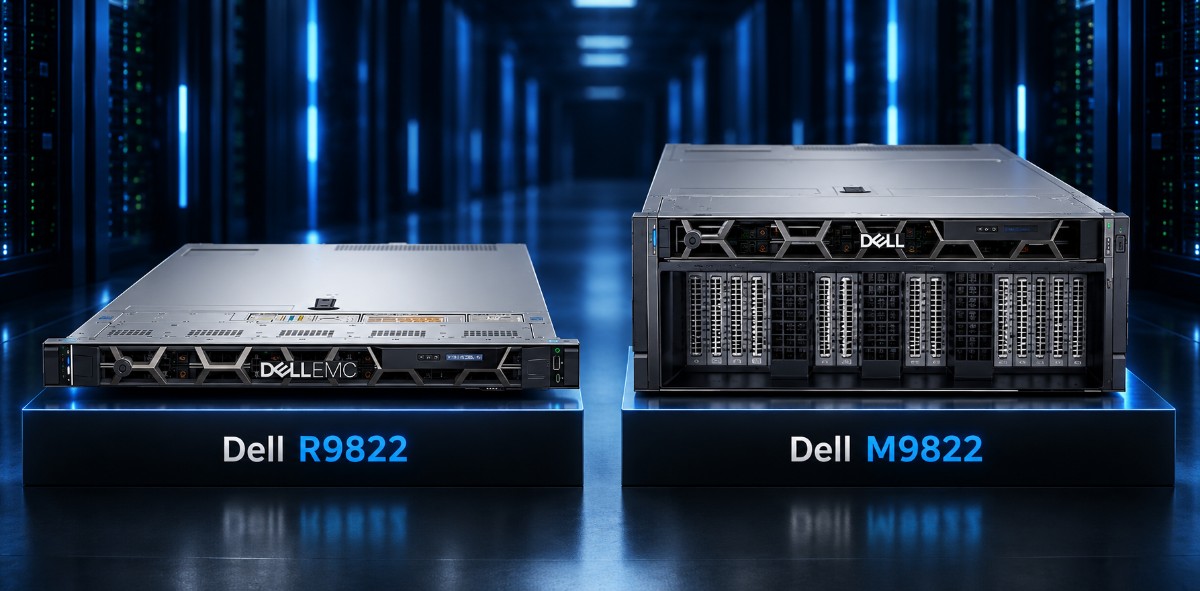
Dell R9822 vs M9822 is not simply a choice between two new PowerEdge servers. It reflects a bigger infrastructure problem emerging with agentic AI: GPUs can handle model inference, but AI agents also need substantial CPU resources for orchestration, retrieval, tool execution, code processing, memory management, and continuous decision-making.
As organizations scale these workflows, traditional server designs can run into limits around compute density, cooling, power, and data movement. Choosing the wrong platform can mean paying for infrastructure that does not match the workload or discovering that the data center cannot support the density the application requires.
Dell addresses those challenges with two NVIDIA Vera CPU-based designs. The PowerEdge R9822 favors flexible, air-cooled deployment, while the PowerEdge M9822 targets dense, direct-liquid-cooled agentic AI and HPC environments.
So, which one fits your AI infrastructure? The answer depends less on the CPU and more on workload intensity, cooling strategy, deployment scale, and the rest of the data center stack.
What Are Dell PowerEdge R9822 and M9822?
Dell PowerEdge R9822 and M9822 are NVIDIA Vera CPU-based servers built for the CPU-heavy side of modern AI. The R9822 uses an expandable 3U air-cooled design for agentic sandboxes, analytics, and general CPU workloads, while the M9822 uses 100% direct liquid cooling for denser agentic AI and HPC environments.
Neither server should be treated as an isolated replacement for GPU infrastructure. Buyers should also consider memory, storage, networking, rack power, and cooling as part of the overall design. That same system-level approach applies to GPU deployment planning, where every infrastructure layer can affect performance and scalability.
Dell R9822 vs M9822 at a glance
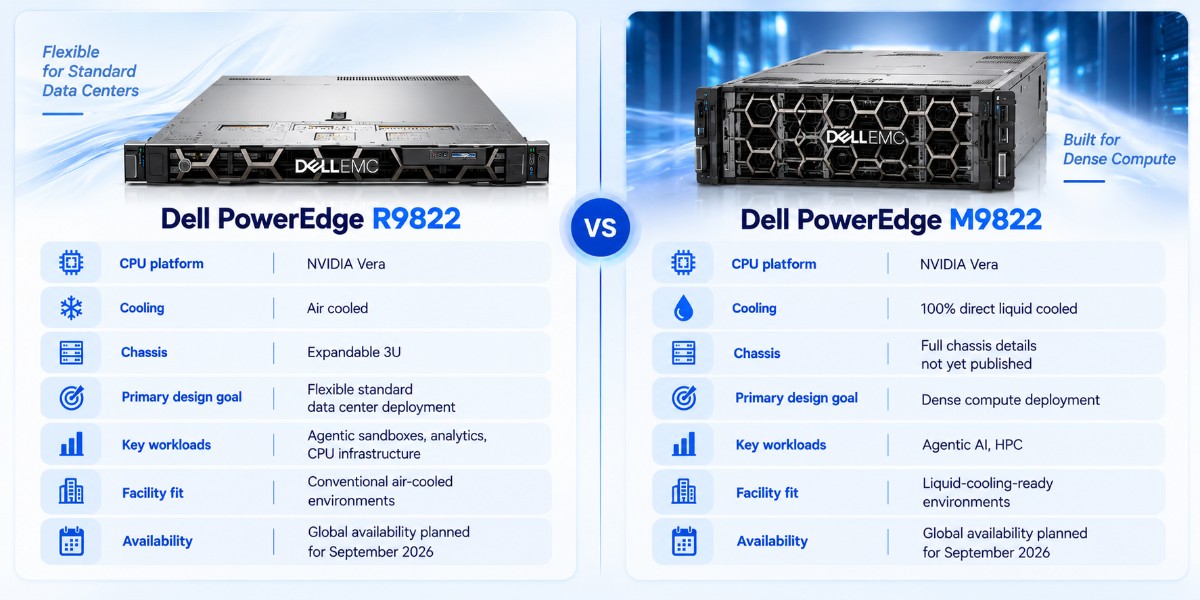
| Feature | Dell PowerEdge R9822 | Dell PowerEdge M9822 |
| CPU platform | NVIDIA Vera | NVIDIA Vera |
| Cooling | Air cooled | 100% direct liquid cooled |
| Confirmed chassis detail | Expandable 3U | Full chassis details not yet published |
| Primary design goal | Flexible standard data center deployment | Dense compute deployment |
| Key workloads | Agentic sandboxes, analytics, CPU infrastructure | Agentic AI, HPC |
| Facility fit | Conventional air-cooled environments | Liquid-cooling-ready environments |
| Availability | Global availability planned for September 2026 | Global availability planned for September 2026 |
Dell has not yet published all server-level specifications in the official material reviewed for this article. Buyers should therefore avoid assuming final socket counts, memory capacities, PCIe configurations, storage layouts, or NIC options until Dell releases validated product documentation.
NVIDIA Vera CPU: Why Agentic AI Needs New CPU Designs
GPUs remain essential for training and accelerated inference, but agentic AI adds workloads that do not stay on the GPU.
A typical agentic workflow may involve:
- Parsing a user request
- Retrieving documents or records
- Calling APIs and software tools
- Running Python or JavaScript
- Querying databases
- Managing multiple agent processes
- Updating memory and context
- Sending work to an inference model
- Evaluating the result and repeating the process
These tasks put the CPU directly on the critical path.
NVIDIA designed Vera for this type of workload. Key platform specifications include:
- 88 NVIDIA Olympus CPU cores
- 176 threads with NVIDIA Spatial Multithreading
- Up to 1.2 TB/s LPDDR5X memory bandwidth
- Up to 1.5 TB of memory
- Arm-compatible architecture
NVIDIA currently describes these specifications as preliminary and subject to change.
Vera focuses on CPU-heavy AI tasks such as:
- Agent orchestration
- Tool execution
- Retrieval
- Analytics
- Sandbox runtimes
- Data processing
- Memory management
- Application services
This creates an important difference from GPU-centric H100 SXM infrastructure. H100 systems focus heavily on accelerated compute and GPU communication, while Vera servers handle more of the CPU, memory, data-processing, and orchestration work around those accelerators.
Dell R9822 vs M9822: The Main Design Difference
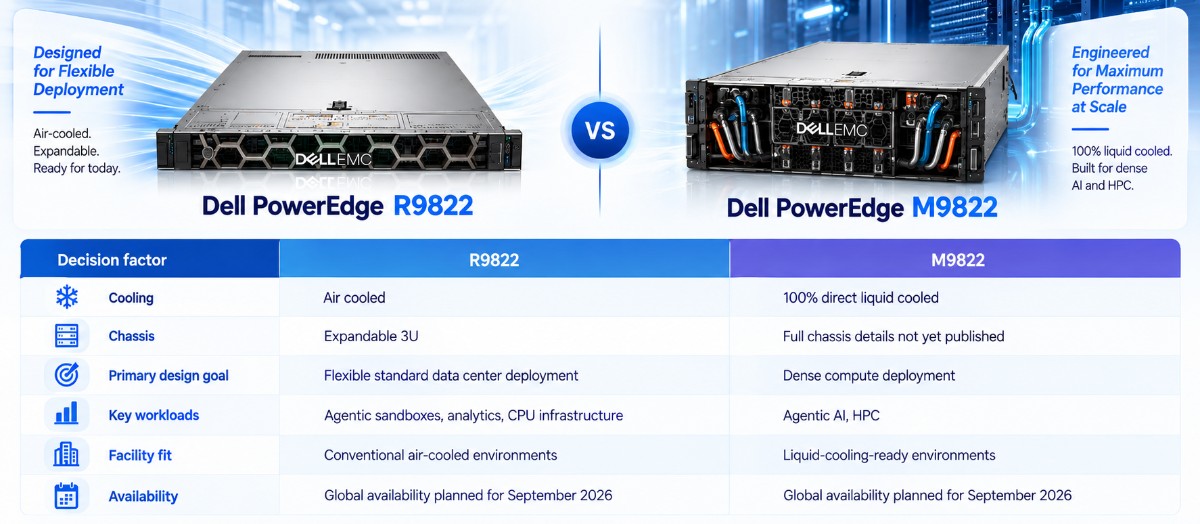
The major difference is not the processor. Both systems use NVIDIA Vera CPUs.
The real difference is how Dell packages Vera for the data center.
The R9822 uses air cooling and a 3U expandable design. That makes it the easier candidate for organizations that want Vera CPU infrastructure without redesigning the facility around direct liquid cooling.
The M9822 uses direct liquid cooling throughout the system. Dell positions it for denser agentic AI and HPC workloads where operators want to maximize performance and efficiency at scale.
This changes the buying decision.
| Decision factor | R9822 | M9822 |
| Existing air-cooled facility | Stronger fit | Requires cooling changes |
| Gradual agentic AI adoption | Stronger fit | May provide more infrastructure than needed |
| Dense CPU compute | Good | Stronger design emphasis |
| HPC environment | Possible workload | Primary stated use case |
| Cooling complexity | Lower | Higher |
| Rack-density priority | Moderate | High |
| Retrofit sensitivity | Better starting point | Facility assessment required |
Liquid cooling should not automatically make the M9822 “better.” It gives operators a different thermal envelope. Organizations need to evaluate CDUs, facility water, heat rejection, redundancy, power feeds, rack design, and maintenance practices as part of their broader AI cooling strategy.
Dell R9822: The Flexible Vera CPU Server Option
The PowerEdge R9822 makes the strongest case for enterprises that want to introduce NVIDIA Vera without immediately moving to a liquid-cooled compute environment.
Dell’s confirmed 3U air-cooled design allows deployment in standard data centers. That can matter for organizations building agentic AI sandboxes, analytics platforms, internal automation systems, CPU-side data pipelines, or mixed enterprise environments.
The R9822 can also make sense when AI remains only one part of the server’s job. An organization may run agent runtimes, database services, retrieval pipelines, analytics, preprocessing, API services, or general CPU workloads on the platform.
It should not automatically replace GPU infrastructure. Large-model training and highly accelerated inference can still require dedicated GPU systems. Instead, the R9822 can provide CPU-side services that keep those accelerators supplied with work.
This makes the R9822 especially relevant to enterprises that already operate GPU infrastructure but need more compute for the surrounding AI pipeline. The hardware stack becomes:
Vera CPU compute → memory/data processing → network → storage → GPU services where required → orchestration and application layer.
Dell M9822: Built for Dense Agentic AI and HPC
The PowerEdge M9822 targets organizations that care more about density and sustained high-load operation.
Dell confirms that the system uses 100% direct liquid cooling. Instead of relying on large volumes of server airflow to remove processor heat, the cooling architecture transfers heat directly into a liquid loop. That can support denser compute designs, but it also moves part of the server decision into the facility.
Operators need suitable coolant distribution, heat rejection, redundancy, monitoring, rack integration, and maintenance procedures. The server cannot deliver the intended deployment model if the data center cannot support the thermal architecture.
HPC environments represent another strong use case. Scientific computing frequently combines CPU-intensive simulation, data preparation, orchestration, storage access, and accelerator workloads. Dell’s separate Vera Rubin HPC systems address GPU-accelerated scientific computing, while the M9822 gives organizations a Vera-based option for dense CPU-centric portions of an HPC environment.
That does not mean every HPC center should choose M9822. Existing cooling infrastructure, application architecture, Arm software support, cluster topology, storage, and budget remain important parts of the decision.
Agentic AI runs as a multi-step process, not a single inference task. The GPU may handle model inference, but CPUs, memory, storage, and networking support most of the workflow around it.
Step 1: Receive and Plan the Request
The agent first interprets the user request and decides what needs to happen next.
The CPU helps manage:
- Agent logic
- Workflow planning
- Task scheduling
- Application state
Step 2: Retrieve Data
The agent may need information from databases, documents, APIs, or enterprise systems before taking action.
CPU resources can process:
- Search queries
- Metadata
- Permissions
- Database requests
- Retrieval pipelines
Step 3: Execute Tools
The agent may then call external tools or applications.
This can involve:
- API requests
- Python or other code
- Containers
- Sandboxed environments
- Business applications
The CPU manages these execution environments and coordinates the results.
Step 4: Manage Memory and Context
Throughout the workflow, the system must keep track of previous actions, retrieved data, tool results, and intermediate decisions.
Memory supports:
- Agent context
- Application data
- Tool outputs
- Multiple concurrent processes
- Intermediate results
As agent concurrency increases, memory capacity and bandwidth become increasingly important.
Step 5: Send Work to the GPU
When accelerated model inference is required, the CPU prepares the request and sends it to the GPU or inference system.
The workflow becomes:
CPU orchestration → GPU inference → result returned to CPU
The GPU handles accelerated model computation, while the CPU continues managing the surrounding application workflow.
Step 6: Evaluate the Result
After inference, the agent evaluates the response and determines whether the task is complete.
The CPU may:
- Validate results
- Update context
- Trigger another tool
- Start another retrieval step
- Send another inference request
This cycle can repeat many times before the agent produces a final response.
Step 7: Move Data Across the Infrastructure
Networking connects the CPU tier with:
- Storage
- Databases
- GPU inference systems
- APIs
- Other compute nodes
Poor network design can slow the entire agent workflow even when the GPU performs inference quickly. Catalyst’s discussion of AI networking challenges explains how network bandwidth, storage traffic, and topology affect AI infrastructure.
The Complete Agentic AI Process
1. User Request → 2. Planning → 3. Retrieval → 4. Tool Execution → 5. GPU Inference → 6. Evaluation → 7. Repeat or Respond
The key point is that agentic AI should be designed as an infrastructure pipeline:
CPU → Memory → Storage → Network → GPU → CPU Evaluation
For buyers comparing Dell R9822 and M9822, the server is only one part of that process. The surrounding memory, storage, networking, cooling, and accelerator infrastructure must also support the workload.
What Should Be Bought With R9822 or M9822?
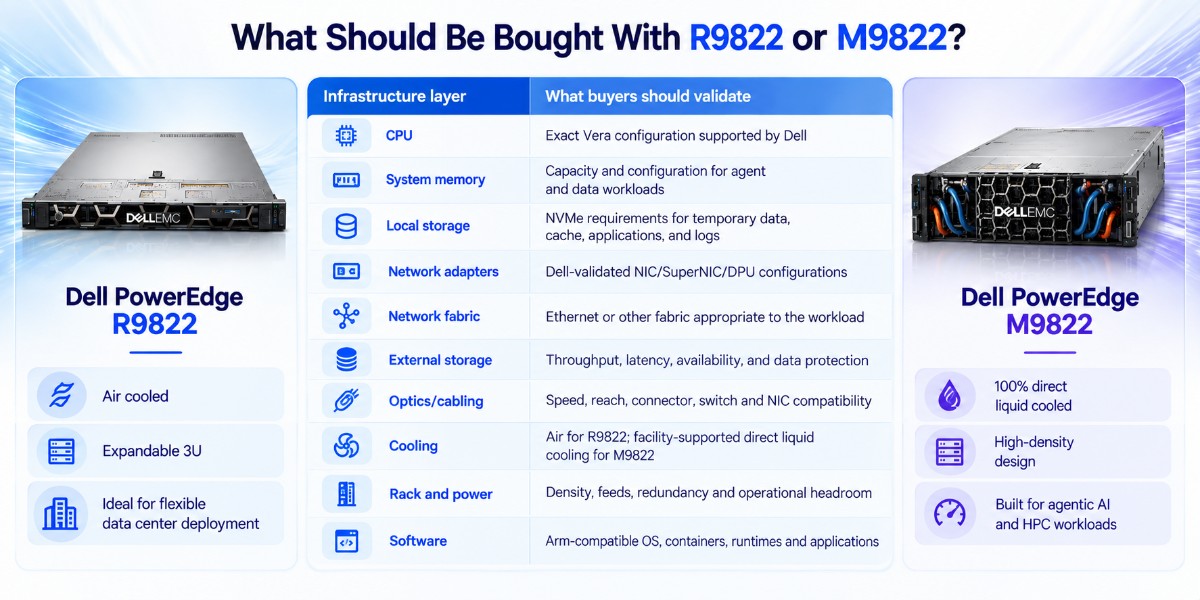
A Dell Vera CPU server still needs supporting infrastructure.
| Infrastructure layer | What buyers should validate |
| CPU | Exact Vera configuration supported by Dell |
| System memory | Capacity and configuration for agent and data workloads |
| Local storage | NVMe requirements for temporary data, cache, applications, and logs |
| Network adapters | Dell-validated NIC/SuperNIC/DPU configurations |
| Network fabric | Ethernet or other fabric appropriate to the workload |
| External storage | Throughput, latency, availability, and data protection |
| Optics/cabling | Speed, reach, connector, switch and NIC compatibility |
| Cooling | Air for R9822; facility-supported direct liquid cooling for M9822 |
| Rack and power | Density, feeds, redundancy and operational headroom |
| Software | Arm-compatible OS, containers, runtimes and applications |
NVIDIA’s broader Vera architecture supports ConnectX networking and BlueField-4 infrastructure offload, but buyers should verify the exact Dell-supported configurations for R9822 and M9822 rather than assuming compatibility from the underlying NVIDIA platform.
That distinction becomes especially important while full Dell server datasheets remain limited.
Choosing Between R9822 and M9822 for Enterprise AI
Choose the Dell PowerEdge R9822 when standard data center deployment matters, the organization still relies heavily on air cooling, workloads include analytics or mixed CPU services, or the team wants to adopt Vera without introducing liquid-cooling infrastructure immediately.
Choose the Dell PowerEdge M9822 when compute density matters more, the facility already supports direct liquid cooling, HPC represents a major workload, or the organization expects large-scale agentic workloads that can justify denser CPU infrastructure.
Neither choice should start with the question, “Which server is faster?”
Start with the workload and facility.
An enterprise running internal agents for document retrieval, application automation, analytics, and moderate tool execution may not need the same infrastructure as a neocloud running thousands of concurrent agents or a research facility combining AI with HPC.
Organizations evaluating an entirely different rack-scale architecture may also compare Dell’s Vera CPU strategy with an AMD rack-scale AI platform, but those platforms solve different problems. AMD Helios combines CPUs and accelerators as an integrated rack-scale architecture, while R9822 and M9822 focus on standalone Vera CPU infrastructure.
Vera CPU Servers vs Traditional x86 AI Servers
Intel Xeon and AMD EPYC remain important data center CPU platforms. They support broad enterprise software ecosystems, virtualization, databases, general compute, cloud infrastructure, HPC, and AI host workloads.
NVIDIA Vera takes a more AI-focused architectural direction.
Vera uses custom Olympus cores, Arm-compatible software execution, high-bandwidth LPDDR5X memory, and an architecture designed around agentic AI, reinforcement learning, analytics, and data processing. NVIDIA also designed Vera to operate both as a standalone CPU platform and as the host CPU for Vera Rubin accelerated systems.
That does not make Vera universally superior to Xeon or EPYC.
Software compatibility alone may favor x86 in some organizations. Existing virtualization platforms, licensing, operational tooling, application certification, procurement standards, and administrator experience can outweigh theoretical CPU advantages.
Vera becomes particularly interesting when agent runtimes, memory bandwidth, high concurrency, data processing, and accelerator coordination dominate the workload.
A practical comparison should therefore evaluate application compatibility, workload performance, power, cooling, memory behavior, PCIe requirements, networking, software support, availability, and total deployment cost rather than a single vendor benchmark.
Why CPU Infrastructure Matters in Future AI Factories
An AI factory needs more than accelerators.
GPUs handle training and inference efficiently, but production AI systems also need CPUs to operate services, execute agent tools, process data, run analytics, manage containers, retrieve information, maintain state, and orchestrate workloads.
Storage keeps datasets, context, databases, checkpoints, and application data available. Networking moves that information between compute layers. Cooling and power determine how much compute the facility can sustain.
That creates a more complete architecture:
CPU services → storage and data → network → accelerated inference → agent evaluation → repeated execution
R9822 and M9822 illustrate two ways Dell can place NVIDIA Vera into that architecture. The R9822 prioritizes conventional deployment flexibility. The M9822 prioritizes dense liquid-cooled compute.
For buyers, the better system is the one that fits the complete infrastructure—not simply the one with the more aggressive thermal design.
Who Is Each Server For?
The R9822 should appeal most to enterprise AI teams, financial or analytics organizations, internal AI platform teams, service providers, and data centers that want Vera CPU infrastructure while retaining conventional air cooling.
The M9822 should appeal more to HPC centers, research environments, high-density AI operators, neoclouds, and organizations already engineering direct-liquid-cooled infrastructure.
Some buyers may need neither. Organizations focused primarily on large GPU inference, model training, visualization, or small departmental AI deployments may get better utilization from a GPU server, a smaller general-purpose server, or existing x86 infrastructure.
That is why workload analysis should come before platform selection.
How Can Catalyst Support a Dell Vera CPU Deployment?
Catalyst Data Solutions works across OEM, channel, and distribution ecosystems to help organizations source AI, HPC, server, networking, storage, optics, cabling, and supporting data center infrastructure.
For R9822 or M9822 projects, the useful starting point is a complete configuration request rather than a server SKU alone. Buyers can request configuration pricing based on workload, server quantity, networking, storage, cooling, power, availability, and deployment timeline.
Because frontier hardware availability can change quickly, Catalyst can also help compare Dell configurations and supporting infrastructure while teams review the broader AI infrastructure catalog for servers, networking, storage, optics, and related components.
Dell R9822 vs M9822 FAQs
1. What is the difference between Dell R9822 and M9822 cooling systems?
The R9822 uses air cooling, while Dell describes the M9822 as 100% direct liquid cooled. The M9822 therefore requires a data center environment capable of supporting liquid-cooling infrastructure.
2. Which Dell Vera CPU server is better for AI agents?
The R9822 fits organizations that value standard data center deployment and workload flexibility. The M9822 better suits dense agentic AI environments with direct liquid cooling. Neither is universally better; workload density and facility design determine the stronger fit.
3. Does Dell M9822 require liquid cooling infrastructure?
Yes. Dell specifically describes the PowerEdge M9822 as a 100% direct-liquid-cooled system. Buyers should validate CDU, facility-water, heat-rejection, rack, redundancy, and service requirements before deployment.
4. Can Dell R9822 run large language models?
It can support AI software and CPU-based model workloads when the model and software stack support the Vera/Arm platform, but Dell positions R9822 primarily for agentic sandboxes, analytics, data processing, and general CPU infrastructure. Large accelerated LLM inference will often still rely on GPUs.
5. What workloads benefit most from NVIDIA Vera CPU?
Agentic AI, reinforcement learning, analytics, retrieval, data processing, orchestration, sandboxed code execution, and memory-intensive AI services are central Vera use cases. NVIDIA designed the CPU specifically around the CPU-heavy work surrounding modern AI models.
6. How does Vera CPU differ from Intel Xeon and AMD EPYC?
Vera uses NVIDIA-designed Olympus Arm-compatible cores and high-bandwidth LPDDR5X memory with an architecture optimized around AI-agent and AI-factory workloads. Xeon and EPYC use x86 architectures and serve much broader established enterprise ecosystems. The best choice depends on software compatibility, workload, infrastructure, and economics.
7. Are Dell R9822 and M9822 designed for AI inference?
They support the infrastructure surrounding inference, especially retrieval, orchestration, data processing, tool execution, and agent runtimes. They should not automatically be treated as substitutes for GPU-accelerated inference servers when a model requires substantial accelerator compute.
8. Are Dell R9822 and M9822 available now?
Not yet according to Dell’s published schedule. Dell announced both systems and states that global availability will begin in September 2026. As of August 30, 2026, they should be described as announced/upcoming rather than generally available.
Research & Fact-Check
Research date: August 30, 2026
Dell R9822/M9822 official Source:
NVIDIA Vera specifications: NVIDIA currently lists 88 Olympus cores, 176 threads, up to 1.5 TB LPDDR5X memory and up to 1.2 TB/s memory bandwidth; NVIDIA marks relevant platform specifications as preliminary and subject to change.
Research key points:
- Dell PowerEdge R9822 and M9822 both use NVIDIA Vera CPUs, but Dell targets them at different deployment environments. The R9822 is an expandable 3U air-cooled server for agentic sandboxes, analytics, and general-purpose CPU infrastructure, while the M9822 is 100% direct liquid cooled for dense agentic AI and HPC workloads.
- NVIDIA Vera is purpose-built for CPU-heavy AI factory workloads, including orchestration, tool execution, analytics, retrieval, and agentic AI. NVIDIA specifies 88 Olympus cores, 176 threads, up to 1.5 TB LPDDR5X memory, and up to 1.2 TB/s memory bandwidth; NVIDIA marks these specifications as preliminary.
- R9822 and M9822 are announced but not yet generally available. Dell states that both systems are scheduled for global availability in September 2026, so the article should not describe them as currently shipping or generally available yet.