
AI infrastructure is moving beyond standalone accelerators toward complete systems that combine GPU compute, host CPUs, networking, storage, power, and cooling. For organizations building large language model infrastructure or enterprise AI platforms, each of these layers can affect performance, scalability, and operating cost.
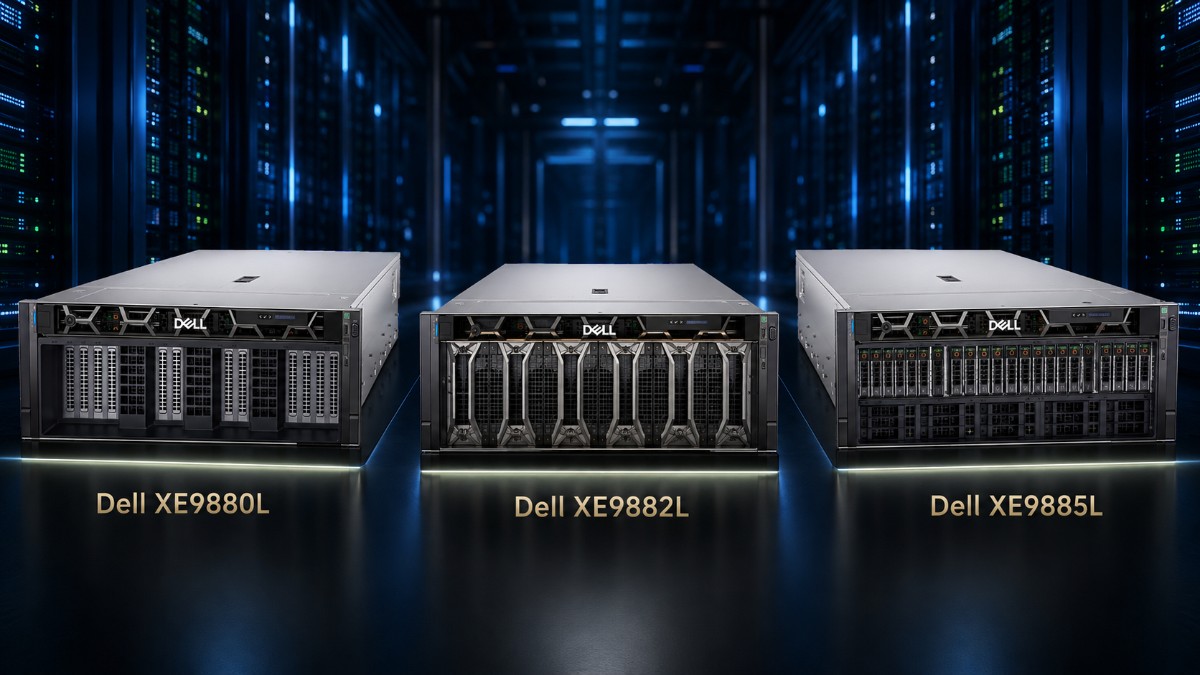
Dell’s Rubin generation reflects this system-level approach. The PowerEdge XE9880L, XE9882L, and XE9885L are liquid-cooled servers built around NVIDIA HGX Rubin NVL8, giving organizations several ways to deploy eight-GPU AI nodes within a larger cluster.
Choosing among them is not simply a matter of selecting the newest or most powerful server. CPU architecture, software compatibility, data movement, networking, cooling capacity, and the intended training or inference workload all influence which configuration makes the most practical sense.
Organizations comparing these systems with NVIDIA-built infrastructure may also benefit from understanding how DGX and HGX platforms differ at the system and deployment level.
What Are Dell XE9880L, XE9882L and XE9885L Servers?
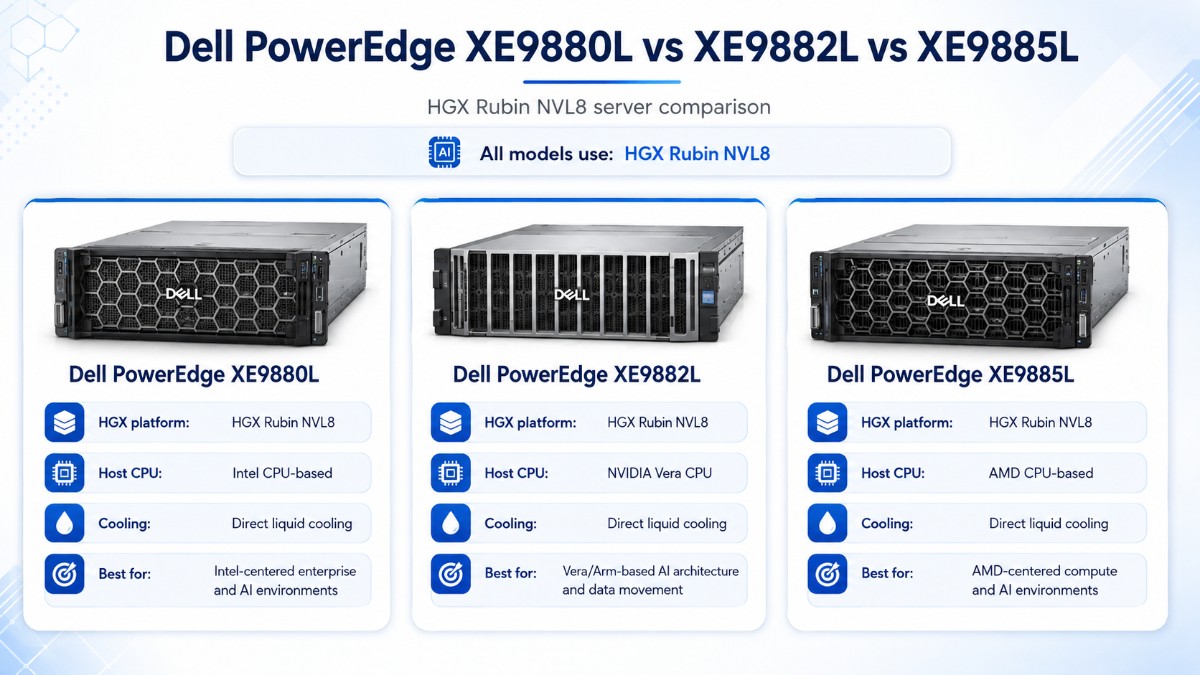
The Dell PowerEdge XE988x family consists of purpose-built AI systems designed around NVIDIA HGX Rubin NVL8. Dell positions the XE9880L, XE9882L, and XE9885L for production AI workloads where organizations need eight-GPU compute nodes rather than a full Vera Rubin NVL72 rack-scale compute domain.
They target AI training, large-scale inference, generative AI, and high-density GPU clusters. Dell also designed the family around direct liquid cooling and integration with its broader AI Factory infrastructure.
| Server | HGX platform | Host CPU direction | Cooling | Best selection reason |
| Dell PowerEdge XE9880L | HGX Rubin NVL8 | Intel CPU-based | Direct liquid cooling | Intel-centered enterprise and AI environments |
| Dell PowerEdge XE9882L | HGX Rubin NVL8 | NVIDIA Vera CPU | Direct liquid cooling | Vera/Arm-based AI architecture and data movement |
| Dell PowerEdge XE9885L | HGX Rubin NVL8 | AMD CPU-based | Direct liquid cooling | AMD-centered compute and AI environments |
The family therefore should not be compared as “basic, better, best.” Each server exposes the same core Rubin accelerator platform through a different host-compute architecture.
That distinction follows a pattern already familiar to organizations operating H100-era HGX deployments: the GPU platform matters, but the surrounding server determines how effectively an organization can deploy it.
NVIDIA HGX Rubin NVL8 Architecture Explained
NVIDIA HGX Rubin NVL8 is an integrated eight-GPU AI computing platform, not simply a server with eight independent GPUs. NVIDIA connects eight Rubin SXM GPUs through sixth-generation NVLink to create a high-bandwidth scale-up domain for training, inference, post-training, and HPC workloads.
Each Rubin GPU includes HBM4 memory and high-speed NVLink connectivity. NVIDIA currently lists 288 GB of HBM4 per GPU, providing approximately 2.3 TB of aggregate GPU memory across an eight-GPU HGX Rubin NVL8 platform.
NVIDIA marks the published Rubin figures as preliminary and subject to change, which matters when planning systems that have not yet reached a fully mature product-documentation cycle.
| NVIDIA HGX Rubin NVL8 characteristic | Current NVIDIA specification |
| GPU configuration | 8 × NVIDIA Rubin SXM |
| Aggregate GPU memory | 2.3 TB HBM4 |
| Aggregate HBM bandwidth | 176 TB/s |
| GPU interconnect | Sixth-generation NVLink |
| NVLink switch bandwidth | 28.8 TB/s |
The Rubin GPU itself provides up to 288 GB HBM4 with 22 TB/s memory bandwidth and 3.6 TB/s NVLink bandwidth per GPU. Those capabilities matter for large models because accelerators spend less time waiting for parameters, activations, or data exchanged between GPUs.
HGX also leaves room for OEM differentiation. NVIDIA explicitly supports Rubin NVL8 with either x86 CPU baseboards or NVIDIA Vera CPUs, which explains the central architectural difference among Dell’s three XE988x systems.
Dell XE9880L vs XE9882L vs XE9885L: Key Differences
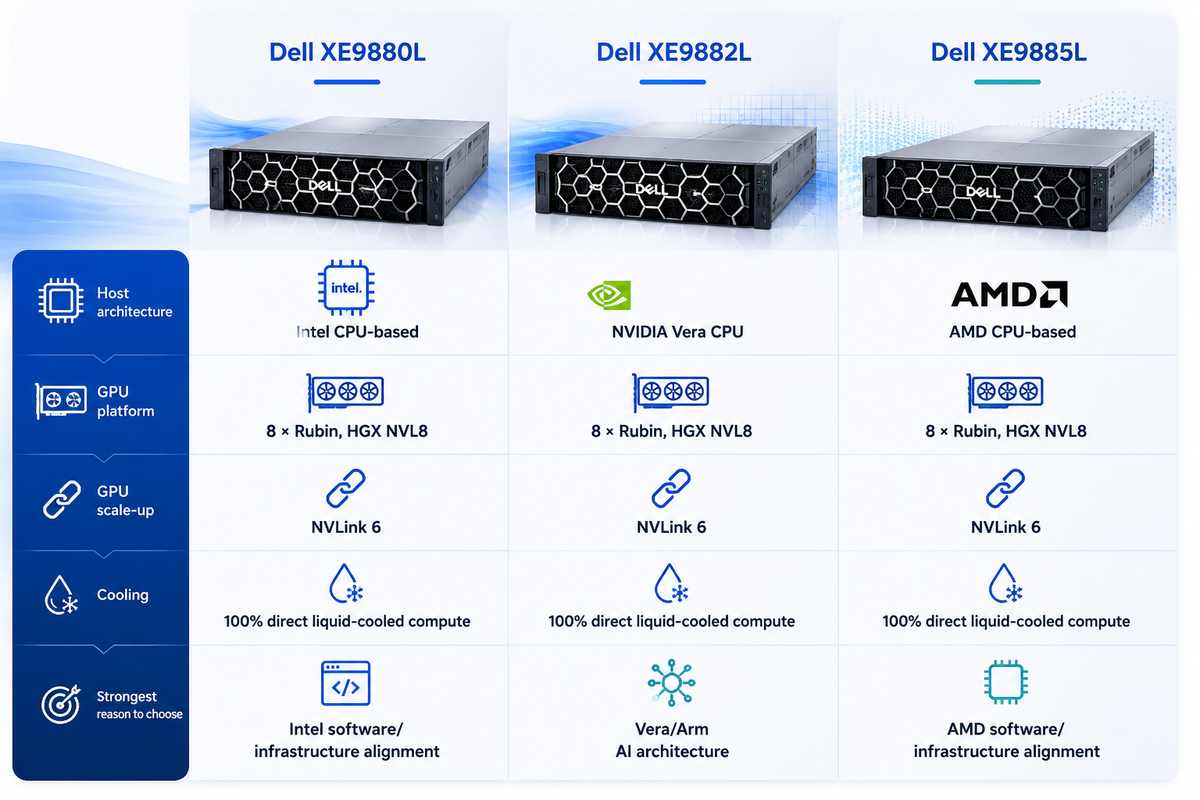
The Dell XE9880L vs XE9882L vs XE9885L decision starts with the host CPU rather than the Rubin GPUs. Dell gives buyers three host-compute paths while keeping HGX Rubin NVL8 as the common accelerator foundation.
| Area | XE9880L | XE9882L | XE9885L |
| Host architecture | Intel CPU-based | NVIDIA Vera CPU | AMD CPU-based |
| GPU platform | 8 × Rubin, HGX NVL8 | 8 × Rubin, HGX NVL8 | 8 × Rubin, HGX NVL8 |
| GPU scale-up | NVLink 6 | NVLink 6 | NVLink 6 |
| Cooling | 100% direct liquid-cooled compute | 100% direct liquid-cooled compute | 100% direct liquid-cooled compute |
| Strongest reason to choose | Intel software/infrastructure alignment | Vera/Arm AI architecture | AMD software/infrastructure alignment |
Dell says these systems can support up to 144 GPUs per rack when deployed in its high-density infrastructure. The company integrates the compute architecture with its IR9000 rack environment, networking, power, and cooling rather than positioning the node as an isolated GPU appliance.
For buyers, three questions should drive the shortlist:
- Which CPU architecture best supports the existing software stack?
- How much CPU-side preprocessing, orchestration, retrieval, or data movement will occur?
- Does the organization want x86 continuity or a Vera-based AI architecture?
- How will multiple eight-GPU nodes connect to storage and the scale-out fabric?
Dell’s public launch materials cited here do not yet provide complete per-model tables for DIMM capacity, PCIe slot allocation, local-drive capacity, or maximum system power. Buyers should verify those details against the final Dell technical documentation before locking a configuration.
Choosing the Right Dell Rubin Server for AI Training
Large language model training places sustained pressure on more than GPU arithmetic. Distributed training requires enough HBM capacity, fast GPU-to-GPU communication, checkpoint storage, and a network that can keep multiple HGX nodes synchronized.
All three Dell systems start with the same eight-Rubin-GPU scale-up domain. That means the CPU decision should reflect the work happening around those GPUs rather than an assumption that one model automatically trains faster.
| Training requirement | What to evaluate |
| Large model capacity | 2.3 TB aggregate HBM4 per HGX Rubin NVL8 platform |
| Intra-node scaling | NVLink 6 between eight Rubin GPUs |
| Multi-node scaling | High-bandwidth Ethernet or InfiniBand fabric |
| Checkpointing | Storage throughput and recovery requirements |
| Host processing | Intel, AMD, or Vera CPU architecture |
Organizations planning multi-node clusters should address GPU deployment planning early. A fast eight-GPU server can still sit underutilized if the network, storage tier, or facility cannot feed it consistently.
For large distributed training, the “best Rubin AI server” is therefore the system that fits the complete cluster architecture. CPU preference alone does not replace fabric, storage, cooling, and rack planning.
Choosing the Right Server for AI Inference and Enterprise AI
Inference changes the priorities. Training often emphasizes sustained throughput across synchronized accelerators, while production inference may prioritize latency, tokens per second, model capacity, concurrency, and predictable service levels.
Rubin’s HBM4 capacity makes the XE988x family relevant for large models, long-context workloads, reasoning, and high-volume model serving. Enterprise deployments may also use CPU resources for retrieval, data preparation, orchestration, APIs, and agent tools before or after GPU inference.
The selection logic remains practical:
- Choose XE9880L when Intel alignment matters to the wider environment.
- Choose XE9885L when AMD alignment better fits the existing platform.
- Evaluate XE9882L when Vera’s Arm-based host architecture fits the AI software and data-flow design.
- Compare smaller GPU systems when eight Rubin GPUs exceed the actual workload.
That last point matters. Not every enterprise private-AI deployment needs an HGX Rubin NVL8 server, especially when a smaller GPU configuration can satisfy inference demand at lower infrastructure complexity.
Memory, Networking and Cooling: What Actually Separates AI Deployments
Memory
Rubin provides up to 288 GB HBM4 per GPU, giving an eight-GPU NVL8 system roughly 2.3 TB of GPU memory. HBM4 also reaches up to 22 TB/s of memory bandwidth per Rubin GPU according to NVIDIA’s preliminary specifications.
Large memory capacity helps keep bigger models and working datasets closer to the accelerator. However, HBM does not replace host memory or external storage; each layer serves a different part of the pipeline.
Networking
NVLink 6 handles communication among the eight Rubin GPUs inside the HGX platform. Once organizations connect multiple XE988x nodes, the design shifts to scale-out Ethernet or InfiniBand.
Dell’s Rubin infrastructure includes PowerSwitch SN6000 systems based on NVIDIA Spectrum-6, with 1.6TbE capabilities and liquid-cooled or co-packaged-optics options. Dell also supports NVIDIA Quantum-X800 InfiniBand within its AI infrastructure portfolio.
The fabric needs careful design because AI networking bottlenecks can reduce effective GPU utilization even when the compute nodes themselves have ample accelerator capacity.
Cooling
Dell describes the XE9880L, XE9882L, and XE9885L compute architecture as 100% direct liquid cooled. That requirement changes deployment planning at the facility level.
Buyers need to consider CDUs, manifolds, facility-water requirements, heat rejection, redundancy, and service procedures. Existing data centers may therefore need infrastructure work before they can deploy a high-density Rubin cluster.
These data center cooling strategies become part of server selection rather than a facilities decision made after purchasing compute.
Storage, Optics and Power
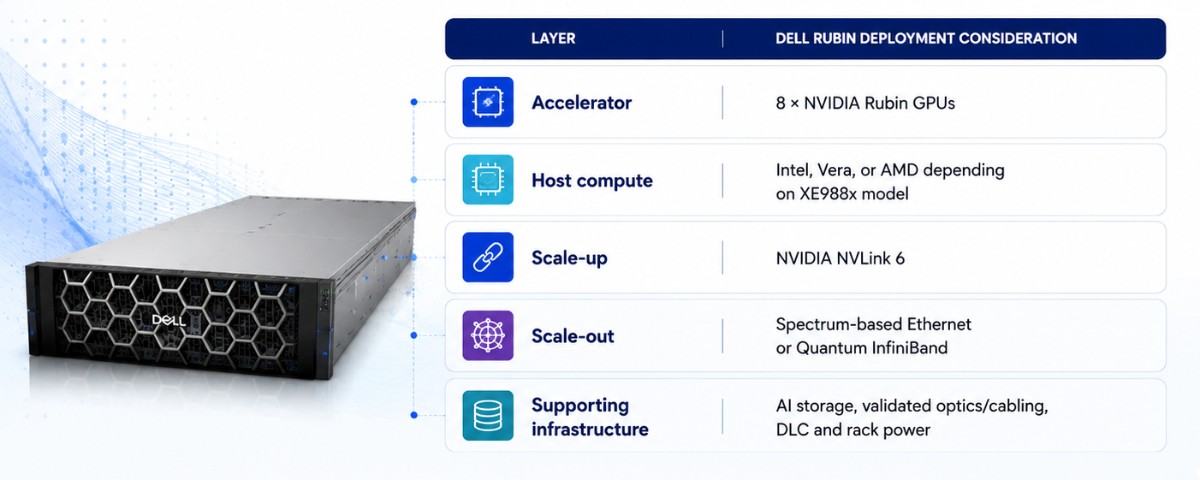
The server is only one layer of an AI factory. Storage needs enough sustained throughput for datasets, checkpoints, RAG content, model artifacts, and inference context without leaving expensive GPUs idle.
| Layer | Dell Rubin deployment consideration |
| Accelerator | 8 × NVIDIA Rubin GPUs |
| Host compute | Intel, Vera, or AMD depending on XE988x model |
| Scale-up | NVIDIA NVLink 6 |
| Scale-out | Spectrum-based Ethernet or Quantum InfiniBand |
| Supporting infrastructure | AI storage, validated optics/cabling, DLC and rack power |
Optics and cables should match the selected NICs, switches, link speeds, and validated Dell/NVIDIA topology. Do not assume compatibility simply because two devices use the same physical connector.
Power also needs configuration-specific verification. Dell’s launch material does not provide one universal XE988x maximum-power figure, and real requirements will vary with CPU, networking, storage, and rack configuration.
Dell XE988x Servers vs NVIDIA DGX Rubin Systems
Dell HGX servers and NVIDIA DGX Rubin systems use NVIDIA’s Rubin technology but address different buying and integration approaches.
NVIDIA describes DGX Rubin NVL8 as a liquid-cooled system with eight Rubin GPUs and NVLink 6 for training, inference, and post-training. Dell uses the HGX platform as the accelerator foundation and adds PowerEdge host choices plus Dell rack, networking, storage, management, and deployment options.
| Decision area | Dell XE988x HGX Rubin | NVIDIA DGX Rubin NVL8 |
| Rubin GPUs | 8 | 8 |
| Platform approach | OEM implementation of HGX | NVIDIA-built DGX system |
| CPU flexibility | Intel, AMD, or Vera across Dell family | NVIDIA-defined DGX configuration |
| Integration focus | Dell PowerEdge / PowerRack / networking / storage | NVIDIA reference AI infrastructure |
| Best fit | Buyers prioritizing Dell infrastructure integration | Buyers prioritizing NVIDIA’s integrated DGX approach |
Neither approach wins automatically. The better option depends on management standards, software requirements, existing infrastructure, support model, networking design, availability, and deployment timeline.
Who Should Choose a Dell XE988x and Who Might Not Need One?
Dell XE988x systems make the strongest case for organizations that can consistently use eight frontier-class GPUs and have the surrounding infrastructure to support them.
Likely users include neocloud providers, research organizations, large enterprises, sovereign AI operators, and teams running large-scale model training or inference.
Organizations may not need an XE988x when:
- Inference demand fits one or a few lower-density GPUs.
- Existing facilities cannot support direct liquid cooling.
- Model size does not require an eight-GPU scale-up domain.
- Budget is better spent balancing compute, storage, and networking.
That distinction matters because GPU utilization not simply buying the newest accelerator determines whether the infrastructure delivers value.
Conclusion
The Dell XE9880L vs XE9882L vs XE9885L comparison comes down primarily to host architecture. All three systems use NVIDIA HGX Rubin NVL8 with eight Rubin GPUs and direct liquid cooling, while Dell differentiates them through Intel, NVIDIA Vera, and AMD CPU options.
The right server depends on more than GPU performance. Buyers should evaluate CPU software compatibility, model requirements, scale-out networking, storage throughput, optics, rack power, cooling, and deployment scale together. For some organizations, an XE988x cluster will provide the right balance between standalone GPU servers and NVL72 rack-scale infrastructure.
Why HGX Rubin NVL8 Matters for Future AI Factories
Rubin shows how AI infrastructure is shifting from individual server specifications toward complete system design. NVIDIA combines HBM4, NVLink 6, new networking, and higher accelerator density because modern training and agentic inference increasingly depend on rapid movement of models, context, and intermediate data.
Dell extends that architecture through CPU choice, liquid-cooled PowerEdge systems, rack integration, storage, Ethernet, and InfiniBand. Buyers can therefore build clusters around eight-GPU nodes instead of committing every workload to a 72-GPU NVL72 scale-up domain.
NVIDIA is not the only rack-scale direction worth evaluating. Organizations comparing broader accelerator ecosystems should also consider the AMD Helios architecture when software compatibility, accelerator strategy, power, availability, or procurement requirements favor an AMD platform.
How Can Catalyst Support a Dell Rubin Deployment?
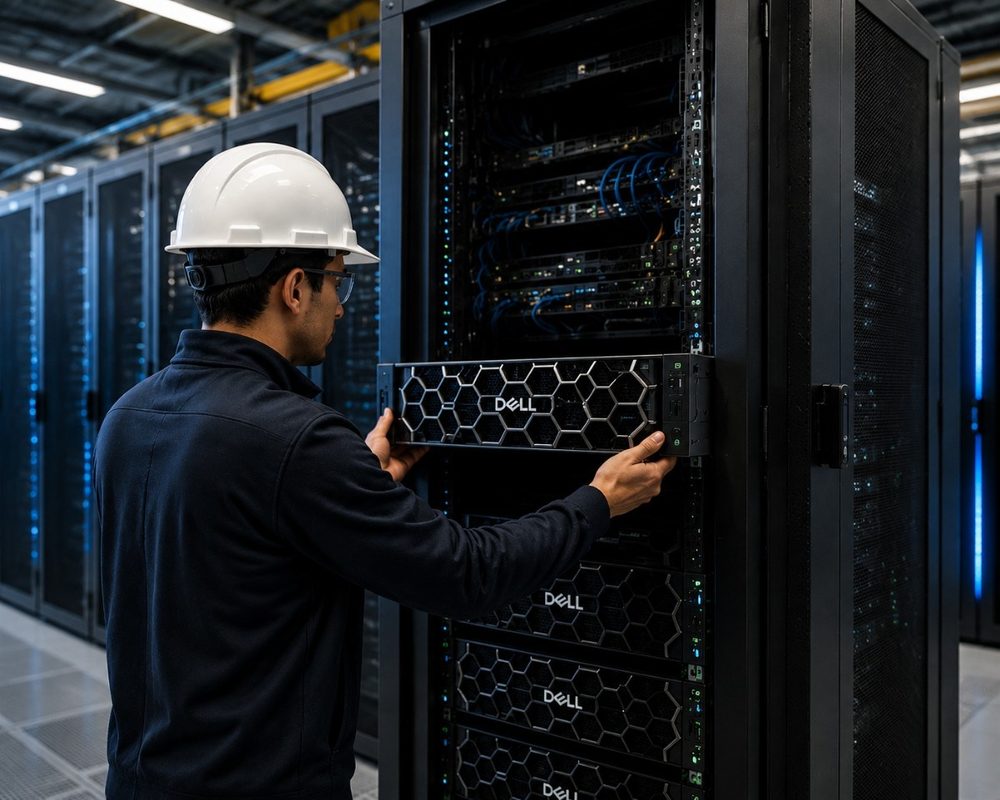
Catalyst Data Solutions Inc helps organizations source AI, HPC, and data-center infrastructure across compute, networking, storage, optics, cabling, power, and supporting hardware.
For an XE988x project, the configuration should start with the workload and CPU architecture, then validate GPU-node count, networking, storage throughput, optics, rack density, liquid-cooling requirements, and delivery schedule.
Buyers can request current availability for the Dell XE9880L, XE9882L, or XE9885L and compare complete configurations based on workload, infrastructure compatibility, budget, and lead time.
Because Rubin hardware availability and final configurations can change quickly, a configuration quote is more useful than treating these platforms as standard “buy now” servers.
Frequently Asked Questions
1. What is the main difference between Dell XE9880L and XE9885L?
The main difference is the host CPU architecture. Dell identifies the XE9880L as Intel CPU-based and the XE9885L as AMD CPU-based; both use NVIDIA HGX Rubin NVL8 with eight Rubin GPUs.
2. Which Dell XE988x server is best for large language models?
There is no universal best model because all three share the eight-GPU Rubin NVL8 foundation. Choose based on CPU architecture, software compatibility, preprocessing needs, network design, storage throughput, and how the node will scale within the wider cluster.
3. How many NVIDIA Rubin GPUs do Dell XE988x servers support?
Each XE9880L, XE9882L, and XE9885L uses eight NVIDIA Rubin GPUs through the NVIDIA HGX Rubin NVL8 platform. Dell says rack configurations can scale to as many as 144 GPUs.
4. Are Dell XE9880L servers suitable for AI inference?
Yes. Dell positions its HGX Rubin NVL8 systems for both AI training and inference. Rubin’s large HBM4 capacity also makes the platform relevant to high-throughput, reasoning, and large-model inference workloads.
5. How much power does a Dell Rubin AI server require?
Dell’s cited launch materials do not provide one final per-server power figure for each XE988x model. Power planning should use the final Dell configuration because CPU choice, eight Rubin GPUs, networking, storage, rack density, and cooling infrastructure all affect the deployment envelope.
6. Does Dell XE988x support private AI deployments?
Yes. Dell designed the family for production AI within enterprise and high-density data-center environments, including organizations that want to operate models and data within controlled infrastructure rather than relying entirely on public-cloud GPU capacity.
7. How does HGX Rubin NVL8 compare with previous HGX platforms?
Rubin introduces HBM4 and sixth-generation NVLink. NVIDIA currently lists up to 288 GB HBM4 and 22 TB/s memory bandwidth per Rubin GPU, although NVIDIA labels the published Rubin specifications preliminary and subject to change.
8. Should enterprises choose Dell XE988x or NVIDIA DGX Rubin?
Choose based on the deployment model rather than the logo. Dell XE988x systems make sense when PowerEdge integration, CPU choice, Dell networking, storage, and rack infrastructure matter; DGX may suit organizations that prefer NVIDIA’s own integrated system approach.
Research Record
Research Date: August 22, 2026
Official Product Source : https://www.dell.com/en-sg/dt/corporate/newsroom/announcements/detailpage.press-releases~usa~2026~03~dell-ai-factory-with-nvidia-delivers-proven-path-to-enterprise-ai-roi.htm
Research Key Points:
- Dell confirms that XE9880L uses Intel host CPUs, XE9885L uses AMD host CPUs, and XE9882L uses NVIDIA Vera, while all three use eight-way NVIDIA HGX Rubin NVL8 acceleration.
- Dell announced Q3 2026 global availability for XE9880L and XE9885L. The cited March availability list did not provide a separate global availability date for XE9882L, so current orderability and lead time should be confirmed rather than assumed.
- NVIDIA currently lists HGX Rubin NVL8 with eight Rubin GPUs, 2.3 TB aggregate HBM4, 176 TB/s aggregate HBM bandwidth, and NVLink 6; NVIDIA labels these figures preliminary.