
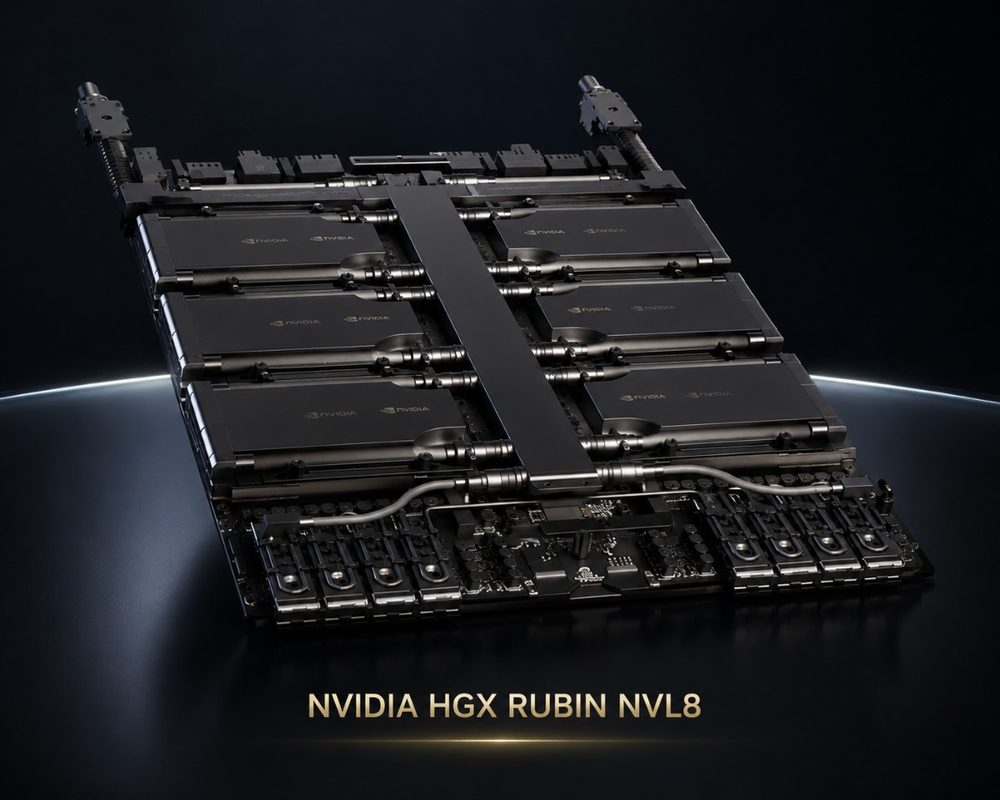
NVIDIA HGX Rubin NVL8 brings the Rubin GPU generation into an eight-GPU server platform designed for enterprises, research organizations, AI service providers, and HPC environments. Instead of requiring a 72-GPU rack-scale deployment, organizations can build Rubin-based servers around a smaller platform while keeping high-bandwidth GPU memory and NVLink 6 communication.
The important question is not simply how fast eight NVIDIA Rubin GPUs are. Buyers also need to understand the host CPU, networking, storage, local NVMe, cooling, rack power, and multi-node fabric required to keep those GPUs productive.
That system-level approach follows the same principle behind modern NVIDIA GPU server design: accelerator performance matters most when the rest of the infrastructure can feed and connect it.
What Is NVIDIA HGX Rubin NVL8?
NVIDIA HGX Rubin NVL8 is an eight-GPU AI and HPC platform that connects eight NVIDIA Rubin GPUs through sixth-generation NVLink. It supports x86 CPU-based OEM servers, while a Vera CPU configuration is offered as HGX Vera Rubin NVL8. The platform targets AI training, inference, reasoning, agentic AI, data analytics, and scientific computing.
Unlike a complete finished server, HGX acts as a foundation that OEMs can integrate with their own CPU, memory, storage, networking, power, and cooling designs. That flexibility makes HGX Rubin NVL8 particularly relevant to organizations that want Rubin performance without committing to a full NVL72 rack architecture.
How Does HGX Rubin NVL8 Work?
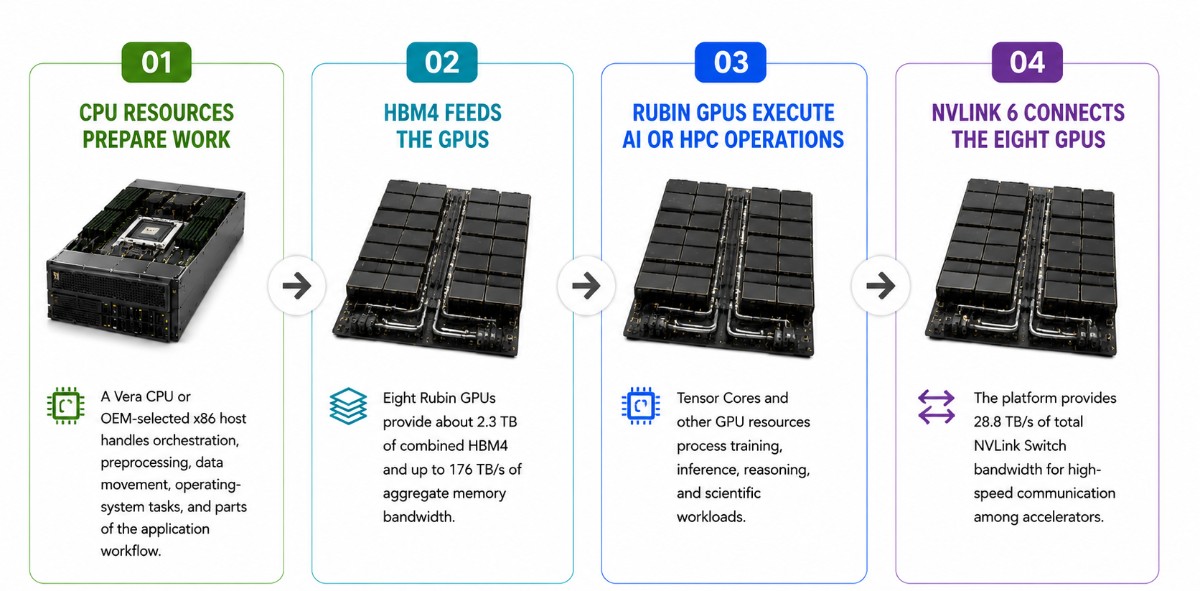
HGX Rubin NVL8 combines compute, memory, and high-speed GPU communication on an eight-GPU platform. Each Rubin GPU has its own HBM4 memory, while NVLink 6 and NVLink Switch technology allow the GPUs to exchange model data far faster than they could through a conventional host connection.
A simplified workload path looks like this:
- CPU resources prepare work. A Vera CPU or OEM-selected x86 host handles orchestration, preprocessing, data movement, operating-system tasks, and parts of the application workflow.
- HBM4 feeds the GPUs. Eight Rubin GPUs provide about 2.3 TB of combined HBM4 and up to 176 TB/s of aggregate memory bandwidth.
- Rubin GPUs execute AI or HPC operations. Tensor Cores and other GPU resources process training, inference, reasoning, and scientific workloads.
- NVLink 6 connects the eight GPUs. The platform provides 28.8 TB/s of total NVLink Switch bandwidth for high-speed communication among accelerators.
This balance matters because a powerful Rubin GPU architecture can still lose utilization when CPU processing, storage, or network throughput cannot keep pace.
What Hardware Is Inside HGX Rubin NVL8?
The HGX platform defines the accelerated-compute foundation. The final server configuration depends partly on which OEM implements it.
| Infrastructure layer | HGX Rubin NVL8 role | Typical technology |
| Accelerators | AI and HPC compute | 8 NVIDIA Rubin SXM GPUs |
| GPU memory | Weights, activations and working data | About 2.3 TB HBM4 total |
| Scale-up fabric | GPU-to-GPU communication | NVLink 6 + NVLink Switch |
| Host CPU | Orchestration and data processing | OEM x86 CPU |
| Alternative host | NVIDIA CPU architecture | Vera CPU in HGX Vera Rubin NVL8 |
| Scale-out network | Connects servers and clusters | NVIDIA networking / OEM fabric |
NVIDIA distinguishes the two CPU configurations. HGX Vera Rubin NVL8 combines eight Rubin GPUs with a single NVIDIA Vera CPU, while HGX Rubin NVL8 supports an x86 CPU platform whose CPU and system-memory specifications depend on the OEM implementation.
That difference makes CPU choice an important part of evaluating a Rubin 8-GPU system rather than a minor server specification.
What Are the HGX Rubin NVL8 Specs?
NVIDIA currently lists the following HGX Rubin NVL8 specifications. The company labels the Rubin figures as preliminary, “up to,” and subject to change, so production OEM systems should always be checked against their current validated documentation.
| Specification | NVIDIA HGX Rubin NVL8 | Why it matters |
| GPU count | 8 Rubin GPUs | Eight-GPU AI/HPC compute domain |
| GPU memory | 2.3 TB HBM4 | Holds large models and active data |
| GPU memory bandwidth | 176 TB/s aggregate | Feeds memory-intensive workloads |
| NVFP4 inference | Up to 400 PFLOPS* | Low-precision AI inference |
| NVFP4 training | Up to 280 PFLOPS | Rubin 4-bit AI training |
| FP8/FP6 training | Up to 140 PFLOPS | Lower-precision model training |
| NVLink | Sixth generation | High-speed GPU communication |
| NVLink Switch bandwidth | 28.8 TB/s | Supports tightly coupled 8-GPU workloads |
| Networking bandwidth | Up to 1.6 TB/s | Connects compute to scale-out infrastructure |
*NVIDIA identifies the NVFP4 inference figure as sparse performance. All Rubin values are preliminary and subject to change.
Each individual Rubin GPU carries 288 GB of HBM4 with up to 22 TB/s of memory bandwidth and 3.6 TB/s of NVLink bandwidth, which produces the platform-level totals when eight GPUs operate together.
Why Does NVLink 6 Matter in an 8-GPU System?
NVLink 6 matters because many advanced AI workloads cannot remain inside one GPU. Large models may distribute parameters, tensors, experts, activations, and intermediate results across several accelerators.
HGX Rubin NVL8 provides 28.8 TB/s of total NVLink Switch bandwidth, twice the 14.4 TB/s listed for HGX B200. Each Rubin GPU supports up to 3.6 TB/s of NVLink bandwidth.
Higher GPU-to-GPU bandwidth can help with:
- model and tensor parallelism;
- mixture-of-experts routing;
- distributed training synchronization;
- multi-GPU reasoning and inference.
NVLink remains a scale-up technology inside the accelerated-compute domain. It does not eliminate the need for Ethernet or InfiniBand when multiple servers or racks need to operate as a larger cluster.
What Is HGX Rubin NVL8 Used For?
NVIDIA positions HGX Rubin NVL8 for demanding AI, data analytics, scientific computing, and HPC workloads. Its combination of HBM4 capacity, memory bandwidth, and NVLink 6 particularly benefits workloads that move large amounts of data among GPUs.
AI Training and Post-Training
Eight Rubin GPUs can support dense and mixture-of-experts model development, fine-tuning, reinforcement learning, and other post-training workflows.
The high memory bandwidth is important because large training jobs repeatedly move weights, activations, gradients, and intermediate data between compute and HBM.
Inference and Reasoning
HGX Rubin NVL8 targets both high-throughput model serving and more demanding reasoning workloads. Agentic systems can call models repeatedly while retrieving information, running tools, and maintaining larger amounts of context.
That makes CPU processing, storage, and networking increasingly important alongside GPU inference.
Agentic AI and MoE Models
Mixture-of-experts models route tokens to selected experts rather than using every model component for each token. This design increases the importance of fast GPU communication when experts and model state span multiple accelerators.
Agentic workflows add another layer by repeatedly moving information between CPUs, GPUs, storage, networking, and external services.
HPC and Data Analytics
HGX Rubin NVL8 is not limited to generative AI. NVIDIA also positions the platform for scientific computing and HPC.
Organizations evaluating GPU deployment for HPC should consider FP64 requirements, application support, network topology, storage performance, and cluster scaling rather than choosing a platform on AI throughput alone.
HGX Rubin NVL8 vs HGX B200: What Changed?
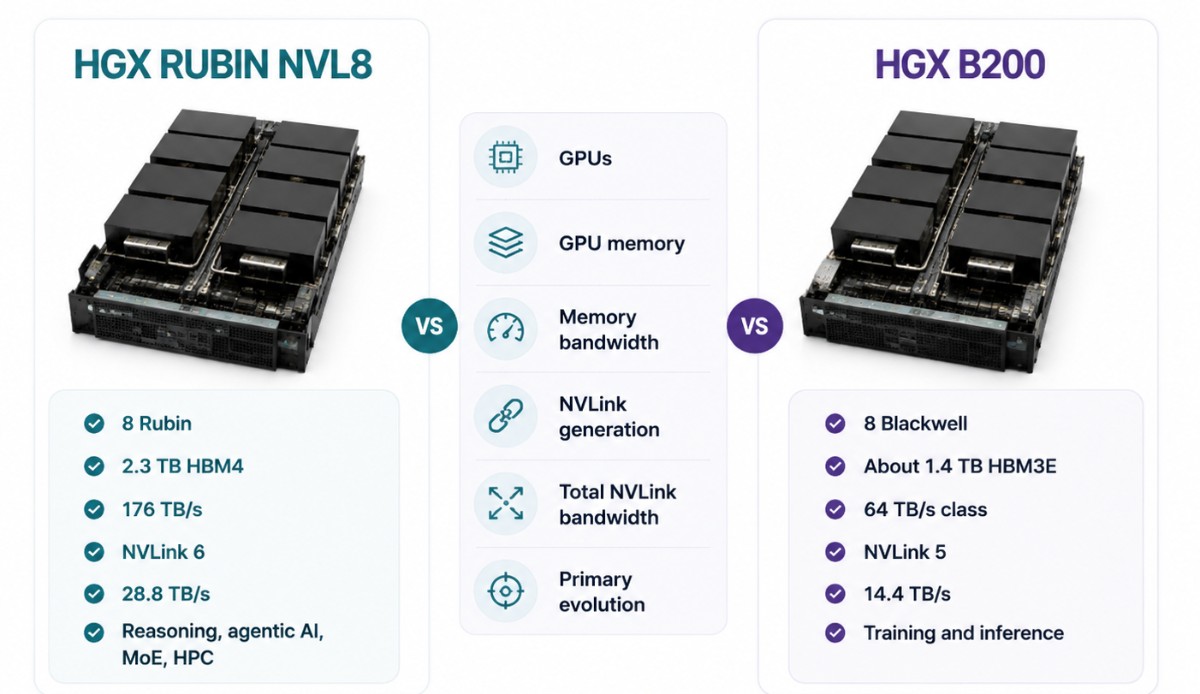
HGX Rubin NVL8 keeps the familiar eight-GPU server model but substantially changes memory and GPU communication.
| Area | HGX Rubin NVL8 | HGX B200 | Main change |
| GPUs | 8 Rubin | 8 Blackwell | New GPU generation |
| GPU memory | 2.3 TB HBM4 | About 1.4 TB HBM3E | More accelerator memory |
| Memory bandwidth | 176 TB/s | 64 TB/s class | Much higher data movement |
| NVLink generation | NVLink 6 | NVLink 5 | New scale-up fabric |
| Total NVLink bandwidth | 28.8 TB/s | 14.4 TB/s | 2× bandwidth |
| Primary evolution | Reasoning, agentic AI, MoE, HPC | Training and inference | Higher memory/communication focus |
NVIDIA says HGX Rubin NVL8 can deliver up to 10× the token-factory throughput of HGX B200 in a specified Kimi K2-Thinking inference scenario. NVIDIA also projects that certain DeepSeek-R1 pretraining workloads can reach equivalent training performance with four times fewer GPUs.
Those figures should not be interpreted as universal 10× or 4× performance gains. NVIDIA identifies them as projected, workload-specific results, and actual performance will depend on the model, precision, software, context length, batch size, networking, and system configuration.
Organizations whose current Blackwell infrastructure meets their utilization and performance requirements may have little reason to replace it solely because Rubin is newer.
HGX Rubin NVL8 vs Vera Rubin NVL72
The biggest difference is not simply eight GPUs versus 72 GPUs. The two products target different infrastructure scales.
| Area | HGX Rubin NVL8 | Vera Rubin NVL72 |
| Basic design | 8-GPU server platform | 72-GPU rack-scale system |
| GPUs | 8 Rubin | 72 Rubin |
| Host CPU | OEM x86; Vera variant available | 36 Vera CPUs |
| Scale-up scope | Within an 8-GPU server | Rack-wide 72-GPU NVLink domain |
| Best fit | Enterprise AI, HPC, flexible servers | Hyperscale AI factories, large training and reasoning |
| Deployment model | OEM server integration | Integrated rack architecture |
NVIDIA describes HGX Rubin NVL8 as an eight-GPU server board, while Vera Rubin NVL72 combines 72 Rubin GPUs, 36 Vera CPUs, NVLink 6, ConnectX-9, BlueField-4, and rack-scale infrastructure.
A company does not automatically need NVL72 to adopt Rubin. Organizations that want a smaller deployment unit can build around NVL8, while very large tightly coupled workloads may justify the NVL72 rack architecture.
HGX Rubin NVL8 vs DGX Rubin NVL8
HGX and DGX Rubin NVL8 use the same eight-GPU Rubin concept but solve different purchasing and integration problems.
HGX is the configurable platform layer that OEMs use when designing servers. DGX Rubin NVL8 is NVIDIA’s own integrated, liquid-cooled system with defined CPUs, networking, software, and management.
| Area | HGX Rubin NVL8 | DGX Rubin NVL8 |
| Product type | OEM platform/building block | Complete NVIDIA system |
| GPUs | 8 Rubin | 8 Rubin |
| CPU | OEM-selected x86 | 2 Intel Xeon 6776P |
| System memory | OEM-defined | Defined by DGX configuration |
| Networking | OEM-defined around platform requirements | 8 ConnectX-9 VPI + 2 BlueField-4 DPUs |
| Cooling | Depends on OEM implementation | Liquid-cooled |
| Software/integration | OEM/system-integrator dependent | NVIDIA DGX software and services |
| Best reason to choose | Configuration flexibility | Turnkey NVIDIA integration |
NVIDIA lists DGX Rubin NVL8 at roughly 24 kW system power with eight ConnectX-9 VPI network ports and two BlueField-4 DPUs. These specifications belong specifically to DGX and should not automatically be applied to every HGX Rubin NVL8 OEM server.
This distinction is similar to the broader DGX and HGX relationship: HGX gives server builders a common accelerated platform, while DGX packages NVIDIA’s platform into a complete system.
Where Does HGX Rubin NVL8 Fit in Enterprise AI Infrastructure?
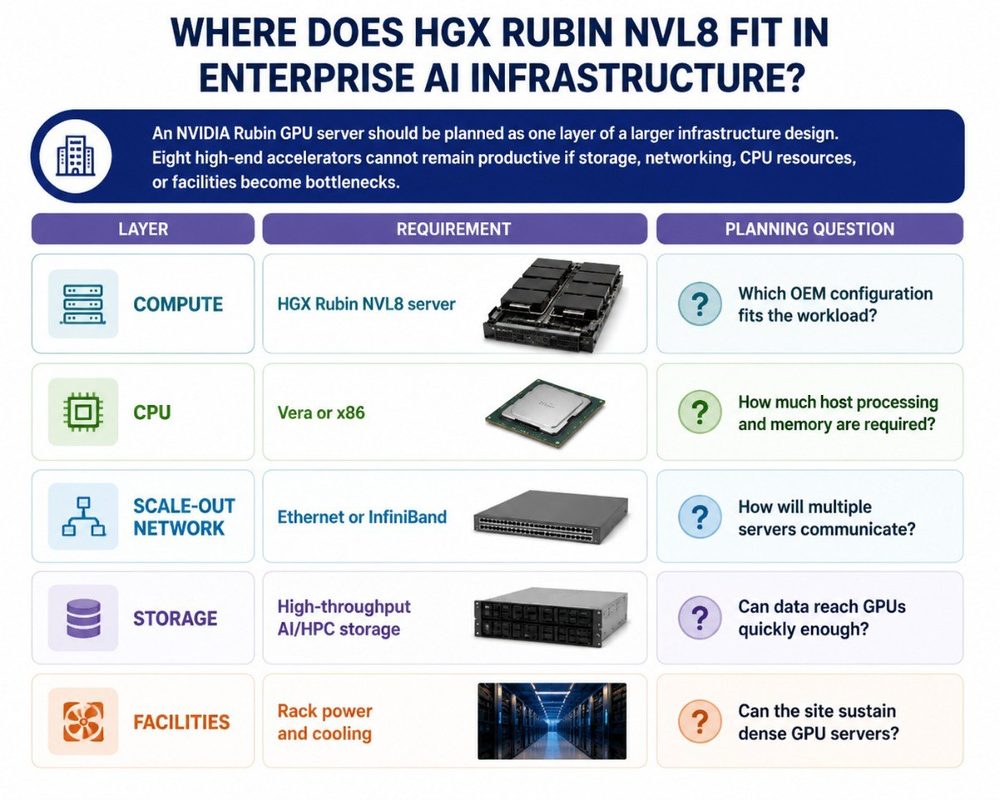
An NVIDIA Rubin GPU server should be planned as one layer of a larger infrastructure design. Eight high-end accelerators cannot remain productive if storage, networking, CPU resources, or facilities become bottlenecks.
A practical HGX Rubin NVL8 deployment requires attention to the following stack:
| Layer | Requirement | Planning question |
| Compute | HGX Rubin NVL8 server | Which OEM configuration fits the workload? |
| CPU | Vera or x86 | How much host processing and memory are required? |
| Scale-out network | Ethernet or InfiniBand | How will multiple servers communicate? |
| Storage | High-throughput AI/HPC storage | Can data reach GPUs quickly enough? |
| Facilities | Rack power and cooling | Can the site sustain dense GPU servers? |
Networking and SuperNICs
A single NVL8 system uses NVLink 6 internally, but a multi-node cluster also needs a scale-out fabric. NVIDIA positions its Rubin infrastructure with next-generation ConnectX networking and either Spectrum-X Ethernet or Quantum InfiniBand depending on deployment requirements.
High-speed AI fabrics need predictable latency, congestion control, and enough east-west bandwidth for distributed GPU jobs. Those requirements differ significantly from conventional enterprise networking, as outlined in common AI networking challenges.
Local NVMe and External Storage
Local NVMe can support caching, temporary datasets, application scratch space, and checkpoint staging, but the exact configuration depends on the OEM server.
At cluster scale, external storage must support training datasets, checkpoints, retrieval data, analytics, and inference context without starving expensive GPU resources.
Cooling and Rack Density
Rubin-class systems raise facility questions before installation. Cooling design, CDU capacity where applicable, rack power distribution, serviceability, and heat rejection must all match the selected OEM implementation.
Organizations replacing older air-cooled GPU servers should evaluate their data center cooling strategy before assuming an existing rack can support a Rubin deployment.
Cabling and Optics
Scale-out connectivity also brings optics and cable requirements. Port speed alone does not prove compatibility between a server NIC, transceiver, cable, and switch.
The chosen OEM and network vendor should validate the complete signal path, especially at 400G, 800G, or higher network speeds.
Practical HGX Rubin NVL8 Enterprise Configuration
Example configuration only:
An enterprise training and inference cluster could deploy several OEM HGX Rubin NVL8 servers, each with eight Rubin GPUs and appropriate host CPUs. High-speed ConnectX-class interfaces could connect the servers through a low-latency Ethernet or InfiniBand fabric.
Parallel or AI-optimized storage would supply datasets and checkpoints, while local NVMe could provide fast staging and scratch capacity. Rack power, redundant networking, optics, cabling, and liquid-cooling infrastructure would be sized around the selected server implementation.
This architecture is not mandatory. A single NVL8 server may be enough for some enterprise environments, while organizations running frontier-scale models may need NVL72 or much larger clustered infrastructure.
What Should Be Bought With HGX Rubin NVL8?
HGX Rubin NVL8 generally belongs inside a validated OEM server rather than being treated as eight independent GPUs.
A complete configuration may require:
- a validated HGX Rubin NVL8 server and host CPU;
- system memory plus local NVMe storage;
- compatible SuperNICs, switches, optics, and cabling;
- external AI/HPC storage and appropriate rack infrastructure;
- power distribution and cooling sized for the selected server.
Compatibility should come from current NVIDIA and OEM documentation. Similar connectors, PCIe generations, physical sizes, or bandwidth ratings do not establish that two products are validated together.
For organizations whose current workloads fit earlier hardware, an existing 8-GPU H100 server can remain a practical option when budget and infrastructure requirements matter more than adopting the newest architecture.
Who Is HGX Rubin NVL8 For?
HGX Rubin NVL8 is a strong fit when an organization needs substantial GPU compute but prefers an eight-GPU server architecture over a complete NVL72 rack.
Likely users include:
- enterprises building private AI infrastructure;
- model developers running training, inference, or post-training;
- universities and research centers combining AI and HPC;
- service providers building modular GPU clusters;
- HPC organizations with GPU-accelerated scientific workloads.
The platform is especially useful when CPU choice, local storage, networking, rack design, or OEM preference makes server-level flexibility valuable.
Who Might Not Need HGX Rubin NVL8 Yet?
Rubin should not become the automatic choice simply because it is newer.
A different platform may make more sense for organizations with:
- small inference workloads that fit one or a few GPUs;
- existing H100, B200, or B300 systems with sufficient capacity;
- facilities that cannot support the required rack power or cooling;
- budgets that favor mature current-generation infrastructure;
- applications that do not benefit from Rubin’s memory or NVLink improvements.
For some deployments, a mature H100 SXM GPU environment can offer a better cost and operational fit than redesigning infrastructure around Rubin.
How Can Catalyst Support an HGX Rubin NVL8 Deployment?
Catalyst Data Solutions Inc works across OEM, channel, and distribution ecosystems to help organizations source AI, HPC, and data center infrastructure. An HGX Rubin NVL8 project can involve the server itself plus CPUs, system memory, storage, NICs, switches, optics, cabling, rack power, and cooling.
The right architecture depends on workload, software requirements, deployment scale, existing infrastructure, budget, availability, and delivery schedule. Catalyst can compare Rubin configurations with current NVIDIA and OEM alternatives without assuming the newest or largest platform is automatically the best fit.
Buyers can request a configuration quote or review the broader GPU hardware catalog. A useful request should include workload, server quantity, GPU count, CPU preference, networking, storage, power, cooling, support, and delivery requirements.
FAQs
How many GPUs are in HGX Rubin NVL8?
HGX Rubin NVL8 contains eight NVIDIA Rubin GPUs. NVIDIA connects the GPUs through sixth-generation NVLink to create a tightly coupled eight-GPU compute platform.
What does NVL8 mean?
NVL8 refers to an eight-GPU NVLink configuration. In HGX Rubin NVL8, eight Rubin GPUs communicate through NVIDIA’s sixth-generation NVLink and NVLink Switch architecture.
What workloads is Rubin NVL8 designed for?
Rubin NVL8 targets training, inference, post-training, reasoning, agentic AI, data analytics, scientific computing, and HPC. Its HBM4 and NVLink 6 architecture particularly benefits memory-intensive and multi-GPU workloads.
Is HGX Rubin NVL8 for AI or HPC?
It supports both AI and HPC. NVIDIA specifically positions HGX Rubin NVL8 for AI training and inference as well as scientific and high-performance computing workloads.
What is the difference between HGX Rubin NVL8 and NVL72?
HGX Rubin NVL8 is an eight-GPU server platform, while Vera Rubin NVL72 is a 72-GPU rack-scale architecture. NVL8 offers more OEM and server-level flexibility; NVL72 targets much larger tightly coupled AI deployments.
What is the difference between HGX and DGX Rubin NVL8?
HGX Rubin NVL8 is a platform that OEMs use to build servers, while DGX Rubin NVL8 is NVIDIA’s integrated system. DGX defines components such as CPUs, ConnectX-9 networking, BlueField-4 DPUs, cooling, software, and system management.
Research and Fact-Check Record
Research date: August 14, 2026
Primary specification source:
Research key point 1:
NVIDIA specifies HGX Rubin NVL8 with 8 Rubin GPUs, 2.3 TB HBM4, 176 TB/s aggregate memory bandwidth, up to 400 PFLOPS NVFP4 inference, NVLink 6, and 28.8 TB/s NVLink Switch bandwidth. These figures are preliminary and subject to change.
Research key point 2:
NVIDIA offers HGX Vera Rubin NVL8 with one Vera CPU and HGX Rubin NVL8 with an OEM-defined x86 CPU platform. CPU and system-memory details for x86 systems depend on the OEM configuration.