
For years, AI infrastructure discussions centered on GPUs. That made sense when most systems sent prompts to a model, generated an answer, and repeated the process. Agentic AI changes that pattern because an AI agent may retrieve data, call tools, execute code, interact with APIs, evaluate results, and repeat those steps before finishing a task.
That shift gives the data center CPU a larger role. The NVIDIA Vera CPU targets this CPU-intensive part of modern AI, while NVIDIA Rubin GPUs handle highly accelerated model computation. NVIDIA designed Vera around high single-thread performance, memory bandwidth, data movement, and CPU-GPU communication rather than treating the CPU as a simple host for accelerators.
The result reflects a broader change in AI infrastructure: the CPU, GPU, memory, networking, storage, and cooling system increasingly need to operate as one coordinated platform. Catalyst’s Rubin architecture overview provides the accelerator side of that system.
What Is the NVIDIA Vera CPU?
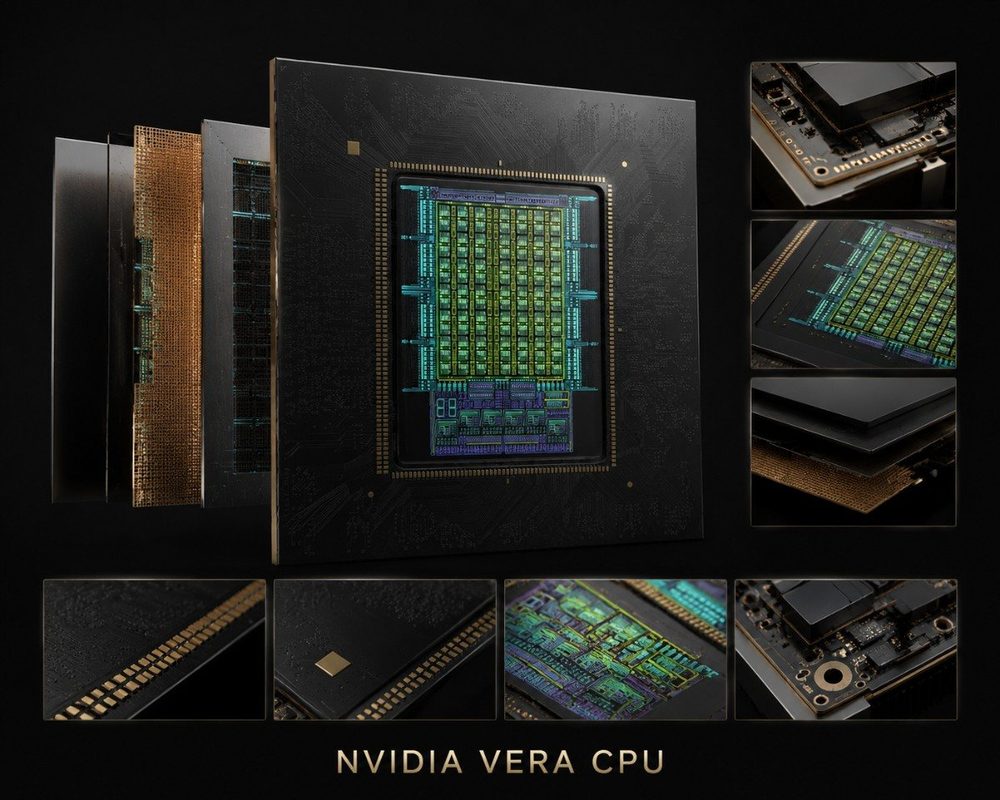
NVIDIA Vera is a data center CPU designed for agentic AI, reinforcement learning, data processing, analytics, and other workloads that place substantial work outside the GPU. NVIDIA supports Vera both as a host CPU for accelerated systems and as a standalone processor for CPU-heavy AI factory workloads.
The Vera CPU architecture uses 88 NVIDIA-designed Olympus cores. NVIDIA Spatial Multithreading allows two hardware threads per core, giving one Vera CPU 176 threads. NVIDIA identifies full Arm compatibility, with its Rubin platform announcement specifying Armv9.2 compatibility.
Vera pairs those cores with high-bandwidth LPDDR5X memory and NVIDIA’s Scalable Coherency Fabric, or SCF. The architecture targets fast execution while keeping cores supplied with data, which matters for retrieval, orchestration, analytics, code execution, and other irregular workloads common in AI-agent pipelines.
NVIDIA Vera CPU Specifications
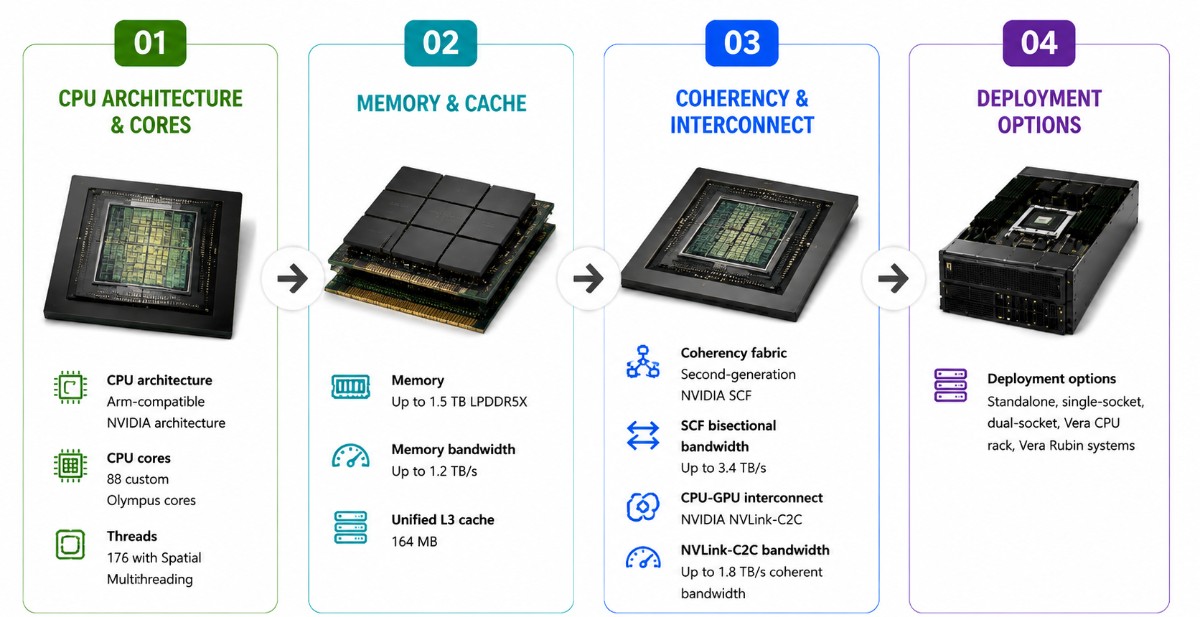
| Specification | NVIDIA Vera CPU |
| CPU architecture | Arm-compatible NVIDIA architecture |
| CPU cores | 88 custom Olympus cores |
| Threads | 176 with Spatial Multithreading |
| Memory | Up to 1.5 TB LPDDR5X |
| Memory bandwidth | Up to 1.2 TB/s |
| Coherency fabric | Second-generation NVIDIA SCF |
| SCF bisectional bandwidth | Up to 3.4 TB/s |
| Unified L3 cache | 164 MB |
| CPU-GPU interconnect | NVIDIA NVLink-C2C |
| NVLink-C2C bandwidth | Up to 1.8 TB/s coherent bandwidth |
| Deployment options | Standalone, single-socket, dual-socket, Vera CPU rack, Vera Rubin systems |
NVIDIA lists these figures as platform capabilities; configuration and final system specifications can vary by OEM implementation.
Vera also sits directly inside the Vera Rubin rack architecture, where the processor works alongside Rubin GPUs, NVLink 6, ConnectX-9, BlueField-4, and scale-out networking.
Why Agentic AI Needs More CPU Compute
A conventional chatbot workload can look relatively simple from an infrastructure perspective: accept an input, prepare it for a model, execute GPU inference, and return generated tokens. Real production systems involve more components, but GPU inference often dominates the visible compute discussion.
An agent can create a much longer execution loop. It may reason about a task, query a database, retrieve documents, invoke an API, execute Python, inspect the result, update its state, and then return to the model for another inference step. NVIDIA specifically identifies code execution, tool use, sandboxing, analytics, data pipelines, and orchestration as Vera target workloads.
Those operations do not all map efficiently to GPU tensor processing. Branch-heavy application logic, interpreters, compilers, database operations, operating-system services, security checks, and API handling remain CPU-oriented tasks.
A production agent may also create several of these tasks at once. One request can generate multiple tool calls or execution environments, while an enterprise deployment may serve thousands of agents concurrently. That creates demand for both strong per-thread execution and substantial aggregate CPU throughput.
Typical CPU-side work can include:
- Running Python, compilers, runtimes, and application logic.
- Handling retrieval, ETL, database queries, and data preparation.
- Operating isolated sandboxes for agent-generated code.
- Coordinating tool calls, APIs, evaluations, and concurrent agents.
- Moving data between storage, networking, memory, and accelerators.
This is why a CPU for AI agents increasingly matters to overall application performance. The GPU can process the model quickly, but the system still loses time whenever the next inference request waits for CPU-side work to finish.
For organizations moving from earlier GPU generations toward modern systems, Catalyst’s GPU deployment guidance helps show why accelerator selection represents only one part of a production AI environment.
How Agentic AI Is Changing the Role of the Data Center CPU
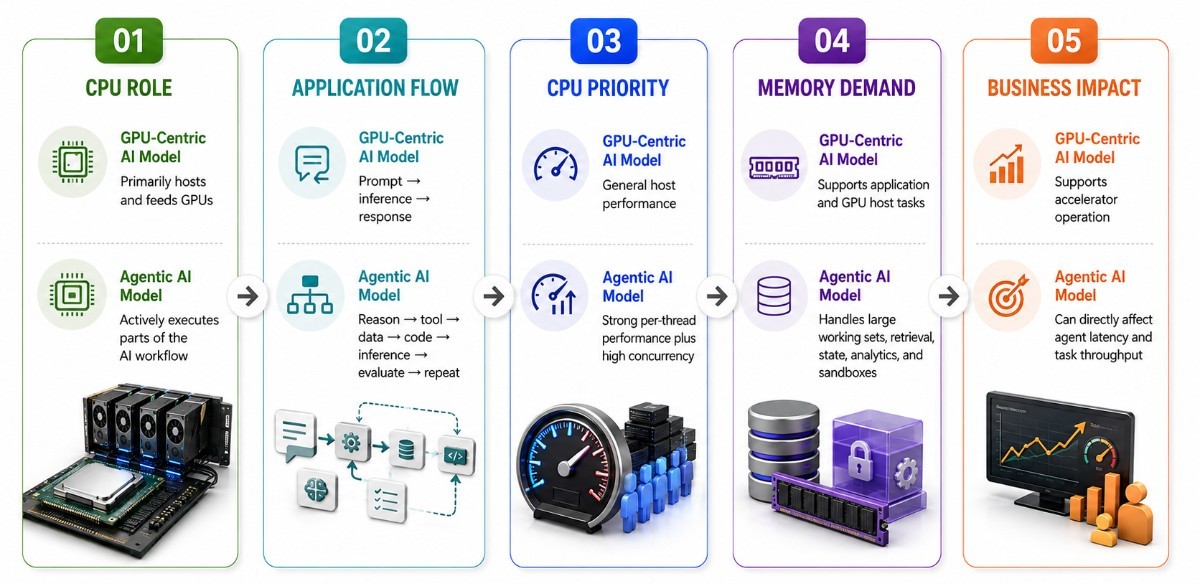
The simplest way to understand the change is to compare two infrastructure models.
| Area | GPU-Centric AI Model | Agentic AI Model |
| CPU role | Primarily hosts and feeds GPUs | Actively executes parts of the AI workflow |
| Application flow | Prompt → inference → response | Reason → tool → data → code → inference → evaluate → repeat |
| CPU priority | General host performance | Strong per-thread performance plus high concurrency |
| Memory demand | Supports application and GPU host tasks | Handles large working sets, retrieval, state, analytics, and sandboxes |
| Business impact | Supports accelerator operation | Can directly affect agent latency and task throughput |
This comparison does not mean earlier AI systems ignored CPUs. Instead, agentic AI increases the amount and diversity of CPU work inside each user task.
The data center CPU for AI becomes an active execution engine. It manages agent runtimes, application services, retrieval systems, security boundaries, schedulers, tools, and the logic that decides what the system should do next.
Concurrency makes this more difficult. An AI factory may run many agents and sandboxes while also supporting data pipelines and accelerator services. Vera’s 88 Olympus cores and 176 hardware threads target that mix of latency-sensitive work and high parallelism.
The CPU also affects GPU utilization. If preprocessing, retrieval, code execution, or orchestration cannot finish quickly enough, expensive accelerators can wait for the next piece of work. NVIDIA therefore positions Vera as a processor that helps keep GPUs supplied while executing ETL, KV-cache management, and orchestration.
That broader role also changes server design. Buyers evaluating an HGX or DGX platform increasingly need to ask not only how many GPUs a server contains, but whether its CPU, memory, networking, storage, and cooling can sustain the intended workflow.
Why NVIDIA Designed Vera Differently
Vera’s architecture makes more sense when viewed through agent behavior rather than a traditional CPU specification checklist.
Olympus Cores Prioritize Execution Speed
NVIDIA designed the Olympus core for high instructions-per-cycle performance and strong single-thread execution. Agent workloads often include branch-heavy Python, compilation, runtime engines, analytics, and control logic where one slow software stage can delay the next model call.
Spatial Multithreading gives Olympus two execution contexts while partitioning resources to reduce interference. NVIDIA’s goal is to combine strong per-thread performance with predictable throughput when many CPU tasks run at once.
LPDDR5X Targets Memory Bandwidth and Efficiency
Vera provides up to 1.2 TB/s of LPDDR5X memory bandwidth and up to 1.5 TB of memory. NVIDIA says this design provides twice the bandwidth while using half the memory power of traditional CPU memory in its comparison.
That bandwidth matters because agents repeatedly move through state, databases, retrieval results, analytics, runtime data, and other working sets. Fast cores cannot deliver their potential if they regularly wait for memory.
SCF Keeps Data Moving Across the Processor
Second-generation NVIDIA SCF links the cores, cache, memory controllers, I/O, and NVLink-C2C interfaces. It provides up to 3.4 TB/s of bisectional bandwidth, while Vera’s monolithic compute die avoids additional cross-chiplet data hops inside the CPU.
NVLink-C2C Connects CPU and Accelerated Compute
NVLink-C2C provides up to 1.8 TB/s of coherent bandwidth between Vera and NVIDIA GPUs. This gives CPU and GPU resources a faster path for data movement than treating them as loosely connected processors.
Together, these features show why comparing NVIDIA Vera vs traditional CPU designs only through core count misses the larger architecture.
NVIDIA Vera vs x86 CPU: What Actually Changes?
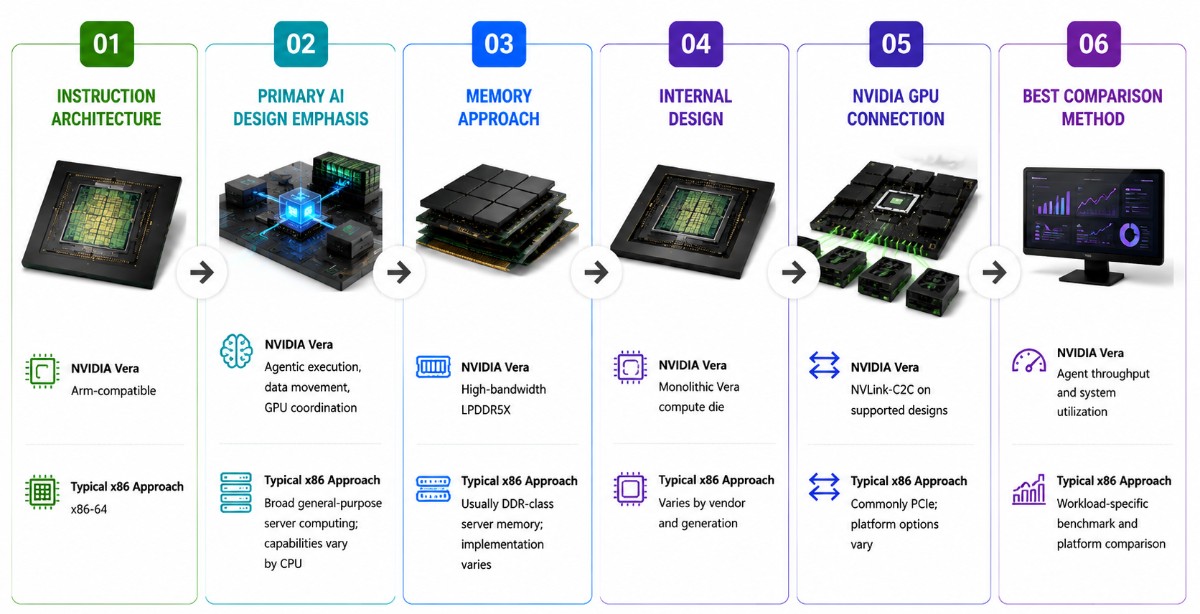
Vera does not make every x86 server obsolete. AMD EPYC and Intel Xeon platforms support broad software ecosystems and many established enterprise, cloud, and HPC deployments. The useful comparison concerns design priorities rather than declaring one architecture universally superior.
| Design Area | NVIDIA Vera | Typical x86 Approach |
| Instruction architecture | Arm-compatible | x86-64 |
| Primary AI design emphasis | Agentic execution, data movement, GPU coordination | Broad general-purpose server computing; capabilities vary by CPU |
| Memory approach | High-bandwidth LPDDR5X | Usually DDR-class server memory; implementation varies |
| Internal design | Monolithic Vera compute die | Varies by vendor and generation |
| NVIDIA GPU connection | NVLink-C2C on supported designs | Commonly PCIe; platform options vary |
| Best comparison method | Agent throughput and system utilization | Workload-specific benchmark and platform comparison |
NVIDIA reports up to 1.8x faster performance on selected agentic workloads versus a latest-generation x86 CPU baseline. Buyers should treat that figure as a vendor benchmark, not a universal result across every application, compiler, database, operating system, or CPU configuration.
A meaningful NVIDIA Vera CPU performance evaluation should therefore test the real workflow: code execution, tool latency, retrieval, analytics, sandbox density, GPU utilization, power use, and completed agent tasks per unit of infrastructure.
Vera and Rubin: How CPU and GPU Work Together
Vera and Rubin address different parts of the same AI pipeline.
The Vera CPU handles orchestration, data processing, runtime logic, tool execution, agent sandboxes, retrieval, and other CPU-heavy tasks. The Rubin GPU provides the accelerated computation used for model training, inference, and other highly parallel AI operations.
That division becomes concrete in Vera Rubin NVL72. A full NVL72 rack combines 36 Vera CPUs and 72 Rubin GPUs with NVLink 6, ConnectX-9 SuperNICs, BlueField-4 DPUs, and either Spectrum-X Ethernet or Quantum-X800 InfiniBand for scale-out connectivity.
The CPU and GPU therefore should not compete for the same job. Each part of the architecture handles work that fits its strengths.
| Component | Primary Role in an Agentic AI System |
| Vera CPU | Orchestration, tools, retrieval, code, data pipelines, system logic |
| Rubin GPU | AI training and accelerated model inference |
| NVLink-C2C | Coherent CPU-GPU data movement |
| NVLink 6 | High-bandwidth GPU scale-up communication |
| ConnectX-9 / BlueField-4 | Network connectivity and infrastructure offload |
This CPU-GPU co-design also appears in HGX Rubin NVL8. NVIDIA states that HGX Rubin NVL8 can use Vera or x86 CPU baseboards, which gives buyers a meaningful architecture choice based on workloads and software requirements.
What Infrastructure Should Be Planned Around NVIDIA Vera?
Buying the processor alone does not create an agentic AI platform. Buyers need to determine where Vera will run, whether GPUs accompany it, how data reaches the system, and what networking, storage, power, and cooling architecture can support sustained operation.
Server Platform
NVIDIA supports Vera in standalone single- and dual-socket configurations, dense Vera CPU racks, Vera Rubin NVL72, and HGX Rubin NVL8. Dell, HPE, Lenovo, Supermicro, and other system manufacturers have announced Vera-based infrastructure.
Dell’s PowerEdge R9822 uses an air-cooled 3U design, while the M9822 uses direct liquid cooling for denser Vera CPU deployments. HPE’s ProLiant Compute DL394 Gen12 is another Vera-based 2U platform aimed at agentic AI and data processing.
Complete Vera Deployment Stack
| Layer | Possible Hardware | Deployment Question |
| CPU | NVIDIA Vera | How much orchestration, sandbox, retrieval, and data-processing capacity is required? |
| GPU | Rubin or supported accelerator | Does the workload require accelerated inference, training, or HPC? |
| Server | Dell, HPE, Supermicro, NVIDIA MGX-based systems | Which form factor and cooling model fits the facility? |
| Network | ConnectX-9 plus Spectrum-X/Spectrum-6 or Quantum-X800 where applicable | What scale-out bandwidth and congestion behavior does the cluster require? |
| Storage | High-throughput AI storage or STX-based architecture | Can storage supply datasets, retrieval data, checkpoints, and context quickly enough? |
| Cooling/Power | Depends on server and rack architecture | Can the facility sustain continuous high-density compute? |
Networking deserves particular attention because agentic systems constantly move data between compute, storage, services, and other nodes. Catalyst’s discussion of AI networking challenges covers the fabric considerations that sit beyond the CPU itself.
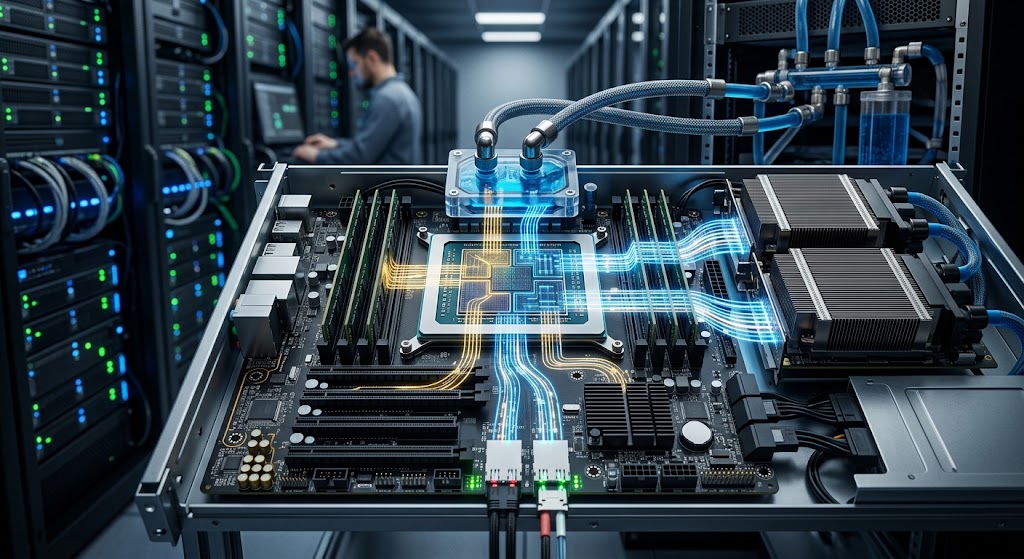
Cooling also depends on the configuration rather than the Vera chip name alone. Standalone systems can use different thermal designs, while dense rack-scale Vera Rubin infrastructure increasingly relies on direct liquid cooling. Facility planning therefore needs to consider CDUs, manifolds, heat rejection, power distribution, and rack density.
Those requirements are covered more broadly in Catalyst’s AI cooling strategies.
Why CPU Performance Now Affects AI Factory Economics
GPU utilization remains important because accelerators represent a large portion of an AI system’s cost and power budget. However, maximizing theoretical GPU performance does not help if retrieval, code execution, orchestration, or data processing regularly makes the accelerator wait.
A faster GPU provides limited value if the CPU cannot keep the agent workflow moving.
CPU performance can affect the time required for each agent step. Faster tool execution can shorten the interval before another model call, while greater CPU concurrency can allow more agents to remain active at once.
NVIDIA reports that Vera reaches up to 1.8x the performance of its x86 comparison system on selected agentic workloads. The company also ties Vera’s LPDDR5X architecture to higher bandwidth and lower memory power. These remain NVIDIA measurements and should be validated against the buyer’s actual applications.
At larger scale, the economic questions become:
- How many agent tasks finish per second?
- How often do GPUs wait for CPU-side work?
- How many concurrent sandboxes can the platform sustain?
- What power does the complete rack consume for each completed task?
- What infrastructure produces the required service-level latency?
NVIDIA’s dense Vera CPU rack illustrates this change in thinking. The company says the MGX-based design can integrate up to 256 Vera CPUs and support more than 22,500 concurrent environments, turning CPU capacity into a dedicated AI-factory resource rather than merely a host attached to GPUs.
What Vera Signals About the Future of Data Center CPUs
Vera suggests that the future AI data center CPU may become more workload-specific. Instead of optimizing the processor separately and then attaching accelerators, system designers increasingly co-design compute, memory, interconnects, networking, storage, and software around the behavior of AI applications.
The growing importance of Arm is another part of that change. Vera uses NVIDIA’s own Arm-compatible Olympus cores rather than an x86 architecture, while NVIDIA combines those cores with its coherency fabric, memory subsystem, and NVLink technology.
Heterogeneous computing should also make individual chip benchmarks less useful on their own. A processor may appear fast in isolation but still perform poorly inside an AI workflow if memory, networking, storage, or accelerator communication creates bottlenecks.
Future infrastructure comparisons will therefore increasingly ask how many useful AI tasks a complete system can finish within a particular power, latency, rack-space, and cost envelope.
Vera also does not eliminate traditional data center CPUs. HGX Rubin NVL8 can pair Rubin GPUs with Vera or x86 CPUs, showing that NVIDIA itself expects multiple CPU architectures to remain relevant.
The correct choice will depend on workload behavior, software compatibility, existing infrastructure, power and cooling constraints, budget, and deployment schedule.
Who Is NVIDIA Vera CPU For?
Vera fits organizations where CPU-side AI activity has become a measurable part of system performance.
Likely early use cases include hyperscale AI factories, neocloud platforms, reinforcement-learning infrastructure, large agent platforms, research environments, HPC systems, data-intensive AI services, and enterprises operating many concurrent AI agents. NVIDIA has announced planned adoption or evaluation across AI labs, cloud providers, financial infrastructure, and major OEM platforms.
Organizations should evaluate Vera particularly when tool execution, sandbox density, retrieval, analytics, or orchestration creates a CPU bottleneck.
Who Might Not Need NVIDIA Vera?
Not every enterprise needs a new CPU architecture solely because it uses AI.
An organization running modest inference workloads on existing GPU servers may receive greater value by improving accelerators, memory, storage, or networking first. Existing x86 infrastructure may also remain preferable when software certification, licensing, operational standards, or application dependencies outweigh Vera’s architectural advantages.
A smaller deployment might instead use an appropriately sized GPU server configuration and upgrade CPU infrastructure only after measurements show that CPU execution limits application throughput.
The right answer should come from workload profiling rather than product generation alone.
Conclusion
Agentic AI is not reducing the importance of CPUs. It is changing what data center CPUs are expected to do.
As AI systems move from generating responses to retrieving information, executing tools, running code, processing data, and coordinating multiple agents, the CPU becomes an active part of the AI compute pipeline. Vera reflects that change through Olympus cores, high-bandwidth LPDDR5X memory, SCF, and NVLink-C2C.
Its importance also extends beyond one processor. Vera demonstrates a broader move toward tightly coordinated CPU, GPU, memory, networking, storage, power, and cooling architectures where overall system throughput matters more than any individual component benchmark.
How Can Catalyst Support an NVIDIA Vera CPU Deployment?

Catalyst Data Solutions Inc works across OEM, channel, and distribution ecosystems to help organizations source AI, HPC, and data center infrastructure. A Vera deployment may involve much more than the processor: compatible servers, accelerators, networking, storage, optics, cabling, rack infrastructure, power, and cooling all need to fit the workload.
Vera hardware is moving from production into partner systems during 2026, so orderability, configurations, and lead times can differ by OEM and region. Catalyst can help buyers compare NVIDIA, Dell, HPE, Supermicro, and alternative architectures based on workload, software, facility constraints, budget, and deployment schedule.
Buyers can request current availability or connect with Catalyst Data Solution Inc to request a configuration quote for a complete AI infrastructure bundle. A useful request should include the intended agent workload, CPU quantity, GPU requirements, server preference, storage, networking, power, cooling, rack density, support requirements, and target delivery date.
Frequently Asked Questions
Is NVIDIA Vera replacing the Grace CPU?
Vera is the successor to Grace in NVIDIA’s data center CPU roadmap, but that does not mean existing Grace systems suddenly become obsolete. Organizations should compare workload requirements, software support, deployment timing, and the surrounding GPU architecture before migrating.
When will NVIDIA Vera-powered systems become available?
NVIDIA says Vera is in full production and partner systems will begin becoming available during fall 2026. Availability varies by manufacturer: Dell lists global PowerEdge R9822 and M9822 availability for September 2026, while HPE lists the DL394 Gen12 for fall 2026.
Can NVIDIA Vera be used without a Rubin GPU?
Yes. NVIDIA supports Vera as a standalone CPU platform in addition to its role in accelerated systems. Single-socket, dual-socket, and dense Vera CPU rack configurations allow deployments that do not require Rubin GPUs.
Does NVIDIA Vera support traditional enterprise workloads?
Yes, although its strongest differentiation centers on AI-oriented workloads. NVIDIA states that standalone Vera platforms also support enterprise, hyperscale cloud, analytics, data processing, and HPC workloads. Application certification should still be checked before deployment.
Is NVIDIA Vera compatible with existing Arm software?
Vera provides full Arm compatibility, with NVIDIA specifying Armv9.2 compatibility for the processor. Software portability should generally benefit from the Arm ecosystem, but buyers should verify operating-system, application, driver, virtualization, and vendor-support requirements for each production workload.
Does NVIDIA Vera require CUDA?
Not for CPU-only workloads. CUDA applies to NVIDIA GPU-accelerated computing, while Vera can operate as a standalone CPU for workloads such as analytics, orchestration, agent execution, and data processing. CUDA becomes relevant when an application uses NVIDIA GPUs for accelerated compute.
Can Vera run large language models directly on the CPU?
CPU-based model execution is technically possible with compatible software, but NVIDIA positions Vera primarily around CPU-side AI workloads and accelerated-system hosting. For large-scale model training and high-throughput inference, Rubin and other GPUs provide the dedicated accelerated compute while Vera handles surrounding agent and data operations.
Will agentic AI increase CPU spending in data centers?
It can shift more infrastructure budget toward CPU capacity when code execution, tools, retrieval, sandboxing, analytics, and orchestration become significant bottlenecks. The actual spending mix will depend on workload design, GPU utilization, concurrency, power limits, existing infrastructure, and the economics of each deployment.
Research Record
Research Date: August 18, 2026
Official Datasheet/Architecture Document:
Research Key Point 1:NVIDIA lists Vera with 88 Olympus cores, 176 threads, up to 1.5 TB LPDDR5X memory, up to 1.2 TB/s memory bandwidth, 3.4 TB/s SCF bisectional bandwidth, and up to 1.8 TB/s NVLink-C2C CPU-GPU bandwidth.
Research Key Point 2:NVIDIA states Vera is in full production, while broader system availability begins through OEM and cloud partners in fall 2026; specific dates vary by manufacturer.
Research Key Point 3: Vera is not limited to Vera Rubin NVL72. NVIDIA supports standalone Vera platforms and Vera-based accelerated systems, while Dell, HPE, Supermicro, and other manufacturers are developing or releasing multiple implementations.