
Enterprise network teams face a hard mix of rising hardware costs, long lead times, upgrade pressure, and tight refresh budgets. For many buyers, the question is not only “What replaces this router?” It is also “Can we keep a proven platform running without adding risk?”
This Cisco ASR1001-X Review explains where the ASR1001-X still fits, when refurbished makes sense, and when a newer routing platform may be the better move. The article follows the uploaded brief for Topic 7.
What Is the Cisco ASR1001-X Used For?
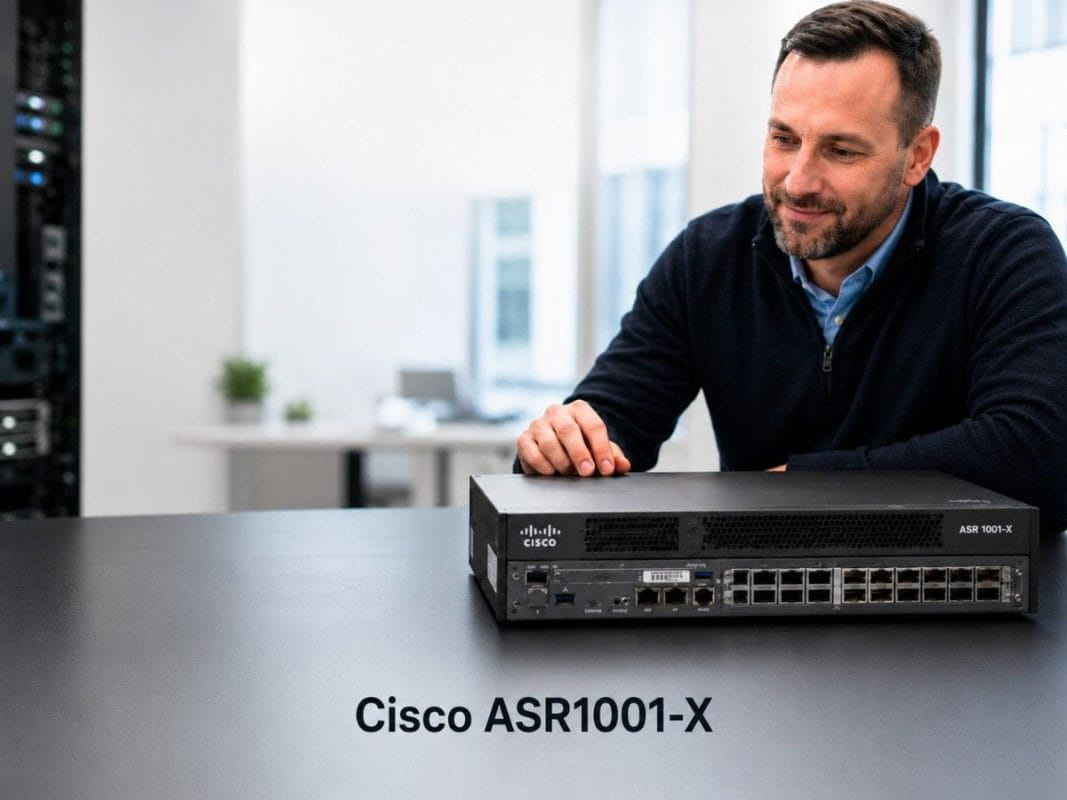
The Cisco ASR1001-X is an enterprise and service provider edge router in the Cisco ASR 1000 Series. Cisco describes the ASR 1000 Series as aggregation services routers built for WAN aggregation, edge routing, security services, traffic management, and service delivery. Cisco’s hardware guide states that the ASR1001-X offers a compact form factor and up to 20 Gbps forwarding throughput with licensing.
In practical terms, buyers use the ASR1001-X for:
- WAN edge routing
- Internet edge connectivity
- Branch-to-core aggregation
- MPLS or private WAN connectivity
- VPN and encrypted transport
- Legacy network support
- Replacement of failed installed units
- Cost-controlled refresh projects
For many organizations, the ASR1001-X remains useful because it already fits their architecture, rack layout, routing design, and operational process.
| Buyer Question | Practical Answer |
| Is ASR1001-X still useful? | Yes, mainly for existing WAN edge, aggregation, and replacement needs. |
| Is it the newest option? | No. Cisco announced end-of-sale for ASR1001-X hardware in 2022. |
| Why still buy it? | To maintain installed environments, reduce cost, and avoid urgent redesign. |
| Should every buyer choose refurbished? | No. It depends on support, lifecycle, software, risk, and growth plans. |
For teams also reviewing campus core design, the ASR1001-X often connects upstream or downstream from platforms covered in a campus core review, especially when routing and switching refreshes happen together.
Why Do Enterprises Still Review the Cisco ASR1001-X?
Many companies do not replace routing platforms just because a newer model exists. They replace them when capacity, support, risk, or architecture requires it.
The ASR1001-X still appears in procurement requests because buyers often need:
- Like-for-like replacement
- Spare inventory
- WAN edge continuity
- Shorter sourcing timelines
- Lower cost than a full redesign
- Compatibility with an existing Cisco environment
- Support for current operational skills
This is why the ASR1001-X has strong secondary-market demand. It solves a real problem for teams that need stable routing capacity without rebuilding the whole WAN.
The same cost logic often appears in broader infrastructure planning. Many buyers compare router replacement against network cost reduction goals before they approve a full refresh.
WAN Edge and Aggregation Use Cases for ASR1001-X
WAN Edge
At the WAN edge, the ASR1001-X can sit between the enterprise LAN and service provider circuits. It can handle routing, segmentation, policy, VPN, and traffic control depending on the installed software and licensing.
Common WAN edge use cases include:
- MPLS edge
- Internet handoff
- Site-to-site VPN
- WAN backup routing
- Cloud access path control
- Branch-to-data-center connectivity
The router works best where the environment already uses Cisco routing standards and the team wants to maintain a familiar platform.
Aggregation
In aggregation roles, the ASR1001-X can collect traffic from branch routers, WAN links, or network zones before passing that traffic toward the core.
This matters for enterprises that still run mixed WAN environments. Some sites may use MPLS, some may use broadband, and some may use private circuits. The ASR1001-X can help centralize routing at the edge of that design.
For buyers planning both routing and switching, ASR1001-X discussions often overlap with access network planning because WAN performance depends on clean handoff between routing, core switching, access switching, uplinks, and optics.
Cisco ASR1001-X Review: Key Buying Factors
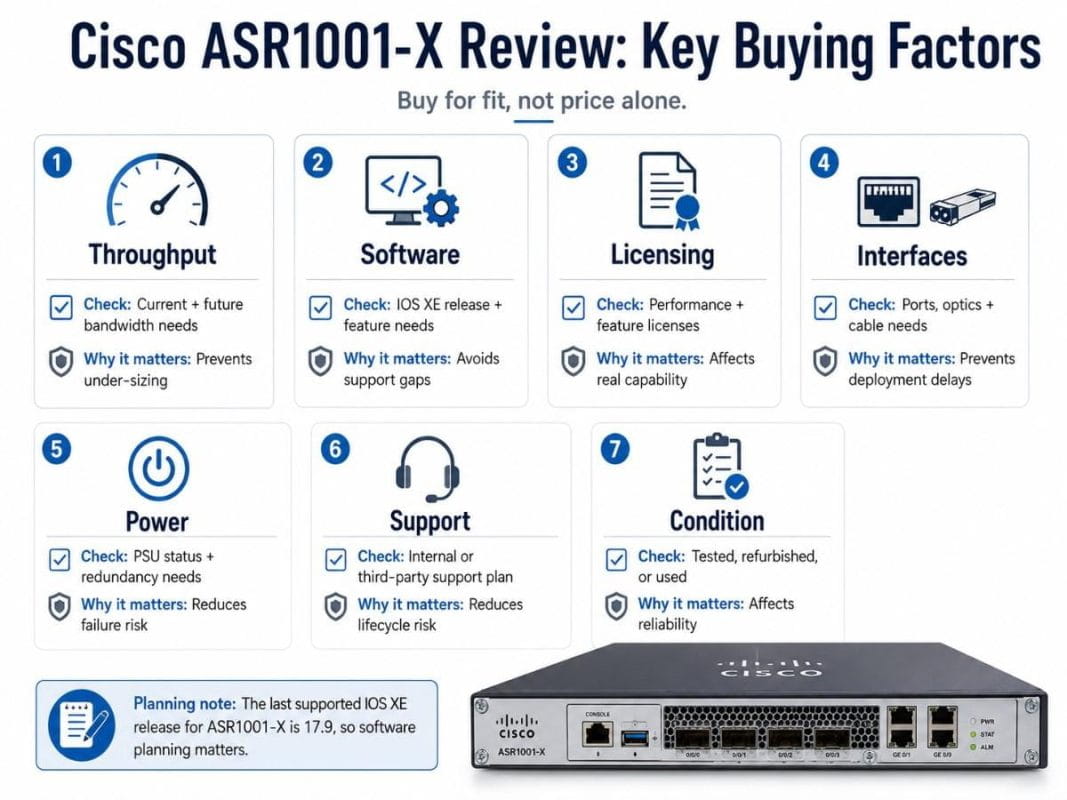
A good ASR1001-X buying decision should not start with price alone. It should start with fit.
| Buying Factor | What to Check | Why It Matters |
| Throughput | Current and future bandwidth needs | Prevents under-sizing |
| Software | IOS XE release and feature needs | Avoids support gaps |
| Licensing | Performance and feature licenses | Affects real capability |
| Interfaces | Port, optics, and cable needs | Prevents deployment delays |
| Power | PSU status and redundancy needs | Reduces failure risk |
| Support | Internal or third-party support plan | Reduces lifecycle risk |
| Condition | Tested, refurbished, or used | Affects reliability |
Cisco’s EOL notice says the last supported IOS XE release for ASR1001-X is IOS XE 17.9, which makes software planning important for buyers that need long-term support.
Why Does ASR1001-X Still Have Secondary-Market Demand?
The ASR1001-X has demand because many enterprises still run networks where consistency matters more than newest-generation hardware.
Buyers may choose a secondary-market ASR1001-X when:
- A current unit fails
- A project needs a fast replacement
- A site expansion must match existing design
- A full migration is not approved yet
- Budget does not support a complete platform change
- Lead time is a bigger risk than lifecycle status
This does not mean every refurbished ASR1001-X is a good buy. It means the product still has practical value when sourced, tested, and matched correctly.
This is where procurement experience matters. A buyer needs more than a part number. They need confirmation of condition, licensing, accessories, power, optics, lead time, and return terms.
New vs Refurbished ASR1001-X: What Should Buyers Know?
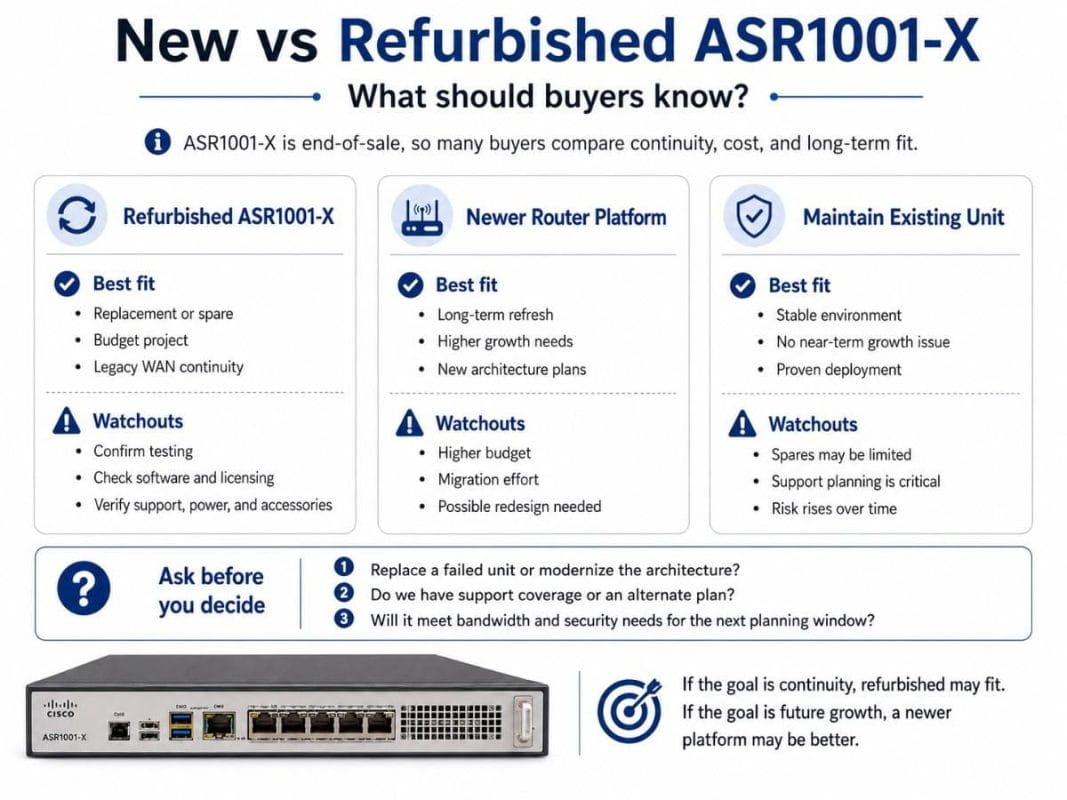
Because ASR1001-X reached end-of-sale, many buyers now evaluate refurbished or secondary-market options instead of new OEM supply. Cisco announced the last day to order affected ASR1001-X hardware through Cisco point-of-sale was August 1, 2022.
Refurbished can make sense when the goal is continuity. It may not make sense when the goal is a long new lifecycle.
| Option | Best Fit | Watchouts |
| Refurbished ASR1001-X | Replacement, spare, budget project, legacy WAN | Confirm testing, software, support, power, and accessories |
| Newer router platform | Long-term refresh, higher growth, new architecture | May require redesign, migration, and higher budget |
| Maintain existing unit | Stable environment with no growth issue | Risk rises if spares and support are not planned |
A practical buyer should ask three questions:
- Do we need to replace a failed unit or modernize the architecture?
- Do we have support coverage or an alternate support plan?
- Will this router meet bandwidth and security needs for the next planning window?
If the answer is mostly about continuity, refurbished ASR1001-X may be a strong fit. If the answer is about future growth, a newer routing platform may be better.
When Should You Upgrade vs Maintain ASR1001-X?
Maintain the ASR1001-X when it still meets the job. Upgrade when it starts creating risk.
You may maintain it when:
- Throughput needs are stable
- The network design is proven
- The router supports current services
- Spare units are available
- Support planning is clear
- Migration risk is higher than hardware risk
You may upgrade when:
- Bandwidth demand is rising fast
- Security or encryption needs have changed
- Software support limits create risk
- Hardware failures increase
- New WAN design requires newer features
- Cloud or SD-WAN plans need a different platform
This decision often links to wider IT optimization. A company may keep ASR1001-X in one site and upgrade another site first, based on risk, cost, and business impact. That phased approach supports IT optimization planning without forcing every location into the same timeline.
How Does ASR1001-X Connect to Catalyst Core and Access Infrastructure?
The ASR1001-X usually handles routing at the enterprise edge, while Catalyst switches handle campus core, distribution, or access switching.
A common flow looks like this:
- WAN provider circuit connects to ASR1001-X
- ASR1001-X routes traffic toward the enterprise core
- Catalyst C9500 or similar core switch aggregates campus traffic
- Catalyst 9300 or 9200L switches serve users, phones, cameras, and APs
- Optics and cables provide the physical handoff
This design works when the routing and switching layers match on interface speed, optics type, VLAN/routing design, and redundancy needs.
For high-speed internal switching, some buyers also compare WAN edge plans with data center switching needs, especially when branch, campus, and data center traffic share the same refresh budget.
Recommended ASR1001-X Bundle Options
The best ASR1001-X purchase is rarely just the router. Buyers should confirm optics, cables, power, support, and switching handoff before ordering.
| Bundle | Includes | Best For |
| WAN Edge Bundle | ASR1001-X, optics/cables as needed, C9500 core switch | Enterprise WAN handoff and core connectivity |
| Branch/Core Connectivity Bundle | ASR1001-X, Catalyst access/core switching | Branch or campus routing into Catalyst infrastructure |
| Refurbished Replacement Bundle | ASR1001-X replacement unit, power/accessory check, support planning | Fast replacement of failed or aging deployed units |
The optics and cable choice depends on the installed interfaces and distance. For 10G fiber handoff, buyers may need compatible transceivers such as 10G LR optics when the link design calls for long-reach single-mode connectivity.
What Should You Check Before Buying a Refurbished ASR1001-X?
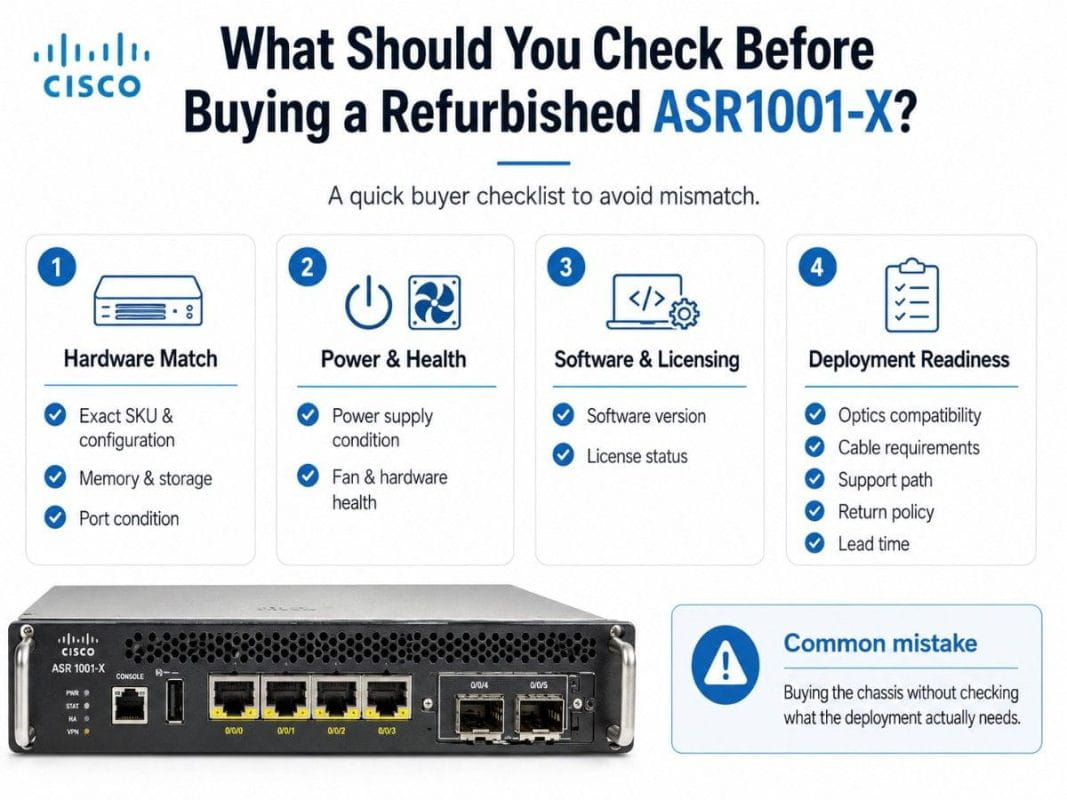
A refurbished router should go through more review than a new boxed product. The goal is not only to find stock. The goal is to avoid mismatch.
Check:
- Exact SKU and configuration
- Memory and storage
- Power supply condition
- Fan and hardware health
- Port condition
- Software version
- License status
- Optics compatibility
- Cable requirements
- Return policy
- Support path
- Lead time
The most common mistake is buying the chassis without checking what the deployment actually needs. That can delay installation even when the router arrives on time.
Need Help Sourcing an ASR1001-X Without Guesswork?
Catalyst can help buyers review ASR1001-X availability, refurbished replacement options, power needs, optics, cabling, and support planning before purchase. The goal is to match the router to the real deployment, not just quote a part number.
Request ASR1001-X availability, replacement options, or refurbished pricing based on your WAN edge, branch, or core connectivity requirements.
Catalyst can also help compare alternatives when ASR1001-X is not the best fit, including routing platforms used in enterprise and provider environments such as the Juniper MX204.
Final Takeaway: Is ASR1001-X Still a Smart Buy?
The Cisco ASR1001-X is not the newest router, but it still has a clear role. It remains useful for WAN edge, aggregation, replacement, and legacy network support when the buyer understands lifecycle status and deployment needs.
A refurbished ASR1001-X can reduce cost and shorten sourcing time. A newer platform may be better when the business needs long-term growth, newer software support, or a redesigned WAN.
The best decision comes from matching the router to the real environment: bandwidth, support, interfaces, accessories, cost, and risk. That is where Catalyst can help buyers make a cleaner decision before they purchase.
Cisco ASR1001-X Review FAQs
Is Cisco ASR1001-X still worth buying refurbished?
Yes, it can be worth buying refurbished when you need a replacement, spare, or cost-controlled router for an existing ASR1001-X environment. It may not be the best choice for a long-term greenfield refresh.
What is Cisco ASR1001-X used for?
The ASR1001-X is used for WAN edge routing, aggregation, VPN, internet edge, and enterprise connectivity. It often connects WAN circuits to a campus or data center core.
When should I maintain ASR1001-X instead of upgrading?
Maintain it when it meets bandwidth, software, and support needs. Upgrade when lifecycle risk, software limits, bandwidth growth, or new architecture needs make the current platform a blocker.
What should ASR1001-X be bundled with?
It should be bundled with the correct optics, cables, power accessories, and a core or access switching plan. Many deployments pair it with Catalyst core and access infrastructure.
Can ASR1001-X connect to Catalyst switches?
Yes. It commonly connects to Catalyst core or aggregation switches, then supports downstream access switching. Buyers must verify interface speeds, optics, cabling, and routing design.
Why is there still demand for ASR1001-X?
Demand remains because many enterprises still use ASR1001-X in stable WAN environments. They often need replacements, spares, or matching units to avoid redesign.
What is the biggest risk when buying refurbished ASR1001-X?
The biggest risk is buying an incomplete or mismatched unit. Buyers should confirm configuration, power, licensing, software, optics, and support before purchase.
Can Catalyst help verify compatibility before purchasing?
Yes. Catalyst can help verify ASR1001-X fit, replacement needs, accessory requirements, refurbished availability, and bundle pricing before buyers commit.