
AI infrastructure is expanding beyond GPU-heavy model training. As enterprises deploy AI agents that retrieve data, call tools, execute code, coordinate workflows, and repeat tasks, CPU performance, memory bandwidth, data movement, and server management become increasingly important.
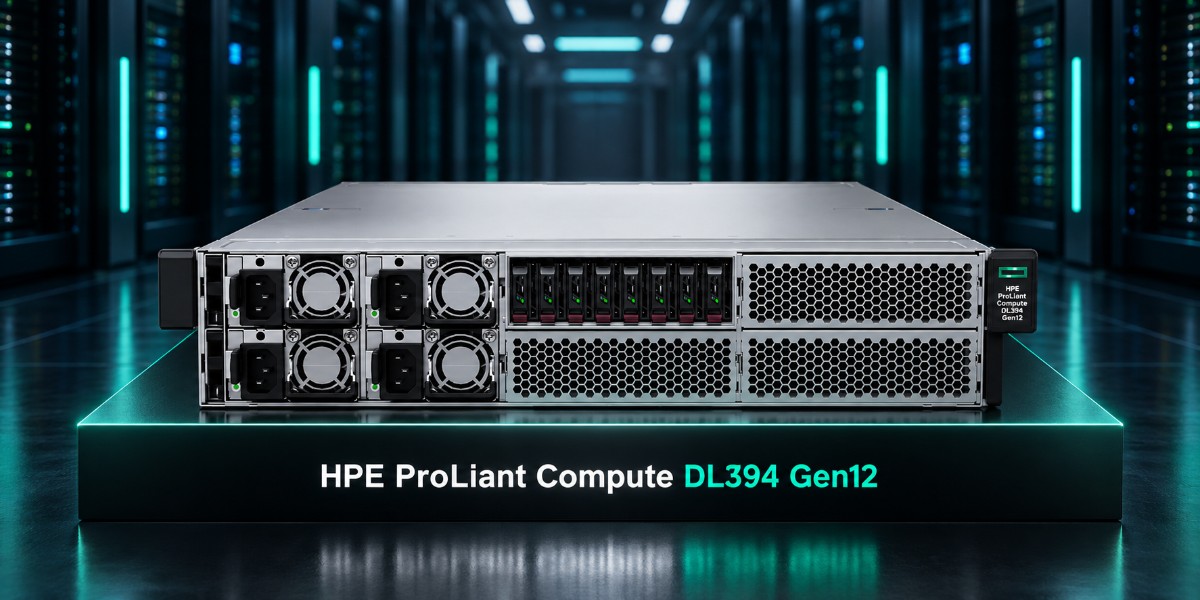
The HPE ProLiant Compute DL394 Gen12 addresses that CPU-side workload. HPE built this 2U server around the NVIDIA Vera CPU for agentic AI, reinforcement learning, real-time analytics, financial modeling, and high-performance data processing. It combines Vera’s high-bandwidth memory architecture with HPE iLO 7 security and HPE Compute Ops Management.
What is HPE ProLiant Compute DL394 Gen12? It is a next-generation, air-cooled HPE ProLiant server powered by NVIDIA Vera CPU, designed primarily for CPU-intensive AI orchestration and data workloads rather than serving as a conventional large-scale GPU training platform. HPE announced it in June 2026 and currently states availability for fall 2026.
What Is HPE ProLiant Compute DL394 Gen12?
The HPE ProLiant DL394 Gen12 is a 2U rack server designed around NVIDIA’s Vera CPU architecture. HPE positions the system for demanding AI and data workloads, including agentic AI sandboxes, reinforcement learning, high-frequency trading, Monte Carlo analysis, and real-time data processing.
Unlike a GPU-dense training server, the HPE DL394 Gen12 emphasizes CPU processing, memory bandwidth, predictable data access, and enterprise management. That makes it particularly relevant when AI workflows spend significant time outside the GPU.
For broader context, our guide to the NVIDIA Vera CPU architecture explains why NVIDIA developed a dedicated CPU platform for this new class of workloads.
HPE DL394 Gen12 specifications at a glance
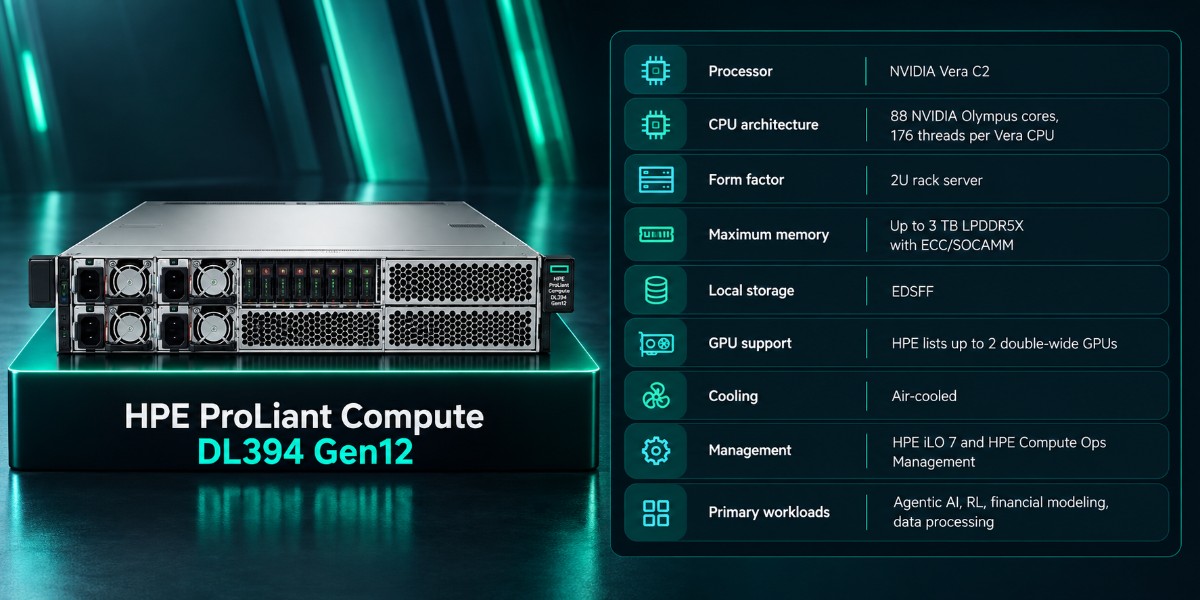
| Area | HPE DL394 Gen12 |
| Processor | NVIDIA Vera C2 |
| CPU architecture | 88 NVIDIA Olympus cores, 176 threads per Vera CPU |
| Form factor | 2U rack server |
| Maximum memory | Up to 3 TB LPDDR5X with ECC/SOCAMM |
| Local storage | EDSFF |
| GPU support | HPE lists up to 2 double-wide GPUs |
| Cooling | Air-cooled |
| Management | HPE iLO 7 and HPE Compute Ops Management |
| Primary workloads | Agentic AI, RL, financial modeling, data processing |
HPE’s current product information lists up to 3 TB of system memory and support for up to two double-wide GPUs. Exact GPU, NIC, storage, power, and expansion configurations should still be verified against the final HPE configuration documentation before procurement.
Why Agentic AI Requires More Powerful CPUs
Traditional AI architecture often puts most attention on the accelerator. GPUs perform model training and inference, while CPUs handle operating systems, application logic, storage operations, networking, and general system control.
Agentic AI changes the balance.
An AI agent may generate a plan, query a database, call an API, execute code in a sandbox, retrieve additional context, evaluate a result, and then invoke a model again. Model inference can still run on GPUs, but much of the surrounding workflow depends heavily on CPU and memory resources.
| Agentic AI stage | Infrastructure requirement |
| Planning and orchestration | CPU compute and application runtime |
| Tool or code execution | CPU cores, memory and isolated environments |
| Data retrieval | CPU, network and storage |
| Model inference | GPU/accelerator where required |
| Evaluation and repetition | CPU orchestration plus accelerator access |
This creates substantial CPU-side concurrency. Hundreds or thousands of agents may operate simultaneously, creating tool calls, database requests, containers, sandboxes, and data-processing jobs.
The result is that CPU architecture can directly affect how efficiently the expensive accelerator layer stays productive.
AI networks also become part of that equation. Retrieval traffic, distributed services, storage access, and accelerator communication need appropriately sized fabrics, making AI cluster networking an important part of server planning rather than an afterthought.
NVIDIA Vera CPU Inside HPE DL394 Gen12 Explained
NVIDIA designed Vera specifically around AI-factory, agentic AI, reinforcement-learning, analytics, and data-processing workloads. Vera uses 88 custom NVIDIA Olympus cores and supports 176 threads through NVIDIA Spatial Multithreading.
Memory architecture is one of its most important characteristics.
NVIDIA specifies up to 1.5 TB of SOCAMM LPDDR5X memory per Vera CPU with peak bandwidth of up to 1.2 TB/s. HPE lists up to 3 TB of memory for the DL394 Gen12 system.
Vera also uses NVIDIA’s second-generation Scalable Coherency Fabric across its cores, cache, memory, I/O, and NVLink-C2C interfaces. NVIDIA says the architecture provides 3.4 TB/s of bisectional bandwidth within the CPU design.
The practical goal is straightforward: reduce the time CPU cores spend waiting for data.
That matters when an AI environment must continuously process context, manage software sandboxes, prepare model inputs, run retrieval operations, and coordinate accelerator work.
Vera also sits within NVIDIA’s larger compute roadmap. It can operate in standalone CPU servers such as the DL394 Gen12 and also forms part of Vera Rubin architectures. The Rubin GPU architecture addresses the accelerator side of that broader infrastructure.
How DL394 Gen12 Handles AI Data Processing Workloads
An AI response begins well before tokens reach an inference engine.
Enterprise systems may first ingest documents, query databases, apply business logic, retrieve embeddings, prepare context, enforce permissions, execute code, and transform incoming information into something a model can use.
The HPE data processing server role therefore extends beyond conventional application hosting.
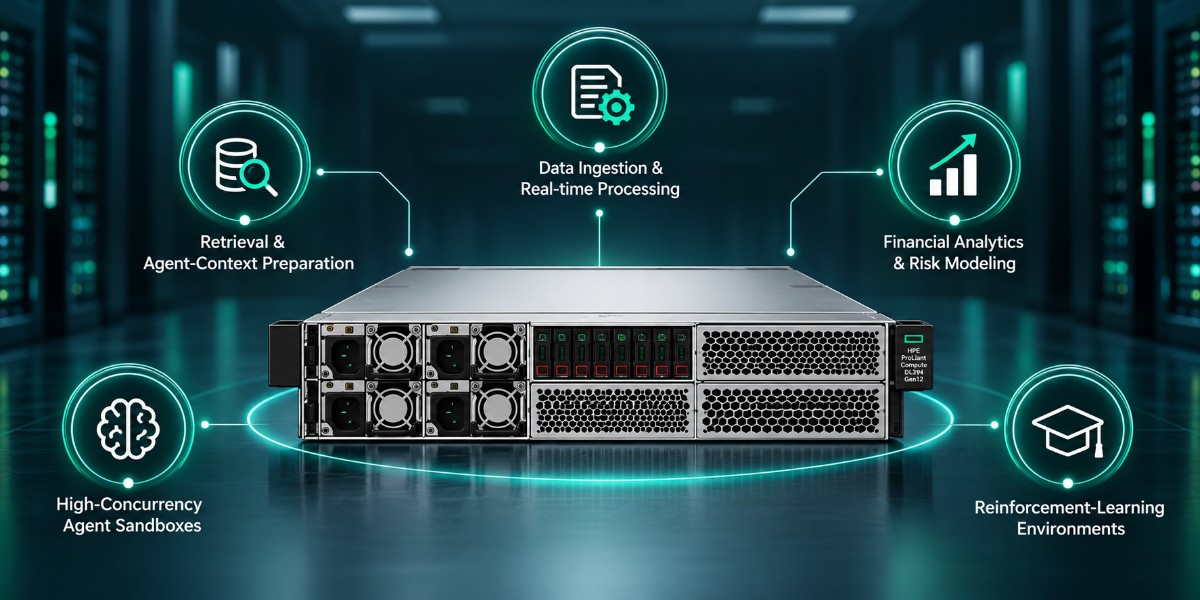
The DL394 Gen12 targets workloads including:
- Real-time data ingestion and processing
- Retrieval and agent-context preparation
- Financial analytics and risk modeling
- Reinforcement-learning environments
- High-concurrency agent sandboxes
HPE specifically highlights high-frequency trading, Monte Carlo workloads, agentic AI sandboxes, and reinforcement learning. HPE has also discussed the platform with Redpanda and the New York Stock Exchange around latency-sensitive, high-volume data infrastructure.
That does not make the DL394 Gen12 a replacement for GPU infrastructure.
For large-model training or accelerator-heavy inference, organizations may still need dedicated GPU systems. The DL394 can instead handle CPU-intensive stages around those accelerators, depending on application architecture.
That distinction is important when planning GPU deployment infrastructure across compute, storage, network, power, and cooling.
HPE DL394 Gen12 for Agentic AI Infrastructure
The value of an HPE agentic AI server becomes clearer when viewed as part of a complete workflow.
A simplified enterprise agent could operate like this:
User request → agent planning → tool execution → data retrieval → model inference → result evaluation → action → response
The DL394 Gen12 can support the CPU-heavy portions of this loop, including application runtime, orchestration, tool execution, data manipulation, retrieval, and parallel sandbox operation.
The GPU, when required, handles highly parallel model computation.
That separation can make infrastructure planning more efficient. Organizations do not necessarily need every server to carry eight high-end accelerators when part of the workload spends substantial time executing CPU-side processes.
HPE also integrates iLO 7 and HPE Compute Ops Management into the platform. These technologies address server lifecycle management, monitoring, automation, and security rather than AI computation itself.
HPE’s Silicon Root of Trust adds hardware-rooted security capabilities, which become particularly relevant when autonomous agents interact with business systems and sensitive enterprise data.
Memory and Connectivity: Why They Matter for AI Servers
Adding more CPU cores does not automatically improve an AI pipeline. Those cores also need fast access to memory, storage, accelerators, and network resources.
Vera’s memory architecture is central to the DL394 design. NVIDIA specifies up to 1.2 TB/s of peak LPDDR5X memory bandwidth per Vera CPU, while HPE lists up to 3 TB total memory capacity for the server.
Connectivity planning depends on the final deployment.
DL394 Gen12 infrastructure stack
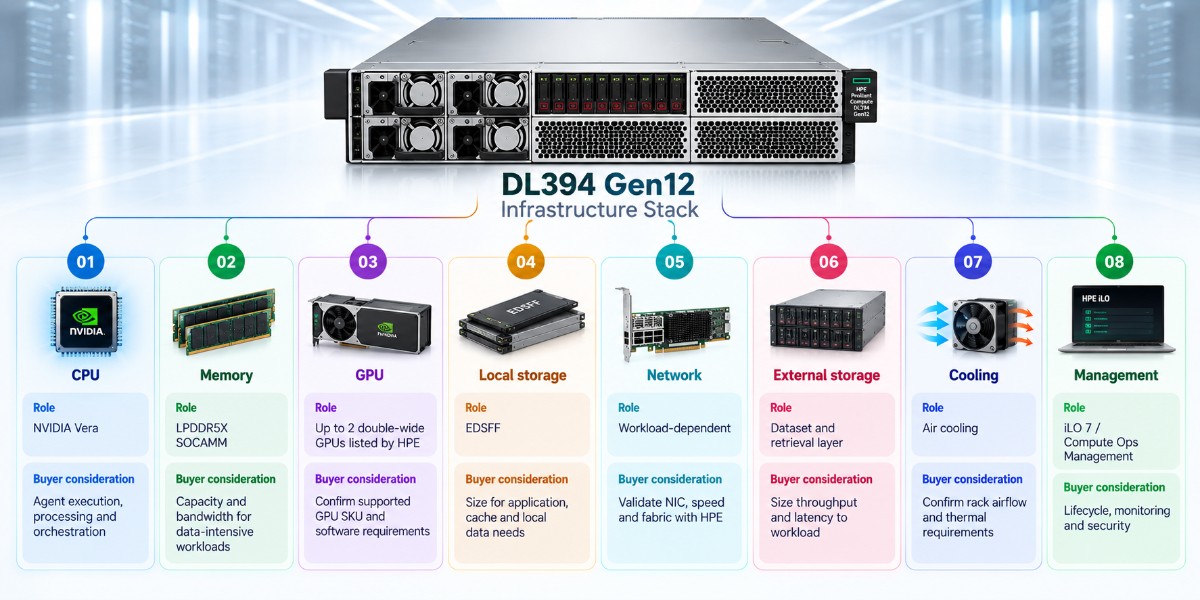
| Layer | Role | Buyer consideration |
| CPU | NVIDIA Vera | Agent execution, processing and orchestration |
| Memory | LPDDR5X SOCAMM | Capacity and bandwidth for data-intensive workloads |
| GPU | Up to 2 double-wide GPUs listed by HPE | Confirm supported GPU SKU and software requirements |
| Local storage | EDSFF | Size for application, cache and local data needs |
| Network | Workload-dependent | Validate NIC, speed and fabric with HPE |
| External storage | Dataset and retrieval layer | Size throughput and latency to workload |
| Cooling | Air cooling | Confirm rack airflow and thermal requirements |
| Management | iLO 7 / Compute Ops Management | Lifecycle, monitoring and security |
The networking requirement can vary sharply between standalone analytics and a distributed AI factory. Storage-heavy retrieval workloads, GPU-backed inference, and clustered agents can all create different east-west traffic patterns.
Those issues are discussed further in our coverage of AI networking challenges.
Compatibility should never be assumed from connector type or theoretical interface support. Buyers should confirm validated NICs, accelerators, EDSFF devices, firmware, optics, and fabric configurations against final HPE documentation before ordering. That follows the compatibility-first approach required by the content strategy.
HPE DL394 Gen12 vs Traditional Enterprise Servers
The distinction is not simply that an AI server has “more performance.” AI infrastructure places different pressure on memory, concurrency, networking, and data movement.
| Area | Traditional enterprise server | HPE DL394 Gen12 focus |
| Primary workloads | Apps, databases, virtualization | Agentic AI, RL and data processing |
| CPU priority | Broad general-purpose performance | High-bandwidth AI-oriented CPU processing |
| Memory priority | Capacity and application performance | Capacity plus very high memory bandwidth |
| AI role | General infrastructure | AI orchestration and CPU-side processing |
| Management | Enterprise lifecycle management | iLO 7 plus Compute Ops Management |
Traditional x86 platforms remain appropriate for a broad range of enterprise software. Existing virtualization stacks, licensing requirements, validated applications, and operational familiarity can outweigh the benefits of moving to a new CPU architecture.
The HPE next-generation ProLiant server makes more sense when the workload benefits specifically from Vera’s memory bandwidth, CPU concurrency, AI-oriented architecture, and HPE’s surrounding management stack.
HPE DL394 Gen12 vs Dell Vera CPU Servers
HPE is not the only OEM bringing NVIDIA Vera into standalone servers.
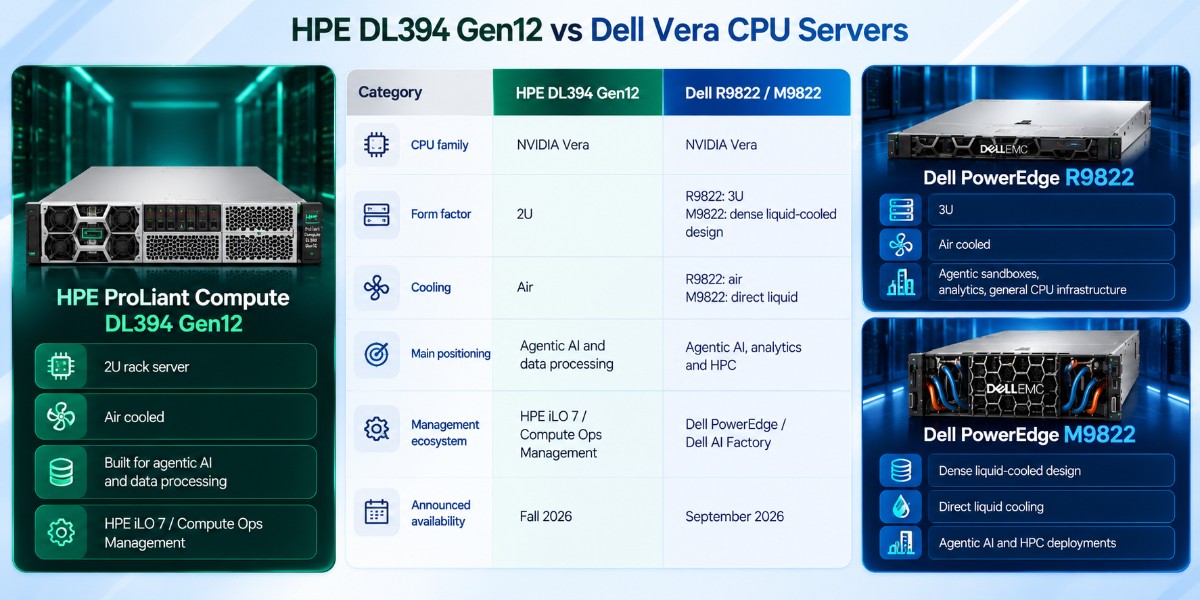
Dell has announced the PowerEdge R9822 and M9822 with Vera CPUs. Dell positions the 3U, air-cooled R9822 for agentic sandboxes, analytics, and general CPU infrastructure, while the M9822 uses direct liquid cooling for denser agentic AI and HPC deployments.
| Category | HPE DL394 Gen12 | Dell R9822 / M9822 |
| CPU family | NVIDIA Vera | NVIDIA Vera |
| Form factor | 2U | R9822: 3U; M9822: dense liquid-cooled design |
| Cooling | Air | R9822 air; M9822 direct liquid |
| Main positioning | Agentic AI and data processing | Agentic AI, analytics and HPC |
| Management ecosystem | HPE iLO 7 / Compute Ops Management | Dell PowerEdge / Dell AI Factory |
| Announced availability | Fall 2026 | September 2026 |
The decision should focus on system architecture and operational fit rather than the Vera CPU alone.
An HPE environment may favor DL394 Gen12 because of existing HPE management, support, storage, and infrastructure practices. Organizations already standardized on Dell may reach a different conclusion.
Cooling also matters. The HPE DL394 is currently specified as air-cooled, while Dell offers both air-cooled R9822 and direct-liquid-cooled M9822 options. Dense deployments should therefore include facility-level thermal analysis rather than comparing CPU specifications in isolation.
For larger accelerator-driven scientific environments, the architectural requirements can differ considerably from these CPU-focused systems, as illustrated by platforms such as the Vera Rubin HPC stack.
What Should Be Deployed With HPE DL394 Gen12?
A DL394 Gen12 purchase should start with the workload, not simply the server SKU.
A complete configuration may require:
- Validated NICs and appropriate Ethernet or other fabric
- EDSFF local storage plus external AI/data storage
- Supported GPU accelerators when the application needs them
- Optics, transceivers, cables, rack PDUs, and power capacity
- Airflow and facility cooling sized for the final configuration
For example, an enterprise agent platform could use DL394 Gen12 nodes for application execution, retrieval, and orchestration while sending model inference to dedicated accelerator servers. Shared high-throughput storage could supply enterprise data and context to both layers.
That is only one possible architecture. GPU choice, NICs, switching, storage protocol, cabling, rack density, and redundancy should follow the specific workload and validated HPE configuration.
Cooling also needs to be considered at the rack level even though the DL394 itself uses air cooling. Higher-density AI environments can combine air- and liquid-cooled equipment, making broader AI cooling strategies relevant to facility planning.
Who Is HPE ProLiant DL394 Gen12 For?
The HPE DL394 Gen12 fits organizations whose AI workloads generate substantial CPU-side data processing and orchestration.
Likely use cases include:
- Enterprises deploying multiple AI agents and sandboxes
- Financial organizations running latency-sensitive analytics
- AI teams building reinforcement-learning infrastructure
- Data-intensive environments with demanding retrieval pipelines
- HPE customers extending existing infrastructure into agentic AI
It may not be the best answer for an organization whose primary requirement is maximum GPU density for frontier-model training. A dedicated HGX, rack-scale accelerator platform, or another GPU-optimized server may fit that workload better.
Likewise, conventional x86 servers can remain the more practical option when an application depends heavily on an existing x86 software ecosystem or does not benefit materially from Vera’s architecture.
Why CPUs Are Becoming Important in AI Factories
GPUs remain central to modern AI, but the AI factory contains much more than accelerators.
Agents generate requests. Applications execute tools. Retrieval systems move information. Storage supplies context. Networks transfer data. CPUs coordinate all of these activities while preparing work for accelerators.
Agentic AI therefore shifts attention from isolated GPU performance toward system utilization.
A powerful accelerator creates limited business value if CPU processing, storage throughput, network congestion, or data preparation continually leaves it waiting.
That is why platforms such as the HPE DL394 Gen12 matter. They represent a broader move toward specialized CPU infrastructure alongside increasingly specialized accelerator, networking, storage, power, and cooling architectures.
Conclusion
The HPE ProLiant Compute DL394 Gen12 represents an important shift in AI server design: CPUs now play a larger role in the infrastructure surrounding AI models.
With NVIDIA Vera CPU, high-bandwidth LPDDR5X memory, HPE iLO 7, and Compute Ops Management, the platform targets agentic AI, reinforcement learning, analytics, and demanding data-processing environments.
Its value should still be judged as part of the complete deployment. Buyers need to consider accelerators, network fabrics, storage throughput, rack power, cooling, software compatibility, and alternative OEM platforms before choosing a configuration.
How Can Catalyst Support an HPE DL394 Gen12 Deployment?
Catalyst Data Solutions helps organizations source AI, HPC, and data center infrastructure across leading OEM, channel, and distribution ecosystems. For an HPE DL394 Gen12 deployment, Catalyst can help evaluate server availability, compatible components, networking, storage, power, cooling, and alternative platforms from HPE, Dell, NVIDIA, AMD, and other vendors based on workload, budget, and deployment requirements.
Because frontier hardware configurations and lead times can change quickly, buyers can request current availability or review the broader AI hardwarecatalog when planning a complete solution. Sharing the target workload, server quantity, memory, storage, networking, accelerator requirements, rack constraints, cooling environment, warranty needs, and deployment timeline can help define a more suitable configuration.
Frequently Asked Questions
1. When will HPE ProLiant DL394 Gen12 be available?
HPE currently states that the HPE ProLiant Compute DL394 Gen12 will be available in fall 2026. HPE announced the server on June 1, 2026, so buyers should distinguish its announced status from confirmed orderability and shipping in a specific region.
2. What workloads are best suited for HPE DL394 Gen12?
HPE targets agentic AI sandboxes, reinforcement learning, high-frequency trading, Monte Carlo analysis, real-time analytics, and high-performance data processing. These workloads can benefit from strong CPU performance and high memory bandwidth.
3. Does HPE DL394 Gen12 support AI inference?
It can participate in AI inference infrastructure, but it is primarily positioned as a CPU-focused AI and data-processing server. HPE currently lists support for up to two double-wide GPUs, although buyers should verify the supported accelerator SKUs and software stack for their intended inference workload.
4. Can HPE DL394 Gen12 run AI agents without GPUs?
Yes, CPU-based portions of an agent workflow can run without GPUs, including application logic, retrieval, tool execution, data processing, and orchestration. Large neural-network inference may still benefit substantially from GPU acceleration, depending on model size and latency requirements.
5. How does NVIDIA Vera CPU compare with Intel Xeon?
Vera uses NVIDIA-designed Arm-compatible Olympus cores and emphasizes high memory bandwidth, agentic AI, reinforcement learning, and AI data processing. Intel Xeon remains a broad x86 server platform with a large established software ecosystem. Buyers should compare validated application performance rather than relying on vendor-level performance claims alone.
6. How does NVIDIA Vera CPU compare with AMD EPYC?
Vera focuses specifically on emerging AI-factory and agentic workloads, while AMD EPYC serves a broad x86 server market spanning cloud, virtualization, HPC, and AI host computing. The better choice depends on software compatibility, workload behavior, memory requirements, platform design, and existing infrastructure.
7. Is HPE DL394 Gen12 designed for enterprise AI deployments?
Yes. HPE positions DL394 Gen12 as a compute-optimized foundation for enterprise agentic AI and high-performance data processing. HPE has also announced plans to integrate the DL394 Gen12 into HPE Private Cloud AI, with that specific integration currently scheduled for 2027.
8. Why are CPUs becoming more important for generative and agentic AI?
AI systems now perform much more than model inference. Tool execution, retrieval, application logic, data preparation, security, sandboxing, and workflow orchestration all create CPU and memory workloads, making CPU utilization increasingly important to overall AI-system performance.
Research & Fact-Check
Research Date: August 28, 2026
Official HPE DL394 Gen12 Source:
https://www.hpe.com/us/en/compute/hpe-proliant-compute/dl394-gen12.html
Research Key Points :
Built for agentic AI: The HPE ProLiant Compute DL394 Gen12 is a 2U, air-cooled server powered by NVIDIA Vera CPU. HPE targets workloads such as agentic AI, reinforcement learning, analytics, financial modeling, and intensive data processing.
Designed for fast data movement: The system supports up to 3 TB of LPDDR5X/SOCAMM memory, while the Vera CPU architecture delivers high memory bandwidth. This helps CPU-heavy AI workflows process, retrieve, and move data efficiently.
Availability is still evolving: HPE announced the DL394 Gen12 in June 2026 and states that general availability is planned for fall 2026. Final configurations, supported components, and regional availability should be verified before purchasing.